


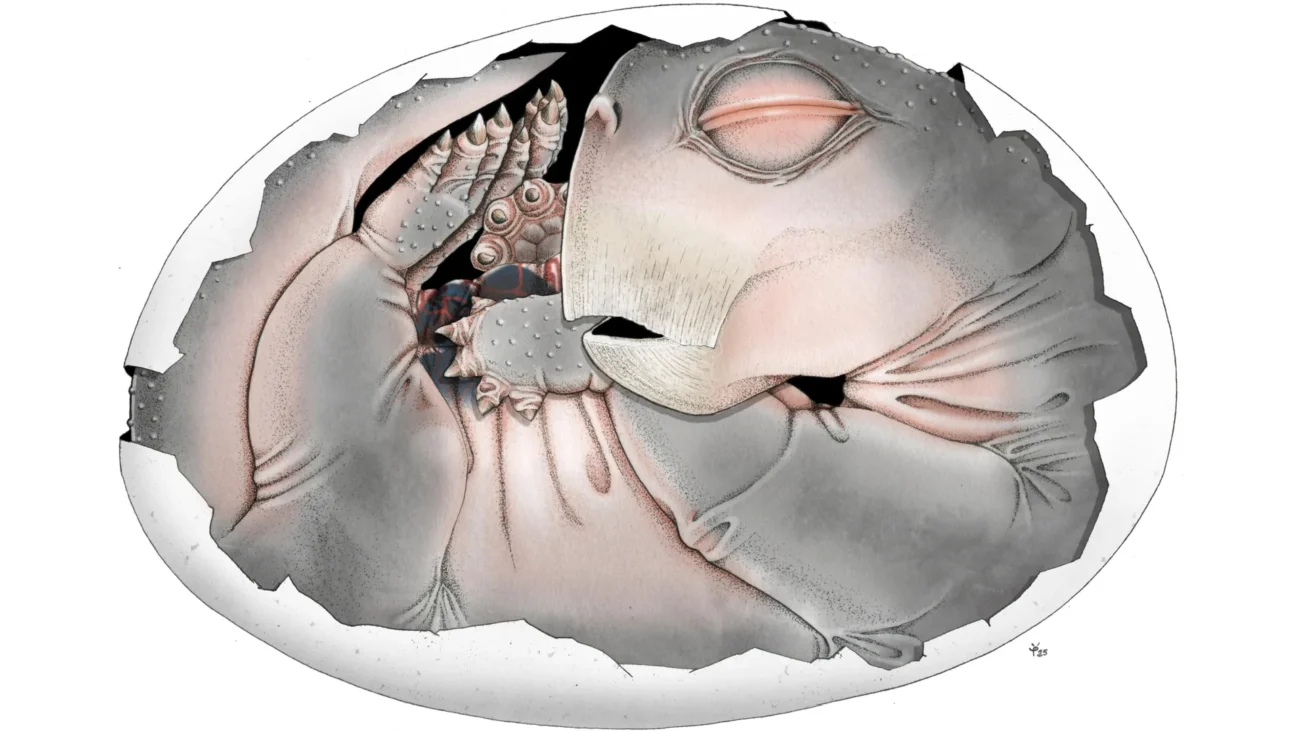
A groundbreaking fossil discovery has not only illuminated one of Earth’s most dramatic survival sagas but has also definitively answered a decades-long scientific puzzle concerning the reproductive habits of our ancient ancestors. The creature in question, Lystrosaurus, a resilient, plant-eating synapsid, rose to become a dominant species in the wake of the End-Permian Mass Extinction approximately 252 million years ago. This catastrophic event, often referred to as the "Great Dying," was the most severe extinction event in Earth’s history, wiping out an estimated 96% of all marine species and 70% of terrestrial vertebrate species. Despite facing an unimaginably hostile environment characterized by extreme heat, atmospheric instability, and prolonged droughts, Lystrosaurus not only survived but spectacularly thrived, laying the foundation for its evolutionary lineage.
Recent research, published in the esteemed scientific journal PLOS ONE, details the discovery of a remarkably preserved egg containing a Lystrosaurus embryo, estimated to be around 250 million years old. This fossil represents the first confirmed egg ever found belonging to an ancestor of mammals, directly addressing a fundamental question that has long perplexed paleontologists: did the early ancestors of mammals lay eggs? The answer, now unequivocally confirmed, is a resounding yes.
The Elusive Nature of Ancient Mammal Ancestor Eggs
The rarity of such a discovery can be attributed to the presumed composition of these ancient eggs. Researchers hypothesize that Lystrosaurus eggs possessed soft shells, a characteristic that significantly hinders their fossilization potential. Unlike the hard, mineralized eggshells of dinosaurs, which are readily preserved in the geological record, soft-shelled eggs are far more susceptible to decay and disintegration before the fossilization process can take hold. This inherent fragility makes the current find exceptionally rare and scientifically invaluable.
However, the significance of this discovery extends far beyond simply confirming a mode of reproduction. It offers profound insights into the evolutionary strategies that enabled Lystrosaurus to conquer a world devastated by the Permian-Triassic extinction.
A Discovery Years in the Making
The journey to this monumental revelation began nearly 17 years ago, during a field expedition in 2008. Professor Jennifer Botha, of the Evolutionary Studies Institute at the University of the Witwatersrand, South Africa, recounts the pivotal moment: "This fossil was discovered during a field excursion I led in 2008, nearly 17 years ago. My preparator and exceptional fossil finder, John Nyaphuli, identified a small nodule that at first revealed only tiny flecks of bone. As he carefully prepared the specimen, it became clear that it was a perfectly curled-up Lystrosaurus hatchling. I suspected even then that it had died within the egg, but at the time, we simply didn’t have the technology to confirm it." This initial observation, made with the limited tools available at the time, laid the groundwork for a future breakthrough.
Unveiling the Embryo with Advanced Imaging Technology
The advent of sophisticated scientific tools, particularly synchrotron X-ray computed tomography (CT) scanning, provided the means to finally resolve the mystery. The powerful X-rays available at facilities like the European Synchrotron Radiation Facility (ESRF) in France allowed an international team, led by Professor Julien Benoit, Professor Jennifer Botha, and Dr. Vincent Fernandez (ESRF), to examine the fossil with unprecedented detail. These advanced imaging techniques enabled researchers to peer inside the specimen non-destructively, confirming what Professor Botha had suspected for years.
Dr. Vincent Fernandez, from the ESRF, articulated the excitement surrounding this technological application: "Understanding reproduction in mammal ancestors has been a long-lasting enigma, and this fossil provides a key piece to this puzzle. It was essential that we scanned the fossil just right to capture the level of detail needed to resolve such tiny, delicate bones." The precision of the scans was crucial in revealing intricate details of the developing embryo.
Crucial Developmental Clues Revealed
Among the most significant findings from the scans was an observation about the embryo’s jaw development. Professor Julien Benoit highlighted a key detail: "When I saw the incomplete mandibular symphysis, I was genuinely excited. The mandible, the lower jaw, is made up of two halves that must fuse before the animal can feed. The fact that this fusion had not yet occurred shows that the individual would have been incapable of feeding itself." This anatomical observation provides critical insight into the developmental stage of the embryo at the time of its demise and has significant implications for understanding Lystrosaurus life history.
Large Eggs and Accelerated Development: A Recipe for Survival
The study’s findings suggest that Lystrosaurus produced relatively large eggs in proportion to its body size. In extant animal species, larger eggs typically contain a greater volume of yolk, a vital nutrient reserve that supports prolonged embryonic development. This abundance of yolk suggests that Lystrosaurus embryos could develop to a sufficiently advanced stage within the egg, reducing the need for extensive post-hatching parental care, such as feeding with milk, which is a hallmark of modern mammals.
Furthermore, the larger egg size offered a distinct advantage in the arid and volatile climate that characterized the post-extinction landscape. These larger eggs would have been more resilient to desiccation, a crucial adaptation for survival in an environment prone to drought.
The evidence strongly indicates that Lystrosaurus hatchlings were likely precocial. This means they were born at an advanced stage of development, capable of independent survival shortly after hatching. Such young animals would have possessed the ability to forage for food, evade predators, and rapidly mature, a strategy that would have been immensely beneficial in the challenging and competitive post-extinction ecosystems. In essence, Lystrosaurus achieved success through rapid growth and early reproductive maturity.
A Winning Strategy in a Devastated World
This reproductive and developmental strategy proved exceptionally effective in the tumultuous conditions that followed the End-Permian Mass Extinction. The discovery provides the first direct empirical evidence that mammal ancestors laid eggs and offers a compelling explanation for Lystrosaurus‘s remarkable ecological dominance in the post-extinction era.
As paleontologists continue to unearth and interpret the fossil record, a broader evolutionary pattern is becoming increasingly apparent: survival and success during periods of extreme global environmental upheaval are often dictated by a species’ adaptability, resilience, and its reproductive strategy. Lystrosaurus appears to have masterfully combined all three of these critical elements.
The Broader Implications for Understanding Life’s Resilience
The research team emphasized the far-reaching significance of their findings. Professor Julien Benoit elaborated on the scientific impact: "This research is important because it provides the first direct evidence that mammal ancestors, such as Lystrosaurus, laid eggs, resolving a long-standing question about the origins of mammalian reproduction. Beyond this fundamental insight, it reveals how reproductive strategies can shape survival in extreme environments: by producing large, yolk-rich eggs and precocial young, Lystrosaurus was able to thrive in the harsh, unpredictable conditions following the end-Permian mass extinction. In a modern context, this work is highly impactful because it offers a deep-time perspective on resilience and adaptability in the face of rapid climate change and ecological crisis. Understanding how past organisms survived global upheaval helps scientists better predict how species today might respond to ongoing environmental stress, making this discovery not just a breakthrough in paleontology, but also highly relevant to current biodiversity and climate challenges."
He also underscored the crucial role of advanced technology: "The opportunity to work at the European Synchrotron Radiation Facility alongside beamline scientists was also an unforgettable part of the journey. The cutting-edge data we generated there allowed us to ‘see’ inside the fossil in extraordinary detail, ultimately revealing that the embryo was still at a pre-hatching stage. That moment, when the pieces all came together, was incredibly rewarding."
Professor Jennifer Botha further highlighted the historical and scientific context of the discovery: "What makes this work especially exciting is that we were able to quite literally follow in John Nyaphuli’s footsteps, returning to a specimen he discovered nearly two decades ago and finally solve the puzzle he uncovered. At the time, all we had was a beautifully curled embryo, but no preserved eggshell to prove it had died within an egg. Using modern imaging techniques, we were able to answer that question definitively." She added, "It is also thrilling because this discovery breaks entirely new ground. For over 150 years of South African paleontology, no fossil had ever been conclusively identified as a therapsid egg. This is the first time we can say, with confidence, that mammal ancestors like Lystrosaurus laid eggs, making it a true milestone in the field."
The End-Permian Mass Extinction: A World Remade
To fully appreciate the significance of Lystrosaurus‘s survival, understanding the scale of the End-Permian Mass Extinction is essential. This cataclysmic event, which occurred at the boundary between the Permian and Triassic periods, was a stark turning point in Earth’s history. The primary drivers are believed to have been massive volcanic eruptions in the Siberian Traps, which released vast quantities of greenhouse gases into the atmosphere. This led to a runaway greenhouse effect, causing global temperatures to soar by as much as 10-15 degrees Celsius.
The consequences were catastrophic: widespread ocean acidification and anoxia (lack of oxygen) decimated marine life. On land, the extreme heat and altered atmospheric composition led to desertification, widespread wildfires, and oxygen depletion. Ecosystems collapsed, and the planet was rendered a desolate and hostile place. It took millions of years for life to recover and for new ecological niches to emerge.
Lystrosaurus: A Post-Extinction Pioneer
It was in this radically altered world that Lystrosaurus emerged as a dominant force. This dicynodont, a group of synapsids characterized by their turtle-like beaks and a single pair of tusks (though some species lacked tusks), was a hardy herbivore. Its ability to subsist on a wide range of tough, low-quality vegetation, coupled with its robust physiology, allowed it to exploit the sparse resources available.
The discovery of its egg, and the evidence for precocial young, reveals a reproductive strategy perfectly suited for a world in flux. Producing large, self-sufficient offspring would have been a significant advantage in an environment where parental resources might have been scarce and unpredictable. This rapid maturation and independence allowed Lystrosaurus populations to expand quickly and colonize new territories as the planet slowly began to heal.
Timeline of Key Events:
- ~252 Million Years Ago: The End-Permian Mass Extinction event occurs, decimating life on Earth.
- ~252-250 Million Years Ago: The early Triassic period begins, characterized by extreme environmental conditions. Lystrosaurus begins its rise to dominance.
- 2008: Professor Jennifer Botha leads a field expedition where the fossilized Lystrosaurus embryo within an egg nodule is discovered by John Nyaphuli.
- ~2008 – 2024: Preparators meticulously work on the fossil, and researchers begin planning advanced imaging studies.
- Recent Years: Synchrotron X-ray CT scanning is performed at the ESRF, revealing the fossilized embryo in remarkable detail.
- Present: The findings are published in PLOS ONE, confirming Lystrosaurus laid eggs and explaining its post-extinction success.
Broader Scientific and Environmental Parallels
The Lystrosaurus story offers a compelling deep-time perspective on resilience and adaptability in the face of rapid environmental change. In an era of accelerating climate change and biodiversity loss, understanding how past organisms navigated and survived global ecological crises provides invaluable context for contemporary conservation efforts. The strategies employed by Lystrosaurus – robust physiology, adaptable diet, and an efficient reproductive strategy – serve as a powerful reminder of the diverse pathways life can take to overcome adversity.
This research not only fills a critical gap in our understanding of mammalian evolution but also underscores the dynamic interplay between evolutionary innovation and environmental pressures. The fossilized egg of Lystrosaurus is more than just a scientific curiosity; it is a testament to life’s enduring capacity to adapt and persist, even in the most challenging of circumstances, offering lessons that resonate from the ancient past to the present day.

