


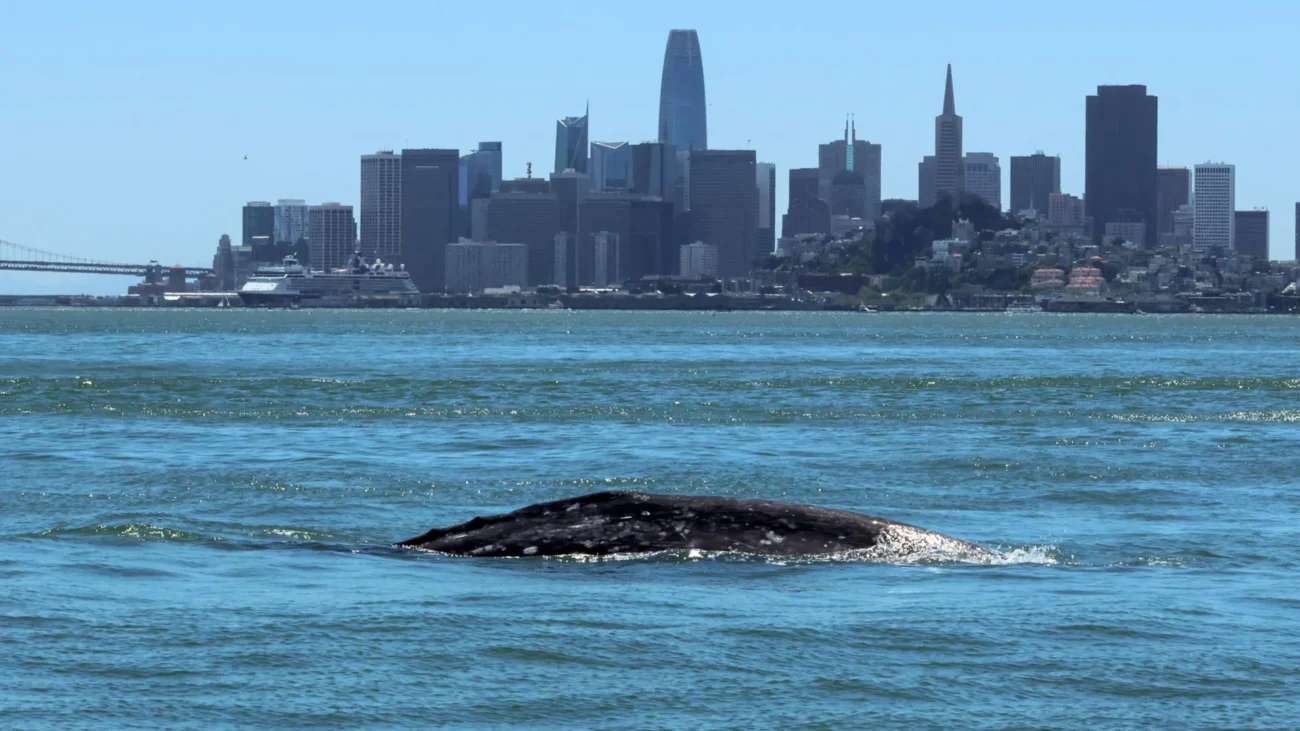
The familiar, epic journey of the gray whale, a testament to nature’s endurance, is being dramatically rewritten by the accelerating forces of climate change. These magnificent marine mammals, renowned for their arduous migrations between the nutrient-rich Arctic feeding grounds and the sheltered breeding lagoons of Baja California, Mexico, are now venturing into unfamiliar territories. In recent years, an alarming trend has emerged: gray whales are being spotted with increasing frequency in areas historically absent from their migratory routes, including the bustling and hazardous waters of San Francisco Bay. This deviation from their ancestral paths is not merely an ecological curiosity; it is a stark indicator of a planet in flux, with profound and tragic consequences for the whales themselves.
Researchers investigating a surge in gray whale mortality have uncovered a sobering reality within San Francisco Bay. A significant portion of the gray whales that enter this heavily trafficked waterway do not survive. Nearly 20% of these whales are lost, with a devastating number succumbing to lethal boat strikes. This phenomenon has prompted urgent scientific inquiry, revealing a complex interplay of environmental pressures and human activity pushing these ancient mariners to the brink.
The Bay’s Lure: A Desperate Feeding Ground
The allure of San Francisco Bay for gray whales is a relatively recent development, with sightings becoming more common since 2018. This shift marks a departure from their typical behavior, which involves minimal feeding during their long migrations. Gray whales traditionally build up substantial blubber reserves in the Arctic to sustain them through their breeding season and journey south. However, the warming Arctic waters, a direct consequence of climate change, are disrupting the delicate balance of their food web. The krill and small crustaceans that form the cornerstone of their diet are becoming scarcer or are shifting their distribution, leaving whales hungry and desperate.
"Gray whales have a low profile to the water when they surface, and this makes them difficult to see in conditions like fog which are common to San Francisco Bay," explained Josephine Slaathaug, lead author of the study published in Frontiers in Marine Science and a researcher at Sonoma State University. "Additionally, San Francisco Bay is a highly trafficked waterway, and the Golden Gate Strait serves as a bottleneck through which all traffic and whales must enter and exit." This confluence of factors – impaired visibility, dense maritime traffic, and a narrow entry point – creates a high-risk environment for whales ill-equipped to navigate its complexities.
The consequences of this altered behavior are stark. The National Oceanic and Atmospheric Administration (NOAA) has reported a significant decline in the gray whale population, with numbers falling by more than half since 2016. Sightings of calves, a crucial indicator of population health, have become exceptionally rare, signaling a worrying reproductive crisis. Scientists are grappling with the question of whether these "Bay Grays" are returning visitors, drawn back by a perceived, albeit perilous, food source, or one-time arrivals in dire straits.
Unraveling the "Bay Grays": A Scientific Investigation
To shed light on this emergent crisis, researchers embarked on a comprehensive study spanning from 2018 to 2025. Their methodology involved meticulously cataloging individual whales through opportunistic sightings and photographic evidence contributed by the public. These citizen-science contributions were augmented by more structured surveys conducted over a two-year period (2023-2025). This wealth of visual data was then cross-referenced with necropsy reports from stranded whales, providing a crucial link between live sightings and mortality events.
The identification process relied on the unique patterns of white mottling on each whale’s skin, akin to a fingerprint. However, the researchers acknowledge that these markings can fade after death, potentially leading to missed identifications. Despite this limitation, the study documented 114 distinct gray whale individuals within San Francisco Bay during the observation period. The findings suggest that the Bay is not a regular feeding destination for a large segment of the population, as only four whales were observed on more than one occasion. This low rate of return supports the hypothesis that the Bay may be serving as an emergency feeding stop for whales already in a weakened condition. Observations of unusually thin individuals foraging in other nontraditional habitats further bolster this theory.
A Grim Toll: Vessel Strikes and Starvation in the Bay
The potential refuge offered by San Francisco Bay, however, comes at a terrible cost. Between 2018 and 2025, a staggering 70 gray whales were found dead in the region surrounding the Bay. Of these, a confirmed 30 were victims of lethal vessel strikes. For the remaining whales where the cause of death could be ascertained, a significant number exhibited clear signs of malnutrition and starvation. This dual threat of physical trauma and nutritional deficiency paints a grim picture of the whales’ plight.
Bekah Lane of the Center for Coastal Studies, a co-author of the study, emphasized the severity of the situation. "At least 18% of the individuals identified in San Francisco Bay later died in the area," she stated. "Our broader analysis of local strandings both inside and outside San Francisco Bay found that over 40% of these whales died of trauma from vessels." This statistic highlights the pervasive danger posed by maritime traffic not only within the Bay but also in the surrounding coastal waters, where whales may be attempting to forage or recover. The findings suggest that whales weakened by starvation may be less able to detect and evade oncoming ships, creating a vicious cycle of vulnerability.
The Urgent Call for Protective Measures
The scientific community is now issuing an urgent call for increased research and immediate protective measures to mitigate the escalating mortality rates of gray whales in San Francisco Bay. The sheer volume of whales entering the area, with groups sometimes exceeding ten individuals in 2025 alone, underscores the critical need for intervention. More detailed tracking efforts, combined with thorough necropsies, are essential to definitively determine whether the low number of returning whales is a direct consequence of high mortality, and whether starvation, vessel strikes, or a combination of both are the primary culprits.
Scientists propose a range of proactive strategies to enhance whale safety in the Bay. These include comprehensive educational campaigns for commercial vessel operators, reassessing and potentially rerouting ferry services in high-risk areas, and implementing temporary speed restrictions for all maritime traffic. Such measures have proven effective in reducing vessel strike mortality for other large whale species.
"In San Francisco Bay, the biggest threat to these whales is vessel traffic," asserted Lane. "Continued monitoring will help illuminate their distribution patterns and behaviors while within the Bay, which can impact risk. Route changes and speed restrictions have been found to significantly reduce vessel strike mortality to large whales, and an assessment of risk can help identify the most effective strategies to protect these animals." The implementation of such measures requires collaboration between research institutions, maritime authorities, and the shipping industry.
A Population Under Unprecedented Pressure
While the findings provide a crucial snapshot of how gray whales are adapting to rapidly changing environmental conditions, researchers acknowledge that significant gaps in understanding remain. The day-to-day movements and behavioral nuances of these elusive creatures are still not fully grasped. "This study is our best analysis of the data we collected, but it’s important to consider that we do not have the full picture of each whale’s movements on a daily timescale," Slaathaug commented. "These results are an important piece of the larger puzzle of what is going on in the overall population as they attempt to adapt to climate change in real time."
The plight of the gray whale in San Francisco Bay serves as a potent microcosm of a broader crisis facing marine ecosystems worldwide. As oceans warm, currents shift, and food webs unravel, species that have navigated these waters for millennia are being forced into unprecedented adaptations. The gray whale’s journey into the Bay is not just a story of a single species; it is a somber warning about the far-reaching consequences of human-induced climate change and the urgent need for global action to protect the planet’s biodiversity. The future of these iconic travelers hinges on our ability to understand and respond to their desperate calls for help, before their ancient migratory routes are silenced forever. The implications extend beyond the whale population itself, touching upon the health of marine ecosystems, the delicate balance of ocean food webs, and the very interconnectedness of life on Earth. As scientists continue to monitor and analyze these trends, the imperative for conservation becomes increasingly clear, demanding innovative solutions and a renewed commitment to safeguarding the natural world.

