


The landscape of animal ownership in the United States is undergoing a quiet, yet profound, transformation. Across local municipal boards, state legislatures, and federal agencies, a steady stream of proposed laws, bills, and regulatory changes threaten to alter the rights of pet owners, aviculturists, and conservationists. For organizations like the American Federation of Aviculture (AFA), monitoring these legislative shifts has become a full-time, high-stakes endeavor. While many citizens assume that sweeping animal welfare laws only target large-scale commercial operations or high-profile species, the reality is far more intricate. Legislative definitions, broad municipal ordinances, and stealthy amendments are increasingly encroaching upon the everyday lives of bird keepers, hobbyists, and professional breeders alike.
To understand the urgency behind monitoring these legal developments, one must first examine the mechanics of modern lawmaking. Historically defined simply as the proposing of a law or laws, legislation today overwhelmingly takes the shape of a bill. In most cases, a bill represents the actual legal framework intended by its author. These documents typically feature an introductory summary detailing the proposed law’s purpose, the agency responsible for its enforcement, and its anticipated community impact. However, legal experts and advocacy groups frequently warn that these summaries can be misleadingly broad or deliberately sanitized.
While bills are formally introduced by elected representatives, their genesis often traces back to specialized lobbying organizations. Animal rights and animal welfare groups with dedicated lobbying arms frequently draft these legislative packages themselves before presenting them to lawmakers for sponsorship. Consequently, the underlying agendas of these drafts rarely align with the practical realities, economic needs, or philosophical views of the general public and specialized animal keepers.
The Vulnerability of Aviculturists: How Local Ordinances Impact Bird Owners
The AFA’s primary concern centers on legislation that directly or indirectly impacts the keeping, breeding, exhibiting, and conservation of birds. For many pet owners, understanding the direct threat of a specific bill can be challenging because anti-animal legislation is rarely drafted in a vacuum. A classic example involves local municipal laws, commonly referred to as ordinances, which dictate the number of companion animals a single household may legally own.
On the surface, an ordinance limiting the number of dogs or cats per household may appear entirely reasonable and fair to the average citizen seeking to curb neglect or hoarding. These municipal proposals typically catalog a wide array of domestic and exotic species, ranging from dogs and cats to fish, birds, and primates.
Consider a hypothetical scenario involving a dedicated canary breeder who maintains six pairs of canaries within a residential home. If a city council passes an ordinance restricting households to six total animals under the blanket category of pets, and subsequent amendments or re-interpretations expand the enforcement to include birds or other small animals like hamsters and fish, that breeder is instantly placed in violation of the law. Such a violation can quickly lead to severe financial penalties, mandatory surrenders, or prolonged legal battles.
It is crucial to distinguish between civil ordinances and criminal statutes when analyzing these risks. Local ordinances are generally civil matters rather than criminal offenses. Much like an ordinance prohibiting an inoperable vehicle on residential property, violations typically result in civil fines or administrative penalties. While the property owner is not arrested or charged with a crime, failing to remove the vehicle or resolve the infraction can result in court summons. A judge ultimately enforces compliance, threatening the non-compliant owner with escalated financial penalties or contempt of court charges.
The Legislative vs. Regulatory Timeline: How Rules Change Without a Vote
Navigating the legal landscape requires a clear understanding of the difference between statutory law and administrative regulation. Laws and ordinances cannot be formally amended or enacted without direct legislative votes by elected bodies—such as city councils, county boards of commissioners, state general assemblies, or the United States Senate and House of Representatives. This formal process ensures a baseline level of public transparency and legislative debate, during which affected communities can organize, testify, and lobby their representatives.
However, regulations—which function as the enforceable rules derived from established laws—can often be altered, expanded, or reinterpreted without a direct vote by elected officials. While regulatory agencies must follow specific administrative procedures, such as publishing notices in the Federal Register and opening public comment periods, these changes bypass the traditional legislative voting process. A prominent example includes the United States Fish and Wildlife Service (USFWS) adding a new species to the Endangered Species Act or modifying the permitting requirements for interstate transport of captive-bred birds. Once the overarching law grants an agency discretionary authority, the rules governing compliance can shift dramatically with minimal public awareness.
The Strategy Behind Indirect Legislation
The AFA Legislative Committee, working in tandem with various other animal-keeping organizations across the United States, actively monitors legislative initiatives that seek to restrict or outright ban the private keeping of birds. A frequent point of confusion among casual observers is why avian advocacy groups mobilize against proposed laws that appear entirely unrelated to birds—such as a local municipal act prohibiting traveling circuses or exotic animal exhibitions.
Experienced legislative analysts recognize that specific wording embedded within these seemingly narrow bills is often intentionally elastic. Broad statutory definitions can allow for unchecked future amendments, creating legal precedents that sweep in private pet owners, aviculturists, and educational exhibitors down the line.
In recent years, the sheer volume of anti-animal use bills introduced at both the local and state levels has reached unprecedented heights. The verbiage utilized in these legislative proposals frequently insinuate noble objectives: eliminating inhumane treatment, curbing animal overpopulation, or enhancing public safety. Yet, upon closer legal examination, the implementing regulations written under the authority of those very laws often culminate in sweeping prohibitions against keeping pet birds entirely, or outlawing specific species groups altogether.
The Broader Impact and Implications for the Future of Aviculture
The implications of unchecked local ordinances and state-level restrictions extend far beyond individual households. When restrictive animal-keeping laws are successfully passed in one jurisdiction, they establish a dangerous legal precedent that is quickly replicated elsewhere. Lobbying networks frequently utilize successful municipal or state bills as template legislation, exporting identical verbiage to legislative bodies across the country.
If this legislative trend continues unabated, the cumulative effect could be the gradual, systematic elimination of aviculture, bird breeding, and pet bird ownership as we know it. Businesses dependent on the avicultural supply chain—ranging from specialized avian veterinarians and feed manufacturers to cage builders and boutique breeders—would face inevitable economic collapse as the consumer base shrinks under regulatory pressure.
Staying Informed and Taking Action
For bird owners, breeders, and conservationists, passive observation is no longer a viable strategy. Staying informed regarding the bills and municipal ordinances being proposed within local communities and state legislatures is an absolute necessity for survival in the modern regulatory climate.
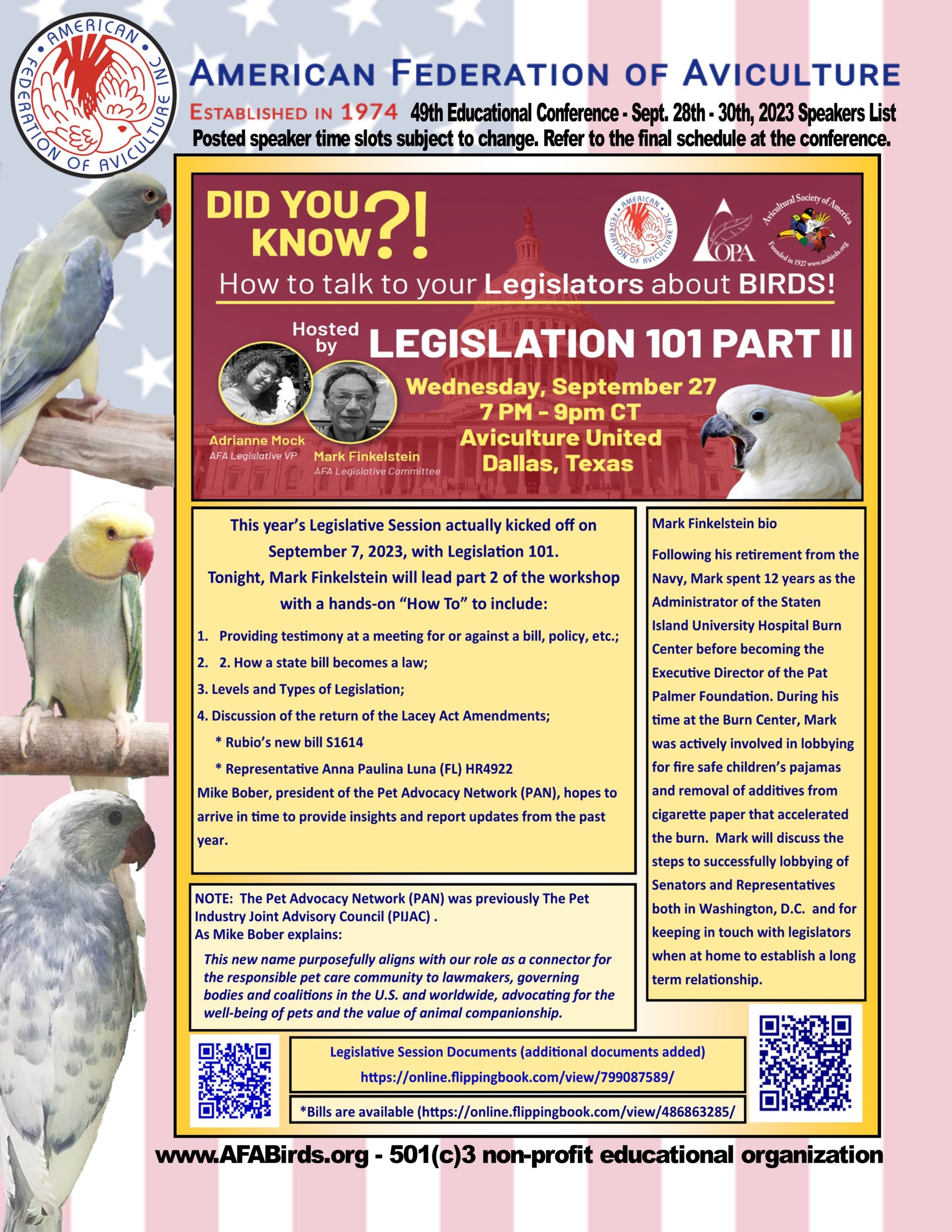
Advocacy groups urge citizens to actively utilize specialized tracking resources, such as the dedicated "Current Legislative Issues" page hosted under the legislation tab on the AFA main menu, alongside foundational educational initiatives like the "Legislation 101: Training Course" and resources detailing federal oversight such as the "USDA Regulation: Animal Welfare Act."
Proposed legislation and municipal ordinances may not always deliver an immediate, disruptive impact on a bird owner’s daily routine. However, the legal architecture being constructed today lays the groundwork for tomorrow’s prohibitions. By understanding the legislative process, recognizing the subtle dangers of broad animal welfare drafts, and engaging actively with elected officials, the avicultural community can work to safeguard the future of responsible bird keeping for generations to come.

