


For generations, the prevailing dogma of paleontology rested on a seemingly immutable biological rule: fossilization is a destructive crucible. According to conventional scientific understanding, the process of mineralization—whereby porous organic tissues within buried bones and teeth are gradually replaced by inorganic minerals over millions of years—completely obliterates original biomolecules. Under this long-held view, fragile structures such as proteins, DNA, and soft tissues were strictly expected to disintegrate entirely within thousands, or at most a few million years, leaving behind nothing more than stone replicas of once-living organisms.
However, a groundbreaking study led by a multidisciplinary team at the University of Liverpool has shattered this long-standing assumption. Providing robust, highly anticipated evidence, the new research demonstrates that original organic materials can indeed survive across deep geological time. By analyzing an exceptionally preserved fossil from the Cretaceous period, scientists have detected undeniable traces of ancient collagen trapped deep within the bone matrix of an Edmontosaurus, a prominent duck-billed dinosaur that roamed North America approximately 75 million years ago.
Published in the peer-reviewed journal Analytical Chemistry, this discovery injects definitive empirical data into a contentious scientific debate that has simmered in academic circles for roughly three decades. By deploying state-of-the-art analytical techniques, including advanced mass spectrometry and protein sequencing, the research team has successfully illuminated a molecular window into the Mesozoic era, offering unprecedented potential for the future of evolutionary biology and paleontology.
An Exceptional Specimen from the Hell Creek Formation
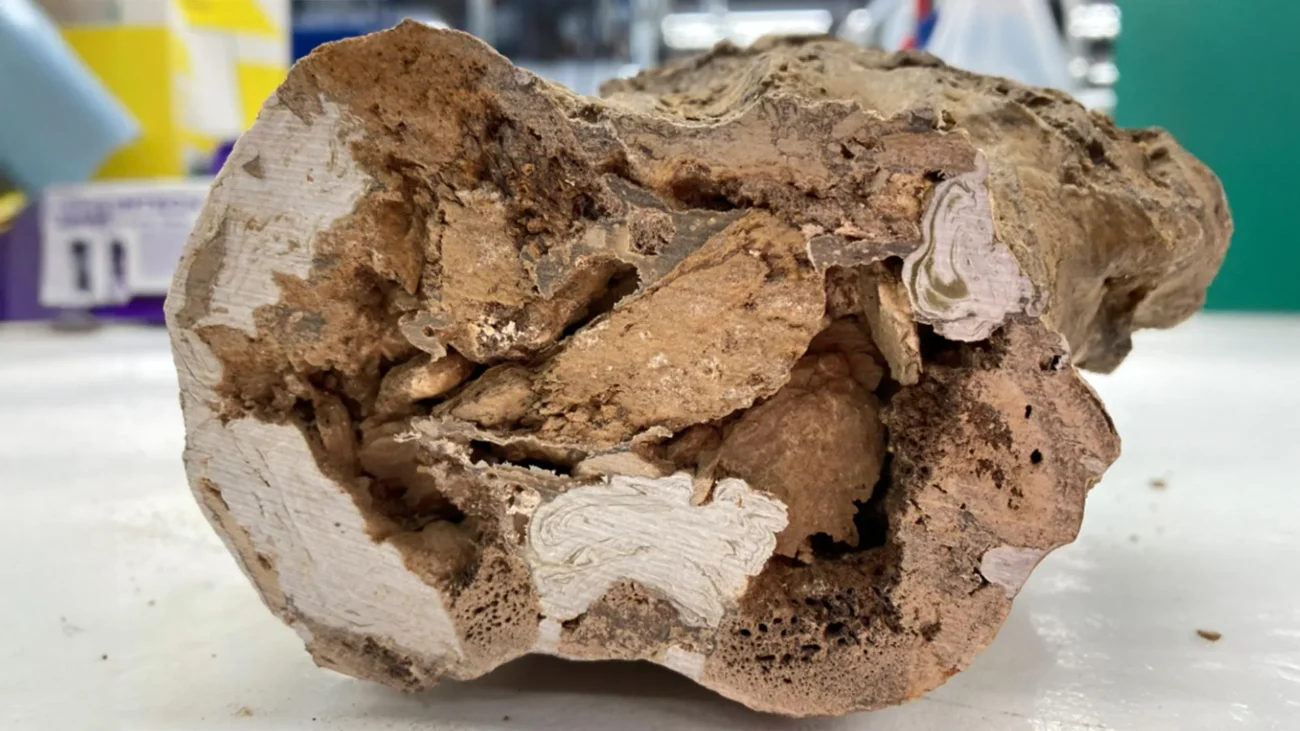
At the heart of this landmark study is a remarkably well-preserved 22-kilogram fossil sacrum—a complex structure of fused vertebrae connected to the pelvis, forming part of the lower spine—belonging to an Edmontosaurus. Unearthed from the fossil-rich Upper Cretaceous rock layers of the renowned Hell Creek Formation in South Dakota, the specimen eventually found a permanent home within the scientific collections of the University of Liverpool.
The Hell Creek Formation is globally celebrated by paleontologists for its rich assemblage of late Cretaceous flora and fauna, capturing ecosystems that thrived immediately prior to the cataclysmic Cretaceous-Paleogene extinction event that wiped out non-avian dinosaurs some 66 million years ago. Yet, even among the thousands of specimens recovered from this geological treasure trove, the Liverpool Edmontosaurus sacrum stands out due to its pristine state of preservation.
Environmental conditions at the time of burial played a critical, albeit still partially mysterious, role in safeguarding the bone’s internal architecture. Rapid burial in fine-grained sediment, combined with specific geochemical properties in the surrounding groundwater and sediment matrix, likely created a microenvironment that shielded the bone from microbial degradation and rapid groundwater leaching. This extraordinary preservation provided researchers with a rare opportunity to apply cutting-edge analytical tools that were entirely unavailable to earlier generations of paleontologists.
Advanced Analytical Methods and Interdisciplinary Collaboration
To interrogate the molecular composition of the ancient bone, the University of Liverpool spearheaded a collaborative effort involving prominent institutions, including the University of California, Los Angeles (UCLA) and several specialized university facilities, such as the Materials Innovation Factory and the Centre for Proteome Research.
Rather than relying on traditional anatomical observation, the research consortium deployed high-resolution mass spectrometry and tandem mass spectrometry to detect, isolate, and quantify specific chemical signatures. Mass spectrometry operates by ionizing chemical compounds to generate charged molecules or molecule fragments, subsequently measuring their mass-to-charge ratios. This allowed the team to systematically scan the bone extracts for molecular building blocks associated with collagen—the principal structural protein that constitutes the vast majority of organic bone mass in vertebrates.
A pivotal breakthrough occurred when researchers from UCLA utilized tandem mass spectrometry to identify and quantify hydroxyproline for the first time in this specific context. Hydroxyproline is a non-proteinogenic amino acid that plays a crucial role in stabilizing the triple-helix structure of collagen. Because hydroxyproline is overwhelmingly specific to collagen within vertebrate bone tissue, its definitive detection served as an unmistakable chemical fingerprint, confirming the presence of degraded yet structurally identifiable ancient protein remnants.
Complementing this finding, the Centre for Proteome Research at the University of Liverpool successfully identified specific fragments of collagen alpha-1, the primary form of collagen found in bone tissue. This convergence of multiple independent analytical techniques effectively eliminated the possibility of analytical artifacts, providing an airtight case for the authenticity of the organic remnants.
Addressing the Contamination Controversy
For nearly thirty years, claims of recovered dinosaur proteins have been met with profound skepticism and rigorous debate within the scientific community. The central pillar of this skepticism has revolved around the perpetual threat of modern contamination. Critics have frequently argued that any organic material detected in ancient fossils must be the result of modern infiltration—introduced via microbial activity, soil humic acids, handling by excavators, museum preservatives, or laboratory reagents.
The results from the University of Liverpool team directly confront and dismantle this longstanding objection. Professor Steve Taylor, chair of the Mass Spectrometry Research Group at the University of Liverpool’s Department of Electrical Engineering & Electronics, emphasized the significance of the findings regarding the contamination hypothesis.
"This research shows beyond doubt that organic biomolecules, such as proteins like collagen, appear to be present in some fossils," Professor Taylor stated. "Our results have far-reaching implications. Firstly, it refutes the hypothesis that any organics found in fossils must result from contamination."
By utilizing rigorous extraction protocols, blank controls, and high-precision molecular identification, the researchers demonstrated that the detected collagen fragments share degradation patterns consistent with extreme antiquity, distinguishing them clearly from modern environmental contaminants. This methodological rigor provides a vital stepping stone toward establishing standardized protocols for future paleoproteomic research.
Revisiting a Century of Geological Archives
Beyond confirming the survival of ancient proteins in a single specimen, the study opens up exciting new pathways for identifying other promising fossils housed in museums and academic institutions around the world. One of the most unexpected outcomes of the research involves the potential reevaluation of historical microscopy data.
For roughly a century, geologists and paleontologists have utilized cross-polarized light microscopy to examine thin sections of fossilized bone. This optical technique employs specially filtered light to reveal internal structural birefringence and anisotropic patterns that remain invisible under standard bright-field microscopy.
According to Professor Taylor, these legacy archives may hold the key to uncovering countless other specimens containing preserved biomolecules. "It suggests that cross-polarized light microscopy images of fossil bones, collected for a century, should be revisited," Taylor explained. "These images may reveal intact patches of bone collagen, potentially offering a ready-made trove of fossil candidates for further protein analysis."
If researchers can correlate optical signatures observed in historical microscope slides with the presence of preserved collagen matrices, museums could rapidly screen existing collections without destructive sampling. This non-invasive preliminary screening could fast-track the discovery of molecularly rich fossils, transforming dusty museum basements into active frontiers for molecular paleontology.
Unlocking New Insights into Extinct Lineages
The ability to extract and sequence proteins from fossils millions of years old promises to revolutionize our understanding of evolutionary biology. While DNA degrades relatively rapidly—with the oldest successfully sequenced ancient DNA currently resting at approximately one to two million years old under optimal permafrost conditions—proteins are significantly more stable over geological timescales.
By analyzing amino acid sequences from fossilized proteins, scientists can construct molecular phylogenies—family trees based on biochemical data rather than purely anatomical traits. Because anatomical features can sometimes undergo convergent evolution (where unrelated species develop similar physical traits due to shared environmental pressures), molecular data provides an independent, highly accurate method for establishing evolutionary relationships.
Applying protein sequencing to dinosaurs and other Mesozoic creatures could eventually resolve long-standing debates regarding the precise phylogenetic positioning of enigmatic species, illuminate the evolutionary pathways that led to modern birds, and provide granular details about the physiological adaptations of extinct megafauna.
The Enigma of Deep-Time Preservation
Despite the triumph of the analytical findings, the discovery brings to light a profound biochemical mystery that continues to puzzle researchers: How can fragile protein structures persist intact across tens of millions of years?
Under standard thermodynamic conditions, proteins are subject to continuous hydrolysis and thermal degradation, meaning peptide bonds should break down over millennia. The survival of collagen fragments in a 75-million-year-old Edmontosaurus implies that natural stabilization mechanisms must exist—mechanisms that scientists are only beginning to comprehend.
Current hypotheses suggest that several factors may act in concert to preserve ancient biomolecules. These include intra-crystalline protein protection (where proteins become locked inside stable mineral crystals, shielding them from water and bacteria), cross-linking induced by natural formaldehyde or sugar-driven Maillard reactions, and unique local geochemical conditions within specific burial environments.
Understanding the precise taphonomic pathways that enable molecular preservation is now one of the most pressing goals in paleobiology. Unlocking these mechanisms will not only explain how dinosaur proteins survive, but will also guide researchers in predicting which geological formations and fossil preservation states are most likely to yield molecular data.
Broader Impact and the Future of Paleoproteomics
The successful detection of original collagen in Cretaceous dinosaur bone marks a definitive turning point for paleontology, effectively bridging the gap between morphological fossil analysis and modern molecular biology. By laying to rest decades of controversy surrounding organic survival in deep time, the University of Liverpool study paves the way for a new era of scientific inquiry.
As laboratories around the world adopt these advanced mass spectrometry and proteomic screening techniques, the field of paleoproteomics is poised for exponential growth. Researchers will no longer be limited to studying the outward shape of bones and teeth; instead, they will possess the analytical capability to peer directly into the molecular machinery of extinct ecosystems.
Ultimately, this research transforms our relationship with the deep past. The realization that delicate proteins can endure across the epochs serves as a powerful reminder that the fossil record holds far more secrets than previously imagined, waiting for science to unlock the molecular echoes of a world long lost.

