


For generations, the conventional wisdom of paleontology and molecular biology was built upon a bedrock of decay. Scientists universally maintained that the fossilization process—a protracted, destructive sequence of mineralization wherein organic tissues are slowly replaced by groundwater minerals over millions of years—left zero room for the survival of original biomolecules. Under this long-standing paradigm, delicate macromolecules such as proteins, DNA, and soft tissues were expected to completely degrade, hydrolyze, and vanish long before a skeleton could cross the threshold from ancient bone into stone. Consequently, any claims of discovering original organic material in Mesozoic-era fossils were met by the scientific community with intense skepticism, often dismissed as modern contamination from handling, soil microbes, or laboratory reagents.
That foundational dogma is now facing a profound and definitive challenge. In a breakthrough study published in the peer-reviewed journal Analytical Chemistry, an international research team spearheaded by the University of Liverpool has delivered robust, empirically verified evidence that original organic molecules can indeed survive within dinosaur fossils across vast expanses of geological time. By applying state-of-the-art analytical techniques to a remarkably well-preserved 22-kilogram pelvic sacrum belonging to an Edmontosaurus—a ubiquitous duck-billed dinosaur that roamed North America during the Late Cretaceous period—the researchers have detected definitive remnants of ancient collagen. This milestone discovery effectively brings closure to a contentious, three-decade-long scientific debate, while simultaneously opening an unprecedented molecular window into the physiology, evolution, and deep-time survival mechanisms of extinct prehistoric fauna.
An Exceptional Specimen from the Hell Creek Formation
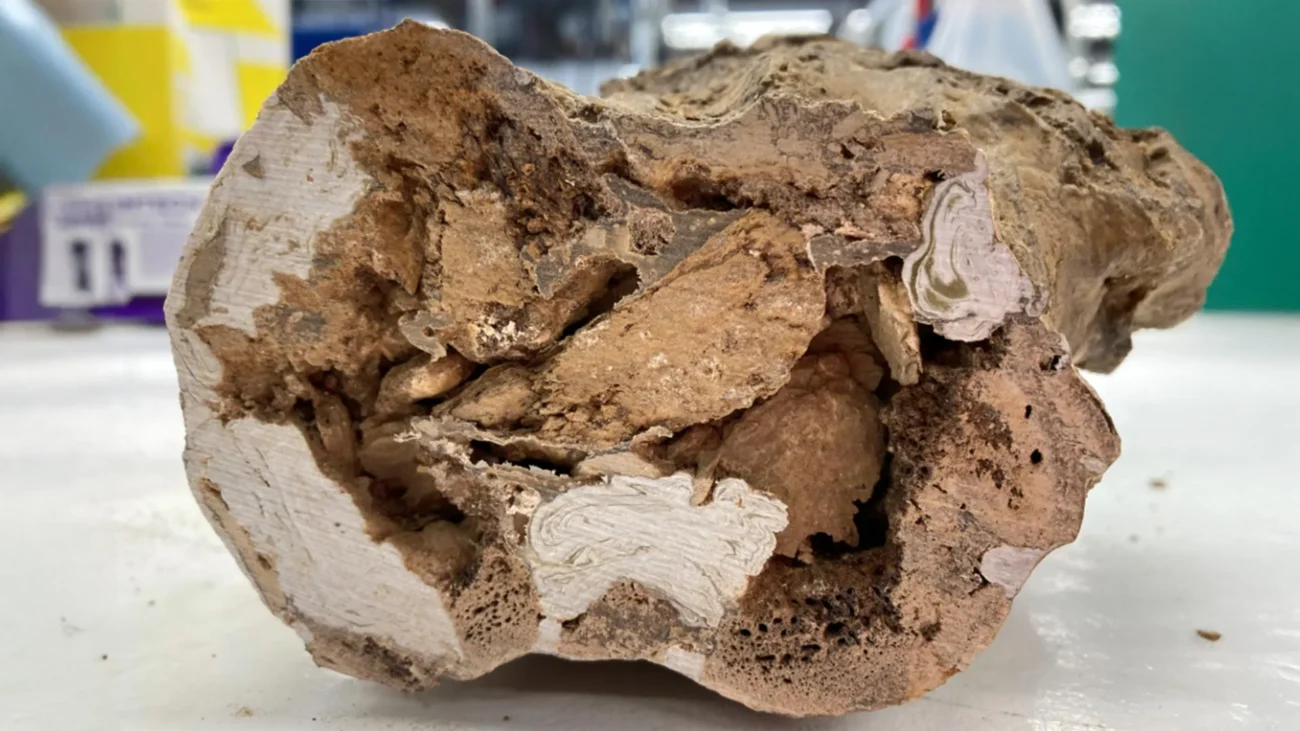
The focal point of this landmark investigation is an unusually pristine fossilized sacrum—a complex fusion of vertebrae connected directly to the pelvis that forms the lower spine of the animal. Unearthed from the fossil-rich Upper Cretaceous rock strata of the Hell Creek Formation in South Dakota, the specimen dates back approximately 75 million years, sitting comfortably near the absolute twilight of the age of dinosaurs. The Hell Creek Formation is globally renowned among paleontologists for its extraordinary preservation of vertebrate fossils, frequently yielding complete or semi-articulated skeletons that offer vital insights into terrestrial ecosystems just prior to the Cretaceous-Paleogene extinction event.
Following its excavation, the 22-kilogram Edmontosaurus sacrum was incorporated into the permanent research collections of the University of Liverpool. Because the bone matrix exhibited an exceptionally high degree of physical preservation—largely free from the severe structural distortion and heavy mineral recrystallization that typically plagues specimens of this antiquity—it presented a rare, highly coveted opportunity. The research team realized that this specific fossil might retain microscopic architecture capable of sheltering microscopic pockets of original biomatter from the harsh geochemical pressures of fossilization.
To interrogate the bone at the molecular level, the Liverpool team joined forces with cross-disciplinary specialists, including researchers from the University of California, Los Angeles (UCLA) and the University’s own Materials Innovation Factory and Centre for Proteome Research. Together, they deployed a battery of cutting-edge analytical instruments designed to hunt for the biochemical calling cards of life.
Precision Science: Mass Spectrometry and Protein Sequencing
At the heart of the analytical methodology were high-resolution mass spectrometry and tandem mass spectrometry, techniques capable of identifying complex molecules by measuring their mass-to-charge ratios and chemical fragmentation patterns. Mass spectrometry acts essentially as a molecular scale, allowing scientists to scan complex biological extracts and isolate specific peptides based on their unique atomic compositions.
In this investigation, the UCLA researchers utilized tandem mass spectrometry to specifically search for—and successfully quantify—hydroxyproline. Hydroxyproline is a non-proteinogenic amino acid that plays a critical stabilizing role in the triple-helix structure of collagen, the primary structural protein found in vertebrate bone and connective tissue. Because hydroxyproline is exceptionally rare outside of collagen in geological contexts, detecting it within the interior matrix of a dinosaur bone serves as a powerful geochemical indicator of degraded, yet structurally distinct, ancient protein remnants.
Complementing this, the Centre for Proteome Research at the University of Liverpool conducted advanced protein sequencing and exhaustive mass spectrometry assays. These tests successfully identified specific fragments of collagen alpha-1, the predominant protein isoform that forms the structural scaffolding of mammalian and reptilian bone tissue. By mapping these peptide sequences against known databases of modern and extinct organisms, the team confirmed that the detected molecules matched the expected evolutionary profile of dinosaurian structural proteins, rather than modern environmental contaminants.
Refuting the Contamination Hypothesis
For thirty years, the primary weapon wielded by critics of ancient protein research has been the contamination argument. Skeptics have persistently maintained that any organic material extracted from dinosaur bones must be the result of modern infiltration—introduced via persistent soil bacteria, groundwater percolation, handling by excavators, or even microscopic airborne spores settling on specimens during laboratory preparation.
Professor Steve Taylor, chair of the Mass Spectrometry Research Group at the University of Liverpool’s Department of Electrical Engineering & Electronics, emphasized that the new study effectively neutralizes this critique.
"This research shows beyond doubt that organic biomolecules, such as proteins like collagen, appear to be present in some fossils," Professor Taylor stated. "Our results have far-reaching implications. Firstly, it refutes the hypothesis that any organics found in fossils must result from contamination."
By employing rigorous chemical controls, sampling deep interior regions of the solid bone matrix where external microbes cannot easily penetrate, and utilizing high-precision sequencing that isolates specific endogenous peptide chains, the research team has established a new gold standard for molecular paleontology. The rigorous multi-institutional verification ensures that the data withstands the rigorous scrutiny demanded by the broader scientific community.
A Century of Archives Awaiting Reexamination
Beyond the immediate chemical confirmation of dinosaurian collagen, the study introduces a brilliant methodological bridge that could exponentially accelerate future discoveries in the field. For roughly a century, paleohistologists have utilized cross-polarized light microscopy to examine thin sections of fossilized bone. This optical technique employs polarized light filters to illuminate internal microstructures, crystallinity patterns, and crystal orientations that remain invisible under standard white-light microscopies.
Historically, these cross-polarized images were used exclusively to study bone mineralization, vascular channel distribution, and the Haversian systems of extinct vertebrates. However, Professor Taylor and his colleagues suggest that these archival images—and the vast museum collections housing them—should now be revisited with fresh eyes.
"Secondly, it suggests that cross-polarized light microscopy images of fossil bones, collected for a century, should be revisited," Professor Taylor explained. "These images may reveal intact patches of bone collagen, potentially offering a ready-made trove of fossil candidates for further protein analysis. This could unlock new insights into dinosaurs—for example revealing connections between dinosaur species that remain unknown."
If specific optical signatures under cross-polarized light correlate reliably with the micro-preservation of original protein matrices, researchers will no longer need to rely entirely on blind screening. Instead, they can scour historical literature, academic archives, and global museum drawers to identify high-probability fossil candidates instantly. This targeted approach could drastically reduce the time and destruction required for destructive molecular sampling, opening up thousands of previously cataloged specimens to advanced proteomic scrutiny.
The Chronology of a Scientific Revolution
To fully grasp the magnitude of the University of Liverpool’s findings, it is helpful to contextualize the historical timeline of molecular paleontology:
- Early 1990s: Initial claims of preserved biomolecules and soft tissues in dinosaur fossils emerge, sparking intense optimism but immediate pushback from the mainstream geochemical community.
- Late 1990s to 2000s: Widespread skepticism dominates paleontology. Critics argue that proteins cannot thermodynamically survive beyond a few hundred thousand to a million years under normal diagenetic conditions, attributing all positive finds to microbial biofilms or laboratory contamination.
- 2000s to 2010s: Advances in mass spectrometry and molecular biology allow researchers like Mary Schweitzer to publish contentious evidence of soft tissue structures and medullary bone proteins in Tyrannosaurus rex and Brachylophosaurus specimens. The debate remains polarized.
- 2020s: Interdisciplinary teams integrating electrical engineering, materials science, and advanced proteomics enter the fray.
- Present Day (Analytical Chemistry Publication): The University of Liverpool, in collaboration with UCLA and materials scientists, provides unequivocal chemical proof of collagen alpha-1 and hydroxyproline in an Edmontosaurus sacrum, effectively bridging the gap between classical paleontology and modern molecular biology.
The Enigma of Deep-Time Preservation
While the empirical evidence confirming the survival of collagen fragments is now exceptionally strong, the discovery gives rise to one of the most perplexing biochemical mysteries in modern science: How do delicate protein structures manage to evade thermodynamic decay, hydrolysis, and microbial consumption for 75 million years?
Proteins are fundamentally fragile polymers composed of amino acid chains linked by peptide bonds. In standard environmental conditions, these bonds break down relatively quickly through hydrolysis, driven by ambient heat, moisture, and microbial activity. For proteins to persist over tens or hundreds of millions of years requires an extraordinary suite of protective mechanisms.
Researchers hypothesize that a combination of factors must be at play in these rare instances of exceptional preservation. One leading theory involves "taphonomic shielding," where mineral crystals—such as carbonate-hydroxylapatite in bone—grow tightly around and within the protein framework, physically sealing the biomolecules off from circulating groundwater, oxygen, and enzymes. Furthermore, natural cross-linking of proteins, potentially catalyzed by iron-mediated oxidation reactions within the burial environment, may create exceptionally stable molecular networks that are virtually impenetrable to normal decay processes.
Unlocking the Molecular Tree of Life
The broader implications of this research extend far beyond the physiological marvel of protein survival. For centuries, paleontology has relied almost exclusively on osteological morphology—the physical shape, size, and articulation of bones—to reconstruct the evolutionary trees and phylogenetic relationships of extinct species. While morphology is immensely powerful, it has distinct limitations, particularly when dealing with fragmentary remains, convergent evolution, or deep evolutionary divergences where physical traits blur.
By successfully extracting and sequencing ancient proteins from dinosaur bones, scientists are stepping across the threshold into the realm of molecular paleontology. Proteins, which are direct translations of an organism’s genetic code, carry rich evolutionary information. While ancient DNA (aDNA) is widely believed to have a absolute survival limit of roughly one to two million years under optimal permafrost conditions—and far less in warm, Mesozoic environments—stable structural proteins like collagen can persist orders of magnitude longer.
By analyzing the amino acid sequences of these ancient proteins, researchers can construct molecular phylogenies for dinosaurs, comparing them directly with modern birds (their surviving avian dinosaur descendants) and non-avian reptiles. This approach could soon resolve decades-old taxonomic debates, illuminating precise evolutionary branches and biological connections between species that remain deeply obscured by the limitations of skeletal anatomy alone.
A New Era for Paleontological Research
The successful detection of collagen in an Edmontosaurus sacrum by the University of Liverpool marks a watershed moment in the study of Earth’s ancient past. By silencing decades of skepticism regarding sample contamination, establishing robust multi-technique verification protocols, and pointing toward historical microscopy archives as a map for future discoveries, this research transforms how the scientific community views fossilization.
As laboratories around the world begin to reevaluate their collections under the lens of these new findings, paleontology is rapidly evolving into a molecular science. The dogma of total organic destruction has fallen, replaced by the realization that under the right geological conditions, deep time does not entirely erase the biological signature of life. Seventy-five million years after it walked the river valleys of Cretaceous North America, the humble duck-billed dinosaur is speaking to us once more—not just through the cold architecture of its stones, but through the enduring, whispered chemistry of its very molecules.

