


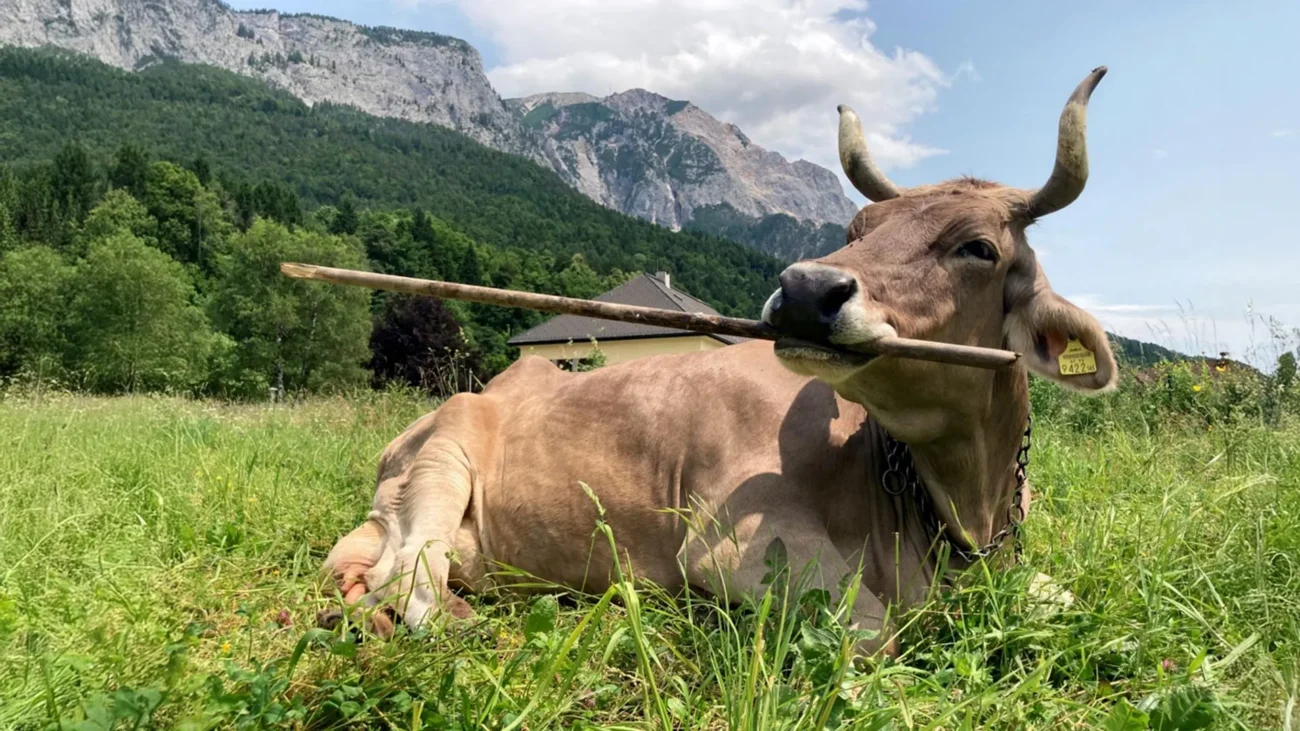
In a groundbreaking development that is challenging long-held assumptions about animal cognition, a Swiss Brown cow named Veronika has demonstrated sophisticated tool use, a behavior previously thought to be exceptionally rare in cattle and largely absent from their perceived cognitive repertoire. This discovery, detailed in a study published in the esteemed journal Current Biology, marks the first documented instance of a domestic cow intentionally selecting and utilizing an external object to achieve a specific goal, pushing the boundaries of our understanding of livestock intelligence. The findings suggest that the perceived intellectual limitations of cattle may stem more from a lack of observation and opportunity than from inherent cognitive deficits.
The scientific community is abuzz with the implications of Veronika’s remarkable abilities, which have directly contradicted the humorous premise of Gary Larson’s iconic 1982 Far Side comic, "Cow Tools." Larson’s cartoon depicted a cow proudly displaying a bizarre assortment of nonsensical objects, humorously playing on the stereotype of cows as unintelligent beings incapable of abstract thought or mechanical aptitude. Today, Veronika stands as a living refutation of that caricature, proving that cows are indeed capable of complex problem-solving and skillful manipulation of their environment.
The Genesis of a Cognitive Breakthrough: Veronika’s Unusual Habit
Veronika’s journey from an ordinary companion animal to a subject of significant scientific interest began over a decade ago on an organic farm in Austria. Her owner, Witgar Wiegele, an organic farmer and baker, described Veronika not as livestock destined for consumption, but as an integral member of his family. It was during this period that Wiegele observed Veronika engaging in a peculiar behavior: she would pick up fallen sticks and use them to scratch her body. Initially, this might have been dismissed as an idiosyncratic habit, but Wiegele’s persistent observation and eventual recording of this behavior brought it to the attention of cognitive biologists.
Alice Auersperg, a leading cognitive biologist at the University of Veterinary Medicine, Vienna, and a key researcher in the study, recounted her initial reaction upon viewing the footage. "When I saw the footage, it was immediately clear that this was not accidental," she stated. "This was a meaningful example of tool use in a species that is rarely considered from a cognitive perspective." This pivotal moment spurred a deeper scientific investigation into Veronika’s capabilities.
Rigorous Scientific Scrutiny: Testing Veronika’s Dexterity
To move beyond anecdotal observation and establish the validity of Veronika’s tool use, the research team designed a series of controlled experiments. These tests were meticulously structured to assess not only if Veronika used tools, but also how she used them, and whether her behavior demonstrated flexibility and purpose.
A key experimental setup involved placing a deck brush in various positions within Veronika’s enclosure. The researchers then observed her interactions with the brush over numerous trials. The results were striking: Veronika consistently demonstrated selective engagement with the brush. She did not simply rub against it randomly. Instead, she exhibited a nuanced approach, choosing specific parts of the brush depending on the area of her body she intended to scratch.
Antonio Osuna-Mascaró, another researcher involved in the study, elaborated on the significance of these findings. "We show that a cow can engage in genuinely flexible tool use," he explained. "Veronika is not just using an object to scratch herself. She uses different parts of the same tool for different purposes, and she applies different techniques depending on the function of the tool and the body region." This level of adaptability and goal-directed behavior is a hallmark of sophisticated cognition.
A Symphony of Movement: Flexible and Multi-Purpose Tool Application
The detailed analysis of Veronika’s brush-wielding technique revealed remarkable precision and adaptability. The researchers observed distinct patterns in her application of the tool, indicating a deep understanding of its function and her own anatomical needs.
When targeting larger, more robust areas of her body, such as her back, Veronika favored the bristled side of the deck brush. This offered a more vigorous and effective scratching action. Conversely, for more sensitive regions on her lower body, she intuitively switched to the smoother handle of the brush. This demonstrates an ability to assess the suitability of different tool components for different purposes.
Furthermore, Veronika’s motor movements also showed significant variation. Scratching her upper body involved broader, more forceful strokes, designed to reach and alleviate irritation in those areas. In contrast, when addressing her lower extremities, her movements became slower and more precise, suggesting a delicate touch and an awareness of the different sensory feedback required for those regions.
Defining Tool Use: Beyond Simple Interaction
The scientific definition of tool use involves the utilization of an external object to achieve a goal through physical interaction. Veronika’s actions unequivocally meet this definition. However, her behavior transcends this basic criterion, qualifying as "flexible, multi-purpose tool use." This classification signifies that an individual can employ different features or aspects of the same object to achieve distinct outcomes, a level of cognitive sophistication that is exceptionally rare in the animal kingdom.
Prior to Veronika’s case, such nuanced and adaptable tool use had been clearly documented primarily in chimpanzees among non-human species. The fact that a bovine animal now joins this elite group underscores the potential for overlooked cognitive abilities in species we have historically underestimated.
Navigating Physical Constraints: The Ingenuity of Egocentric Tool Use
Veronika’s tool use is categorized as "egocentric tool use," meaning the tool is used to interact with her own body. While this form of tool use is often considered less complex than using tools to manipulate external objects, it presents its own unique set of challenges, particularly for an animal without the manual dexterity of primates.
Cows, lacking hands, must rely on their mouths to grasp and manipulate objects. Despite this significant physical limitation, Veronika exhibited remarkable control and apparent foresight. She demonstrated the ability to anticipate the effects of her actions, adjusting her grip and the angle of her movements with precision to achieve the desired scratching sensation. This suggests a level of proprioception and motor planning that is far more advanced than previously attributed to cattle.
Environmental Catalysts: Why This Behavior Might Be Rare
The researchers posit that Veronika’s unique living environment and her long-term relationship with her owner likely played a crucial role in fostering her tool-using abilities. Unlike the vast majority of cattle raised for agricultural purposes, Veronika has lived a prolonged life in a rich, complex, and stimulating environment. Her daily interactions with humans and her access to a variety of manipulable objects provided ample opportunities for exploration, experimentation, and learning.
These enriched conditions are believed to have created the necessary conditions for Veronika to discover, develop, and refine her tool-using skills. The absence of such opportunities in typical agricultural settings may explain why this behavior has remained largely undocumented in other cattle.
The researchers thoughtfully concluded their observation by noting the irony: "[Veronika] did not fashion tools like the cow in Gary Larson’s cartoon, but she selected, adjusted, and used one with notable dexterity and flexibility," they wrote. "Perhaps the real absurdity lies not in imagining a tool-using cow, but in assuming such a thing could never exist." This statement powerfully encapsulates the paradigm shift Veronika’s discovery represents.
Implications for Animal Intelligence and Conservation
Veronika’s discovery is not merely an interesting anecdote; it represents a significant paradigm shift in our understanding of animal intelligence. It is the first scientifically validated instance of tool use in cattle, a species that comprises a substantial portion of the global livestock population. This finding compels a re-evaluation of the cognitive capacities of not only cattle but potentially many other domesticated and wild animals whose intelligence has been historically underestimated.
The research team is now embarking on further investigations to explore the specific environmental and social conditions that facilitate the development of such complex behaviors. They are keen to understand whether Veronika’s abilities are an anomaly or if similar, yet undiscovered, tool-using behaviors exist in other populations of cattle.
"Because we suspect this ability may be more widespread than currently documented," Osuna-Mascaró remarked, "we invite readers who have observed cows or bulls using sticks or other handheld objects for purposeful actions to contact us." This open invitation to citizen scientists and the broader agricultural community highlights the collaborative effort needed to expand our knowledge base.
The implications extend beyond academic curiosity. A deeper understanding of animal cognition can inform more humane and effective animal husbandry practices. It can also influence conservation efforts, emphasizing the cognitive complexity and emotional lives of animals we share the planet with. The case of Veronika serves as a powerful reminder that the natural world is replete with wonders waiting to be discovered, often challenging our preconceived notions and expanding the very definition of intelligence. The humble cow, once confined to the realm of cartoonish simplicity, has now emerged as a compelling example of sophisticated problem-solving and adaptive behavior, urging us to look closer and listen more intently to the diverse voices of the animal kingdom.

