



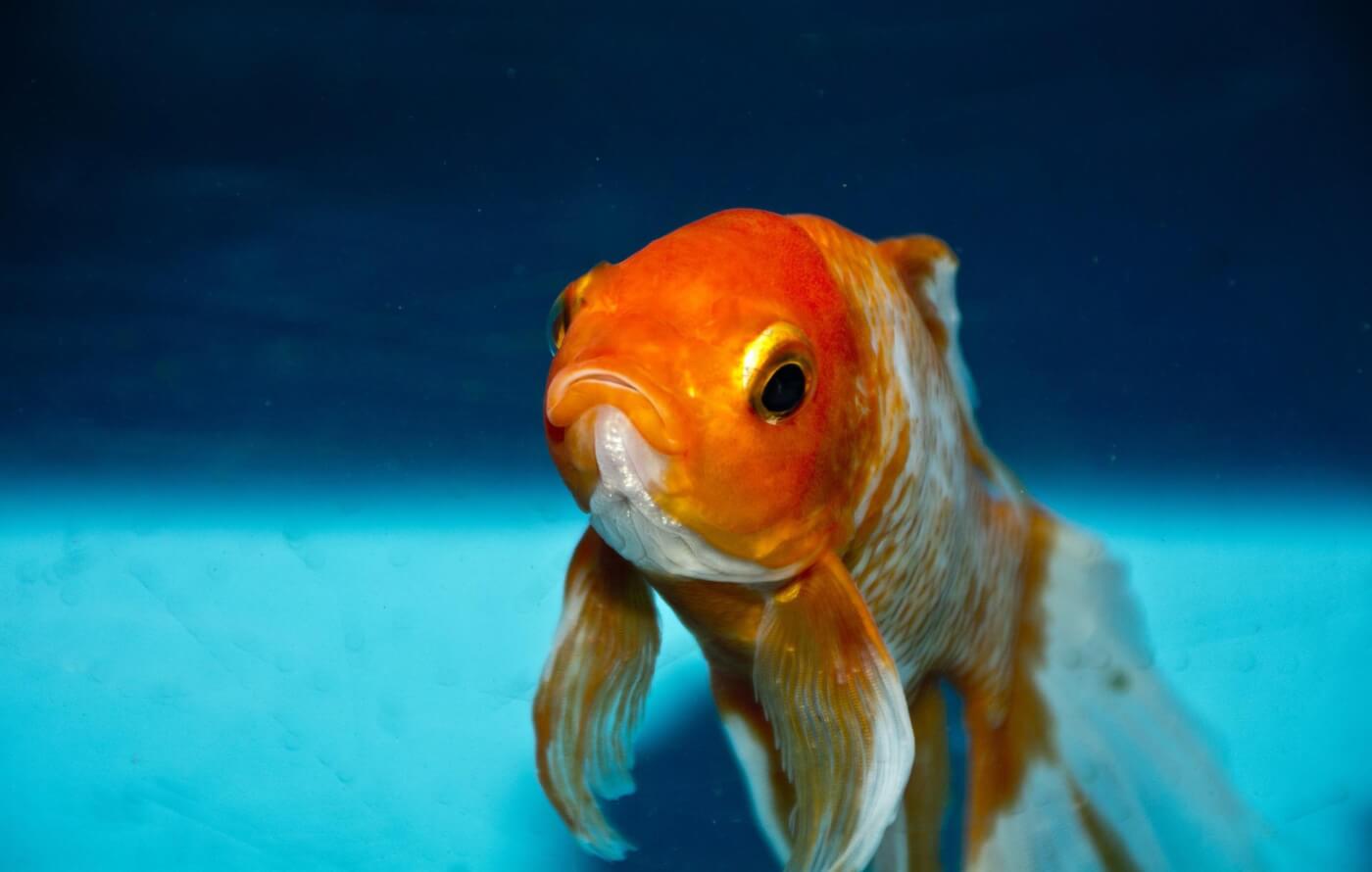
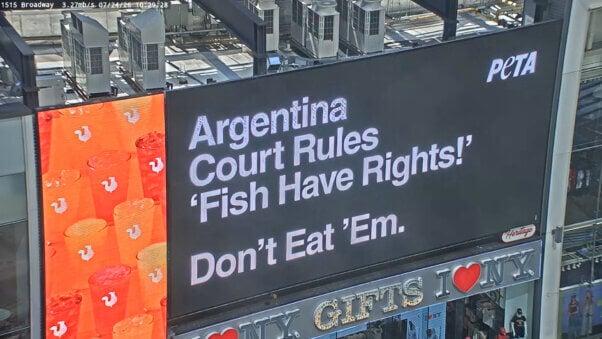
In a landmark legal decision that has sent ripples through the international legal and animal welfare communities, a court in Argentina has officially recognized two goldfish as sentient beings possessing inherent rights rather than mere property. The ruling, which centered on two fish named Fede and Magui, has prompted a high-profile global awareness campaign by People for the Ethical Treatment of Animals (PETA), including a massive billboard in New York City’s Times Square. This judicial precedent marks a significant shift in how non-human animals are categorized within the legal framework of South America, potentially setting the stage for future litigation regarding the treatment of aquatic life worldwide.
The case originated in Buenos Aires, where the animal advocacy group Jaulas Vacías (Empty Cages) filed a formal complaint against a local sushi restaurant. The establishment had placed Fede and Magui in a small, glass display tank on the sidewalk to attract customers. Observers and activists noted that the fish were subjected to constant environmental stressors, including direct exposure to intense sunlight, high levels of urban noise, and physical disturbance from passersby who frequently tapped on the glass. According to reports from the advocacy group, the fish exhibited visible signs of physical neglect and chronic stress, including the loss of scales and lethargic behavior.
The Argentine court, evaluating the complaint under the nation’s existing animal cruelty laws, ultimately sided with the activists. The presiding judge determined that the conditions in which the goldfish were kept constituted a violation of their basic needs as sentient organisms. In an extraordinary move, the court did not merely order the removal of the fish but explicitly redefined their legal status, declaring that they are "sentient beings with rights." This distinction removes them from the category of "objects" or "property"—a legal classification that has historically limited the protections afforded to animals in many jurisdictions.
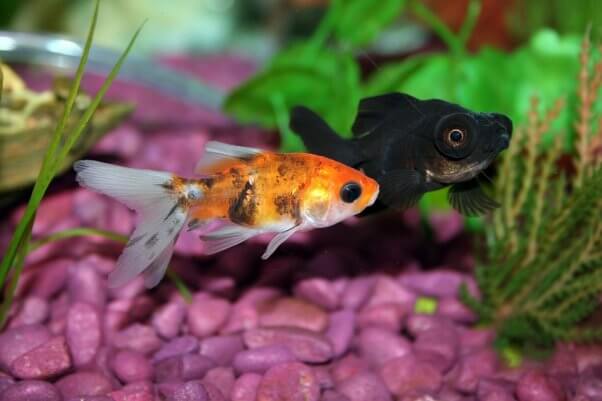
Following the ruling, Fede and Magui were relocated to a 660-gallon aquarium under the supervision of aquatic specialists, where they are reported to be recovering in a controlled, enriched environment. However, the implications of their case extend far beyond their individual rescue.
A Chronology of Legal Precedents in Argentina
Argentina has emerged as a global leader in the evolving field of "non-human personhood" and animal rights. The ruling regarding Fede and Magui is the latest in a series of judicial decisions that have challenged traditional Western legal concepts of animal status.
In 2014, the Argentine legal system gained international attention when a court granted a "habeas corpus" to Sandra, an orangutan held at the Buenos Aires Zoo. The court ruled that Sandra was a "non-human person" who was being unlawfully deprived of her liberty. This was followed in 2016 by a similar ruling for Cecilia, a chimpanzee at the Mendoza Zoo, who was subsequently moved to a sanctuary in Brazil. These cases established a framework in Argentina where animals with high cognitive functions could be recognized as legal subjects with a right to freedom from suffering and captivity.
The case of the goldfish, however, represents a significant expansion of this logic. While previous cases focused on Great Apes—animals whose genetic and behavioral proximity to humans is easily recognized—the goldfish ruling applies these protections to a vertebrate group often dismissed by the public: fish. By recognizing the sentience of goldfish, the court has acknowledged that the capacity to suffer, rather than human-like intelligence, is the primary criterion for legal protection.
Scientific Foundations of Fish Sentience
The court’s decision aligns with a growing body of scientific research regarding the cognitive and emotional lives of fish. For decades, the prevailing myth was that fish lacked the neurological complexity to feel pain or possess long-term memory. However, modern ichthyology and marine biology have debunked these notions.
Research conducted by scientists such as Dr. Culum Brown of Macquarie University and the late Dr. Victoria Braithwaite has demonstrated that fish possess sophisticated nervous systems. Fish have nociceptors—sensory receptors that respond to potentially damaging stimuli—similar to those found in mammals and birds. When exposed to painful stimuli, fish exhibit physiological changes, such as increased respiratory rates and the release of stress hormones like cortisol. They also demonstrate behavioral changes, such as rubbing affected areas or avoiding locations where they previously experienced discomfort.
Beyond the capacity for pain, fish have shown remarkable cognitive abilities. Studies have confirmed that many species of fish:
- Exhibit Long-term Memory: Goldfish, contrary to the "three-second memory" myth, can remember information for months and can be trained to navigate mazes or respond to specific cues.
- Use Tools: Certain species, such as the blackspot tuskfish, have been observed using rocks to crack open shells, a behavior once thought to be exclusive to primates and birds.
- Recognize Individuals: Many fish can distinguish between different members of their own species and even recognize individual human faces.
- Engage in Social Cooperation: Species like the moray eel and the coral grouper have been documented hunting cooperatively, using signals to coordinate their movements.
The Argentine court’s recognition of sentience reflects this scientific consensus, acknowledging that fish are not biological automatons but individuals with the capacity for a subjective experience of the world.
PETA’s Global Campaign and the Times Square Billboard
Recognizing the international significance of the Argentine ruling, PETA launched a high-visibility campaign to bring the news to a global audience. The centerpiece of this effort is a bold billboard located in New York City’s Times Square. The advertisement features an image of a fish alongside the text: "Argentina Court Rules Fish Have Rights! Don’t Eat ‘Em."
The strategic choice of Times Square—one of the most heavily trafficked pedestrian areas in the world—is intended to spark a conversation about the ethics of fish consumption. PETA representatives have stated that if a court of law recognizes fish as sentient beings deserving of protection from cruelty, the logical extension of that recognition is a re-evaluation of the commercial fishing and aquaculture industries.
"Fish are sensitive individuals who value their own lives," PETA said in a statement accompanying the campaign. "They feel pain, fear, and stress, yet trillions are killed every year for food. This ruling is a wake-up call to the world that it is time to leave these animals off our plates."
PETA Latino, the organization’s Spanish-language arm, has been active in Argentina for years, pushing for similar recognitions. Their previous campaigns in the region have addressed the psychological similarities between domestic pets and farmed animals. One notable campaign asked the public, "If you wouldn’t eat your dog, why eat a cow?" while another highlighted the environmental impact of animal agriculture on South American ecosystems, particularly its role in fueling wildfires.
The Scale of Global Fish Consumption and Industry Impact
The legal recognition of fish rights stands in stark contrast to the scale of the global fishing industry. According to data from the Food and Agriculture Organization (FAO) of the United Nations and advocacy groups like Fish Count, humans kill between 1 trillion and 2.8 trillion wild fish every year. This does not include the billions of fish raised in intensive aquaculture farms.
The methods used in commercial fishing—such as bottom trawling, long-lining, and gillnetting—often result in prolonged suffering. Fish pulled from great depths experience painful decompression, which can cause their swim bladders to rupture and their eyes to bulge. Once on deck, they typically die of suffocation or are processed while still conscious. In aquaculture, overcrowding leads to high rates of disease, parasitic infestations, and chronic stress.
Critics of the "fish rights" movement argue that extending legal personhood to aquatic species could have devastating economic consequences for the global food supply and the livelihoods of millions of people employed in the fishing sector. However, proponents argue that the legal system must evolve to reflect scientific reality, and that the transition toward plant-based alternatives is a necessary step for both ethical and environmental reasons.
Broader Implications and Analysis
The Argentine ruling regarding Fede and Magui may serve as a catalyst for legislative and judicial shifts in other nations. Currently, animal welfare laws vary significantly by country. In the United Kingdom, the Animal Welfare (Sentience) Act 2022 recently recognized decapods (such as lobsters and crabs) and cephalopods (such as octopuses) as sentient beings. In Switzerland, it is illegal to flush a goldfish down the toilet or to keep social species in isolation.

The shift toward recognizing animals as "legal subjects" rather than "objects" represents a fundamental challenge to the property-based logic of modern legal systems. If an animal has a right to be free from suffering, the owners of that animal have a legal duty that exceeds simple maintenance; they must provide for the animal’s psychological and biological well-being.
As the case of Fede and Magui continues to gain international attention, it highlights a growing tension between traditional dietary habits and emerging ethical standards. The Argentine court has provided a legal blueprint for those seeking to expand the circle of compassion to include the most numerous vertebrates on the planet. Whether other nations follow suit remains to be seen, but for now, the two goldfish from a Buenos Aires sidewalk have become the unlikely faces of a global movement for animal rights.

