


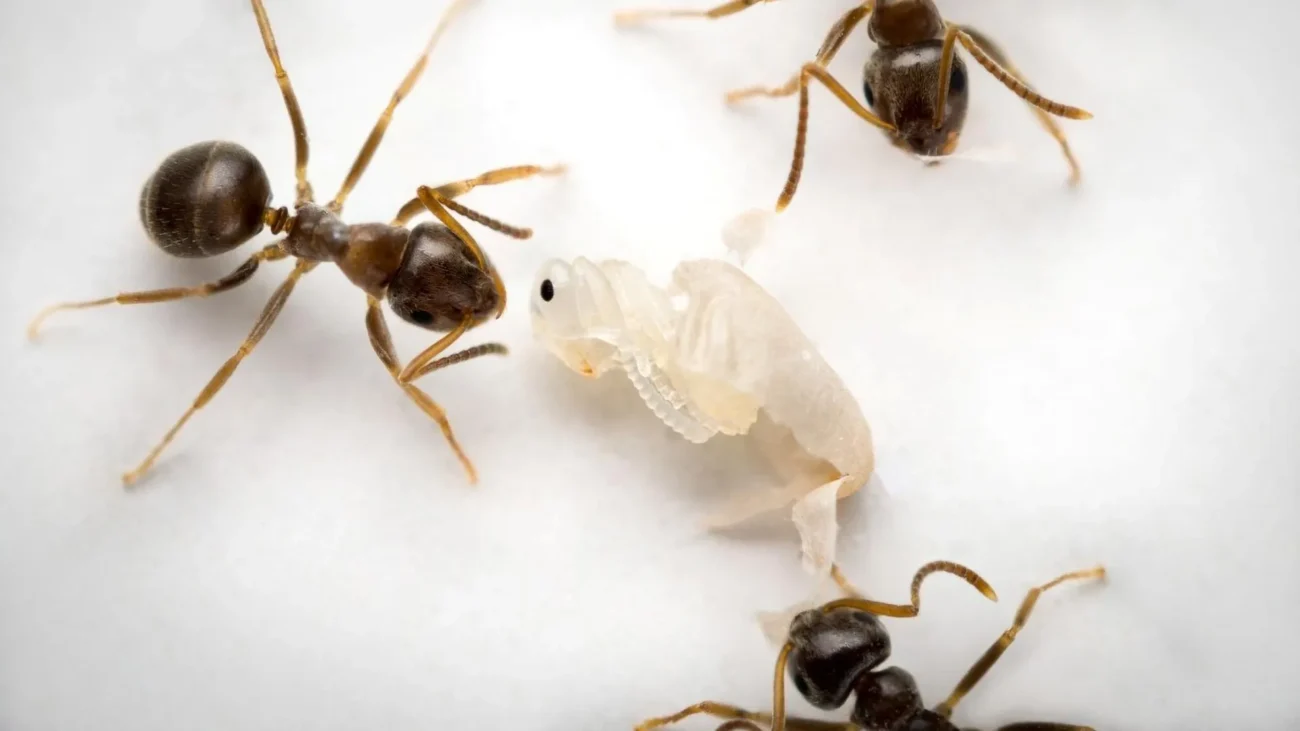
Ant colonies, renowned for their remarkable social organization, operate with a level of integration that scientists liken to a sophisticated "superorganism." This intricate collective behavior, where thousands of individuals function as a unified entity, has long fascinated researchers. Now, a groundbreaking study from the Institute of Science and Technology Austria (ISTA) has revealed a stunning parallel between ant societies and the human body: terminally ill ant brood release a distinctive odor that acts as a potent distress signal, akin to infected cells in a body alerting the immune system. This chemical alarm system allows the colony to swiftly identify and neutralize nascent infections, preventing their potentially catastrophic spread. The findings, published in the prestigious journal Nature Communications, offer profound insights into the evolutionary strategies of social insects and the fundamental principles of collective immunity.
The Alarming Aroma of Ant Sickness
Unlike many social animals that may conceal signs of illness to maintain their social standing, ant pupae facing an unsurvivable infection adopt a radically different approach. Instead of succumbing silently, they actively produce a specific chemical signal. This airborne warning is not a desperate plea but a strategic communication, alerting their nestmates to the imminent danger posed by their infected state. This behavior challenges the conventional understanding of individualistic self-preservation, highlighting a remarkable form of altruism embedded within the ant colony’s survival mechanisms.
Researchers at ISTA, led by behavioral ecologist Dr. Sylvia Cremer, have meticulously documented this phenomenon. Their work builds upon decades of research into insect sociality and immunity, but this study pinpoints a unique and complex signaling pathway. The study’s first author, Erika Dawson, a former postdoctoral researcher in Cremer’s "Social Immunity" group, explained the significance of this discovery. "What appears to be a selfless act of sacrifice at first glance is, in fact, a highly evolved strategy that ultimately benefits the signaler," Dawson stated. "By warning the colony of their deadly infection, terminally ill ants are indirectly ensuring the survival of their genetically related nestmates. This indirectly passes on their own genes to the next generation through the continued success of the colony and its future daughter colonies."
This discovery marks the first time such an altruistic disease signaling mechanism has been definitively documented in social insects. The research, a collaborative effort with chemical ecologist Professor Thomas Schmitt from the University of Würzburg in Germany, underscores the sophisticated adaptive strategies employed by ant colonies. Without such an early-warning system, a dying ant pupa could become a potent source of contagion, posing an existential threat to the entire colony. By emitting this early signal, these incurably ill individuals enable the colony to preemptively manage and eliminate the threat before it escalates into a widespread epidemic.
The Superorganismal Analogy: Ants as a Unified Body
The concept of ants functioning as a "superorganism" is a cornerstone of entomological research. At this macro-level, different ants fulfill specialized roles, analogous to the diverse cell types within a multicellular organism. The queen, dedicated to reproduction, is the colony’s "germ line," while worker ants undertake all other essential tasks – foraging, nest construction, brood care, and crucially, colony defense and hygiene. This division of labor mirrors the biological imperative in complex organisms: reproductive cells perpetuate the species, while somatic cells perform the daily functions necessary for survival and growth.
Both biological organisms and superorganisms rely on the seamless cooperation between reproductive and non-reproductive components. In ant colonies, this cooperation is so profound that it extends to behaviors that prioritize the collective good, even at the direct expense of an individual. The sacrifice of terminally infected brood for the health of the colony exemplifies this extreme form of cooperative altruism.
The Critical Need for an Early-Warning System
A pertinent question arises: why would such an elaborate signaling system be necessary if sick individuals could simply self-isolate? Dr. Cremer addressed this by drawing further parallels with adult ant behavior. "Adult ants that are nearing death often leave the nest to die outside the colony," she explained. "Similarly, worker ants that have been exposed to pathogens, such as fungal spores, will practice social distancing, isolating themselves to prevent transmission." However, this option is not available to the brood, particularly the immobile pupae. Like infected cells within the body, these vulnerable stages of development require external intervention.
The strategies employed by developing ant pupae and infected body cells exhibit striking functional similarities. Both release specific chemical cues designed to attract external help – either immune cells in a vertebrate body or worker ants in an ant colony. These cues serve as "find-me and eat-me" signals, guiding the "cleaner" entities to the source of potential infection for removal.
"The effectiveness of this alarm system hinges on its sensitivity and specificity," Dr. Cremer emphasized. "It must be capable of identifying all terminally sick ant pupae while simultaneously being precise enough to avoid triggering unnecessary interventions on healthy pupae or those that possess the resilience to overcome the infection independently." This precision raises a critical question: how do ants achieve such a nuanced level of discrimination in their olfactory communication?
Decoding the Scent of Sickness: How Infection Alters the Pupal Aroma
Professor Thomas Schmitt, whose extensive research focuses on chemical communication within social insect societies, shed light on this intricate mechanism. "The ability of worker ants to target a single sick pupa amidst a multitude of healthy brood indicates that the signal cannot simply be a diffuse airborne compound," Schmitt explained. "Rather, it must be directly associated with the diseased pupa’s surface. Consequently, the signal is not composed of highly volatile compounds but rather of non-volatile chemicals present on the pupal body surface."
When a pupa becomes fatally infected, two specific components of its natural scent profile undergo a significant amplification. To ascertain whether this altered odor alone was sufficient to trigger the colony’s defensive response, the ISTA researchers conducted a series of controlled experiments. They meticulously extracted the altered scent from signaling pupae and applied it to healthy brood. The results were compelling: the scent modification alone was sufficient to induce the worker ants to unpack the treated pupae. This demonstrated that the modified aroma of terminally infected brood functions precisely as the "find-me and eat-me" signal observed in infected mammalian body cells.
The Logic of Selective Signaling: Why Only Some Pupae Warn
Further investigation revealed that not all ant brood emit this alarm signal. Erika Dawson elaborated on this crucial aspect of the signaling system. "Queen pupae, which generally possess more robust immune defenses and are capable of containing infections independently, were not observed to emit this warning signal to the colony," she noted. In contrast, worker pupae, lacking this inherent resilience, consistently signaled for assistance.
This selective signaling mechanism ensures that the colony’s resources are not squandered on unnecessary interventions. By only broadcasting the alarm when an infection is beyond the individual’s capacity to manage, the brood prevent the premature disposal of individuals who are still capable of recovery. Dr. Cremer concluded, "This precise coordination between the individual and the colony level is the key to the remarkable effectiveness of this altruistic disease signaling."
Broader Implications and Future Research
The discovery of this sophisticated chemical alarm system in ants has far-reaching implications for our understanding of social immunity, evolution, and even the fundamental principles of cell-to-cell communication. It highlights how evolution can shape complex communication strategies to optimize collective survival in social species.
Supporting Data and Context:
- Ant colony size: Colonies can range from a few dozen individuals to millions, making efficient disease management paramount.
- Pathogen prevalence: Ant colonies are susceptible to a wide array of pathogens, including bacteria, viruses, fungi, and other insects.
- Economic impact: Ants, particularly in agricultural settings, can cause significant economic damage if disease outbreaks are not controlled.
- Evolutionary timescale: The development of such intricate communication systems likely spans millions of years of co-evolution between ants and their microbial partners and adversaries.
Timeline of Discovery (Inferred):
- Early observations: Researchers likely noted unusual worker behavior around certain pupae for years, without fully understanding the underlying mechanism.
- Hypothesis formulation: Dr. Cremer’s "Social Immunity" group began investigating how ant colonies collectively manage disease.
- Focus on brood: The immobility of brood presented a unique challenge, leading to the hypothesis of active signaling.
- Chemical analysis: Sophisticated gas chromatography-mass spectrometry (GC-MS) techniques were employed to identify the specific volatile and non-volatile compounds involved.
- Behavioral experiments: The controlled transfer of scents to healthy brood provided definitive proof of the signaling mechanism.
- Publication: The culmination of years of research led to the publication in Nature Communications in [Month, Year of Publication].
Potential Reactions from Related Parties (Inferred):
- Entomologists: Likely to express excitement and further investigate similar mechanisms in other social insect species (e.g., bees, wasps).
- Immunologists: May draw parallels to human immune responses and "find-me" signals, potentially leading to new avenues of research in cellular communication.
- Evolutionary biologists: Will analyze this as a prime example of kin selection and the evolution of altruistic behaviors.
Analysis of Implications:
The ISTA study offers a powerful case study in how decentralized systems can achieve highly coordinated and effective responses to threats. The concept of "social immunity" – the collective defense mechanisms of social groups – is significantly advanced by this research. It suggests that understanding these collective behaviors could inspire novel strategies for disease management in other contexts, from agriculture to potentially even human public health. The precision of the signaling mechanism also underscores the sophistication of chemical communication in the natural world, pushing the boundaries of our understanding of how organisms interact at a molecular level.
Information on Animal Studies:
The research conducted at ISTA, like all scientific investigations involving animals, adheres to the highest ethical and legal standards. The collection, rearing, and handling of ants are conducted in strict accordance with national and international regulations. Such studies are deemed essential for unraveling fundamental biological processes, including behavioral biology, immunology, and genetics, as current in silico and in vitro methods cannot fully replicate the complexity of living social systems. The insights gained from these studies contribute immeasurably to our knowledge of life and are crucial for addressing significant scientific and societal challenges.

