


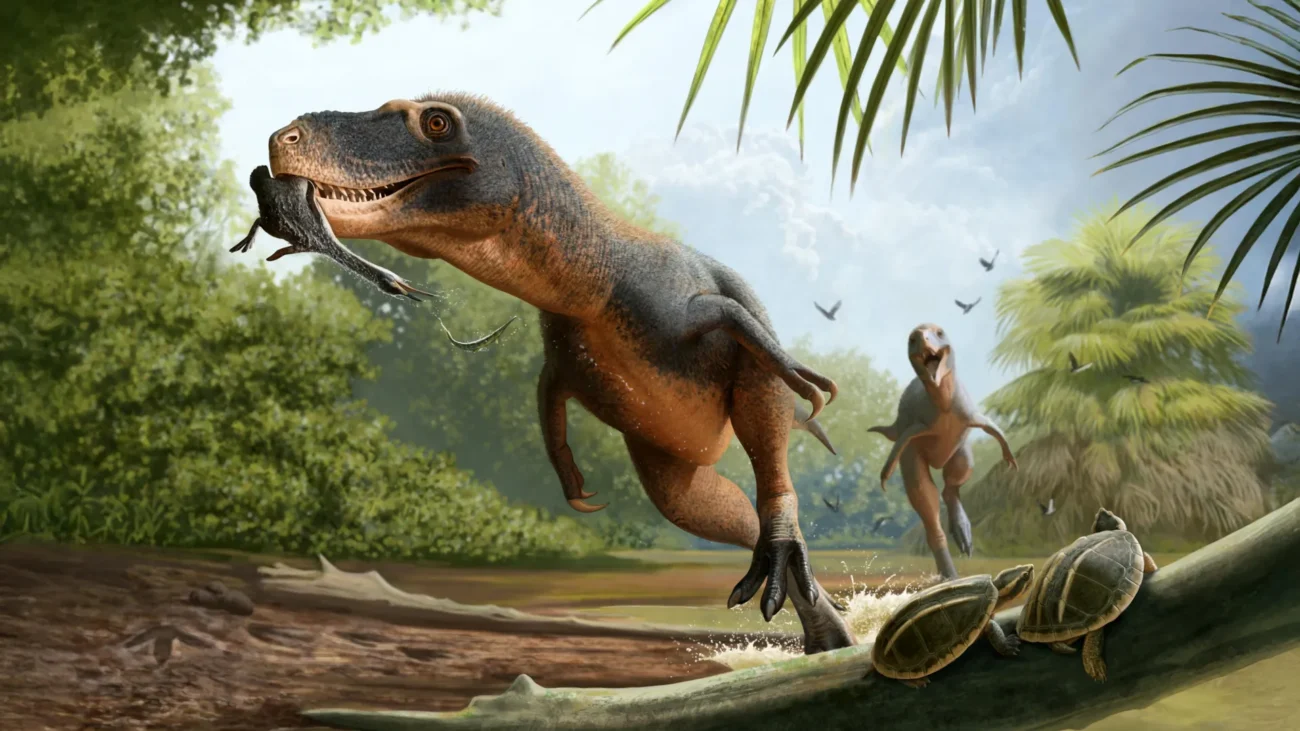
A groundbreaking discovery locked inside a modest, golf-ball-sized fossilized coprolite from the late Cretaceous period has provided paleontologists with unprecedented insights into the evolution of feathers and a potential explanation for why modern birds survived the catastrophic mass extinction that wiped out non-avian dinosaurs. The findings, recently published in the scientific journal Current Biology, center on an exceptionally preserved feather specimen ingested by a large carnivorous dinosaur—possibly a Tyrannosaurus rex or a Nanotyrannus—roughly 66 million years ago.
This remarkable find offers a rare glimpse into ancient predator-prey dynamics while opening an entirely unconventional avenue for paleontological research: the systematic analysis of micro-remains preserved within fossilized feces. Led by an international team of researchers, the study bridges gaps in the evolutionary history of avian insulation, challenging prevailing hypotheses regarding how certain lineages managed to endure the devastating aftermath of an asteroid impact.
Main Facts of the Discovery
The focal point of the research is a dark, reddish-brown coprolite recovered from the geologically rich Hell Creek Formation in northeastern Montana. Discovered initially in 2016 by David DeMar, Jr., a research scientist and Hell Creek Project collections manager at the University of Washington Burke Museum, the nodule was distinguished by its unusual composition. Upon examining the exterior with a hand lens, DeMar identified a tiny fossilized feather protruding from the surface—a staggering anomaly given that feathers had not previously been documented within the Hell Creek Formation despite over a century and a half of intensive fossil prospecting.
Subsequent laboratory analyses utilizing advanced micro-CT imaging at the University of Southern California’s medical campus revealed a hidden trove of biological data. Without destroying the fragile specimen, the digital scans generated high-resolution, three-dimensional visual reconstructions. Inside the coprolite, researchers identified:
- Multiple pristine fossilized feathers.
- Tiny, microscopic scales belonging to a gar fish.
- Fragmented leg bones attributed to an ancient aquatic bird known as a hesperornithiform.
The co-occurrence of the avian bones and feathers strongly indicates that the plumage originated from the consumed bird itself, swallowed whole or in part by a formidable apex predator shortly before the close of the Mesozoic Era.
Chronology of the Find and Investigation
The journey from a rocky outcrop in Montana to the pages of Current Biology followed a rigorous scientific timeline spanning several years:
- 150 Million Years Ago: The emergence of Archaeopteryx, recognized as the oldest known transitional bird species, initiating a lengthy co-existence between early avian lineages and terrestrial dinosaurs.
- 66 Million Years Ago: A massive asteroid strikes the Yucatán Peninsula, triggering global climate devastation, catastrophic wildfires, and an "impact winter" that drives approximately 75 percent of all plant and animal species on Earth to extinction—including all non-avian dinosaurs and most early bird groups.
- 2016: Paleontologist David DeMar, Jr., hunting for fish fossils in the Hell Creek Formation of Montana, discovers the golf-ball-sized coprolite containing an exposed trace of a feather.
- Post-2016 Laboratory Phase: The specimen undergoes comprehensive analysis, including mineral composition testing and micro-CT scanning, led by specialists from institutions including the Field Museum, the Burke Museum, the Carter County Museum, and USC.
- Publication: Following extensive data processing and comparative anatomical studies, the team officially publishes their conclusions in Current Biology, detailing the significance of the fossilized feather and its implications for avian survival theories.
The Enigma of Avian Survival: Habitat Versus Adaptation
To understand the weight of the new discovery, scientists must look back at the bifurcation of the avian family tree during the Cretaceous Period. While dinosaurs ruled the land, avian species had branched into distinct groups. The most dominant birds of the era were the enantiornithines, which occupied various terrestrial niches. A separate lineage, the hesperornithiforms, evolved as specialized aquatic diving birds, functionally resembling modern loons with tooth-filled beaks and reduced wings adapted for propulsion underwater.
Simultaneously, a third group known as Neornithes—the direct ancestors of every modern bird species alive today—was quietly establishing a foothold. When the asteroid struck, almost all enantiornithines and hesperornithiforms perished alongside the non-avian dinosaurs, while the Neornithes lineage miraculously endured.
For decades, paleontologists debated the primary driver of this selective survival. A prominent hypothesis suggested that aquatic habitats provided a buffer against the immediate terrestrial catastrophes of the asteroid impact, such as widespread thermal radiation and raging wildfires. Proponents argued that water-dwelling birds, or those capable of seeking refuge near bodies of water, had a higher statistical chance of weathering the initial cataclysm.
However, the discovery of the hesperornithiform remains inside the Montana coprolite complicates this neat narrative. Hesperornithiforms were distinctly aquatic organisms, highly adapted to marine and freshwater ecosystems, yet their lineage still suffered complete extinction. This contradiction implies that proximity to water alone was insufficient to guarantee survival, forcing researchers to look closer at physiological traits—specifically, insulation.
Scientific Analysis: Feathers and the Impact Winter
According to Dr. Jingmai O’Connor, associate curator of fossil reptiles at the Field Museum in Chicago and lead author of the study, the structural composition of the newly discovered feathers provides a compelling missing link.
The feathers extracted from the coprolite belong to a hesperornithiform, representing the first time researchers have been able to analyze plumage from this specific group. Morphologically, the feathers occupy an evolutionary middle ground: they exhibit advanced, modern-looking waterproof characteristics suitable for diving, yet they simultaneously retain primitive, fuzzy, down-like structures typically associated with non-avian theropod dinosaurs and enantiornithines.
This hybrid feather structure has profound implications when modeled against the environmental conditions of the post-impact "impact winter." The asteroid collision launched massive volumes of pulverized rock, soot, and sulfate aerosols into the stratosphere, blanketing the globe in darkness and triggering a dramatic, multi-year drop in surface temperatures.
During such a prolonged cold snap, efficient thermoregulation would have been a matter of life and death. If hesperornithiforms and enantiornithines possessed primitive body plumage that failed to trap heat as effectively as the advanced, specialized contour and down feathers of ancestral Neornithes, those anatomical shortcomings could explain their vulnerability. Birds with inferior thermal insulation would have succumbed to hypothermia and starvation as insect populations collapsed and food chains unraveled in the sunless global winter.
Official Responses and Expert Perspectives
The uniqueness of the specimen has drawn enthusiastic reactions from the paleontological community, highlighting both the methodological breakthrough and the ecological data preserved within.
Dr. Greg Wilson Mantilla, professor at the University of Washington and curator of vertebrate paleontology at the Burke Museum, emphasized the extreme rarity of the find. "We rarely find fossils of birds and even more rarely their feathers, giving us such important insight into the evolution of this key aspect of their biology," Mantilla noted. "On top of that, these bird feathers found within a large fossilized dinosaur dung give us an incredible window into predator-prey interactions 66 million years ago."
Co-author Nate Carroll of the Carter County Museum underscored the technological milestone achieved by utilizing medical imaging on unconventional geological samples. Having previously relied primarily on delicate amber inclusions to study three-dimensional feather structures, Carroll described the realization that fossilized feces could yield such pristine preservation as a paradigm shift for the field.
"Every hour processing the data revealed another feather, another scale, another bone—in stunning 3D," Carroll stated, noting that the coprolite acted as a secure chemical micro-environment that protected fragile soft tissues from destruction during the fossilization process.
Broader Implications for Paleontology
Beyond resolving evolutionary debates surrounding avian insulation, the study serves as a proof-of-concept for a largely untapped methodological approach. Historically, coprolites have been analyzed primarily for gross dietary content, such as bone fragments, tooth marks, or pollen grains. The accidental discovery in Montana demonstrates that microscopic integumentary structures—such as feathers, hair-like proto-feathers, skin impressions, and microscopic parasites—can survive the digestive tracts of apex predators and subsequent fossilization.
O’Connor hopes the success of this project will encourage museums and research institutions worldwide to re-examine existing coprolite collections using non-destructive computed tomography scanning. Thousands of fossilized droppings currently sit unstudied in archive drawers, potentially harboring delicate biological records that were previously assumed to have been completely digested or destroyed.
As paleontologists continue to piece together the closing chapters of the Mesozoic Era, this serendipitous discovery in the badlands of Montana underscores how critical clues to Earth’s history can occasionally be found in the most unexpected places—transforming prehistoric waste into a priceless archive of evolutionary survival.

