


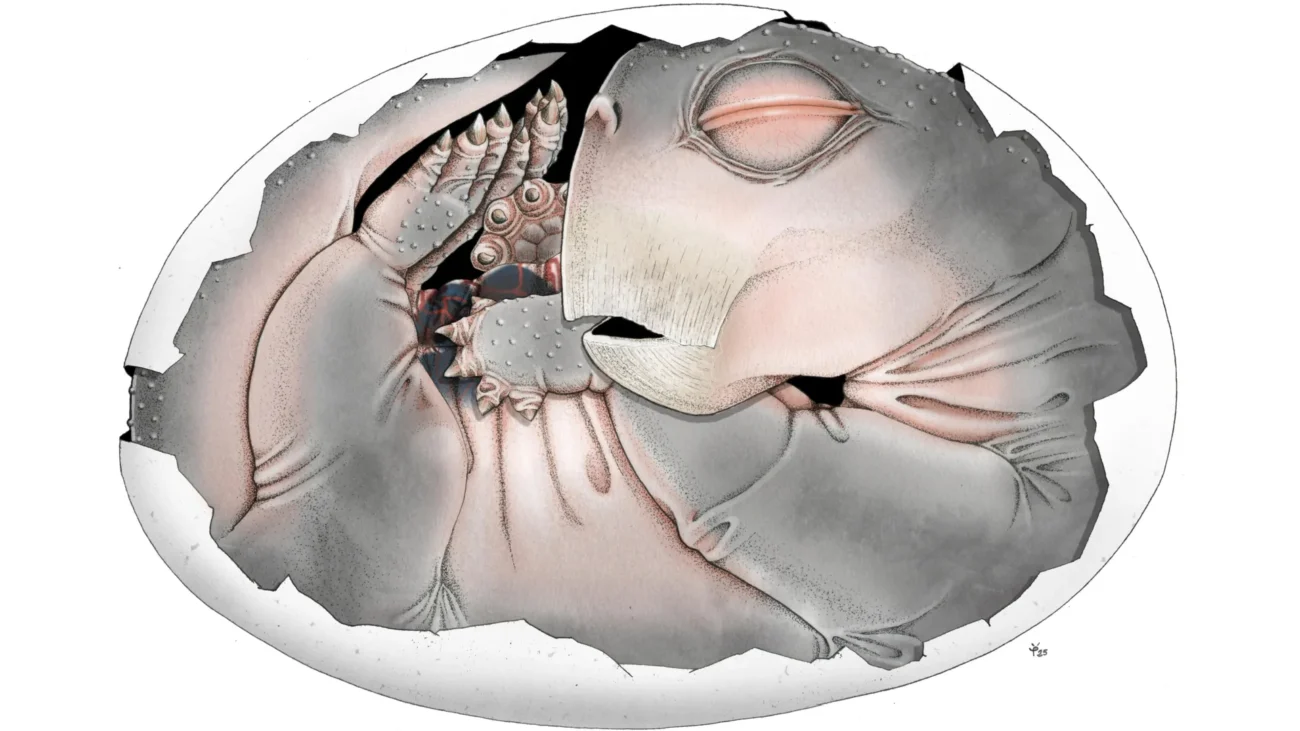
The discovery of a remarkably preserved fossilized egg containing a prehistoric embryo has finally resolved a decades-long scientific debate regarding the reproductive biology of early mammal ancestors. Published in the journal PLOS ONE, the breakthrough centers on Lystrosaurus, a robust, herbivorous therapsid that emerged as one of the most successful and dominant terrestrial creatures in the wake of Earth’s most devastating biological crisis. The fossil provides the first definitive, direct evidence that the forerunners of modern mammals laid eggs, echoing the reproductive strategy still seen today in monotremes like the platypus and echidna.
Led by an international collaboration of paleontologists—including Professor Julien Benoit and Professor Jennifer Botha from the Evolutionary Studies Institute at the University of the Witwatersrand in South Africa, alongside Dr. Vincent Fernandez from the European Synchrotron Radiation Facility (ESRF) in France—the research team utilized cutting-edge imaging technology to peer inside a geological specimen that had languished in museum archives for nearly two decades. The findings not only close a significant knowledge gap in vertebrate evolution but also shed light on the specific biological adaptations that allowed certain lineages to endure global catastrophe.
The End-Permian Mass Extinction: Context of a Global Crisis
To understand the magnitude of the Lystrosaurus survival story, paleontologists must look back approximately 252 million years to the Permian-Triassic boundary. Often referred to by scientists as the "Great Dying," this catastrophic extinction event eradicated an estimated 70 percent of terrestrial vertebrate species and up to 96 percent of all marine species. The collapse of global ecosystems was triggered by massive, prolonged volcanic eruptions in what is now the Siberian Traps. These cataclysmic events released colossal volumes of greenhouse gases into the atmosphere, leading to runaway global warming, severe ocean acidification, widespread marine anoxia, and prolonged, intense droughts across terrestrial landscapes.
In the aftermath of this apocalyptic scenario, the Earth entered a harsh, unstable early Triassic period characterized by extreme temperatures and shifting weather patterns that left most of the planet barren. Yet, amidst the ecological ruin, Lystrosaurus not only survived but underwent a dramatic population explosion, temporarily dominating ecosystems worldwide. For years, evolutionary biologists debated the precise physiological and reproductive mechanisms that granted this barrel-chested, beak-jawed animal such extraordinary resilience while countless other lineages vanished permanently from the fossil record.
A Seventeen-Year Journey from Field Discovery to Laboratory Breakthrough
The path to solving this ancient evolutionary puzzle began in 2008 during a routine paleontological field expedition in South Africa led by Professor Botha. John Nyaphuli, an exceptional fossil preparator and field technician, identified an unassuming, small geological nodule exposed in the sedimentary rock. Upon initial inspection, the specimen revealed only tiny, isolated flecks of bone, offering little indication of its true scientific value.
Over the following years, Nyaphuli meticulously prepared the specimen in the laboratory, slowly chipping away the surrounding matrix until the outline of a perfectly curled-up Lystrosaurus hatchling emerged. While Professor Botha and her colleagues strongly suspected at the time that the juvenile specimen had perished within an egg prior to birth, the technological limitations of the era prevented them from confirming the presence of an enclosing eggshell. The specimen was safely cataloged and stored, awaiting the development of non-invasive imaging tools powerful enough to resolve microscopic structures hidden deep within dense rock without destroying the delicate fossil.
Advanced Synchrotron Imaging Unlocks Hidden Details
The technological leap required to unlock the secrets of the Lystrosaurus egg came via modern synchrotron X-ray computed tomography (CT) scanning at the ESRF in Grenoble, France. Utilizing high-flux, high-energy X-rays generated by a particle accelerator, Dr. Fernandez and his colleagues were able to construct ultra-high-resolution, three-dimensional digital models of the internal contents of the nodule down to the sub-millimeter scale.
This non-destructive imaging technique allowed the research team to examine the micro-architecture of the fossilized remains without risking damage to the fragile embryonic bones. The scans verified the presence of the elusive egg structure and revealed crucial anatomical details regarding the developmental stage of the juvenile animal.
According to Professor Benoit, a particularly revealing anatomical feature was the incomplete mandibular symphysis—the joint connecting the two halves of the lower jaw. In vertebrates, this structural junction must fully fuse before the animal can independently process and ingest food. The scans clearly demonstrated that this bony fusion had not yet taken place in the Lystrosaurus embryo, confirming that the individual was still in a pre-hatching stage of development and would have been entirely incapable of feeding itself at the time of death.
Reproductive Strategy: Large Eggs and Fast-Developing Young
Beyond confirming that early mammal ancestors laid eggs, the physical dimensions and structural characteristics of the fossilized specimen provided profound insights into the parental investment and life-history strategies of Lystrosaurus. Morphological analysis indicates that the animals produced relatively large eggs in proportion to their adult body size.
In contemporary vertebrate biology, egg size is directly correlated with yolk content. Larger, yolk-rich eggs provide embryos with an abundant energy supply during gestation, enabling offspring to complete a greater share of their physical development before hatching. Consequently, the researchers concluded that Lystrosaurus did not rely on lactation—the defining reproductive characteristic of modern, crown-group mammals—to nourish its newborn young.
Furthermore, the production of large, nutrient-dense eggs offered significant ecological advantages in the volatile post-extinction climate. Larger eggs inherently possess a higher surface-area-to-volume ratio and structural robustness that makes them more resistant to desiccation—a critical survival trait during the severe, prolonged droughts of the early Triassic.
Based on these anatomical clues, the research team infers that Lystrosaurus hatchlings were precocial. Rather than emerging in a helpless, altricial state requiring intensive parental care and feeding, precocial young are born at an advanced physiological stage. They possess the sensory and locomotor capabilities necessary to forage for vegetation, evade potential predators, and grow toward reproductive maturity at an accelerated rate. In essence, the species successfully navigated a hostile planet through a life-history strategy centered on rapid generational turnover and early maturation.
Broader Implications for Evolutionary Biology and Paleontology
The confirmation that Lystrosaurus laid soft-shelled eggs addresses a major historical blind spot in the fossil record. Paleontologists have long recognized that soft-shelled eggs are exceptionally difficult to fossilize because their organic membranes and unmineralized or lightly mineralized outer layers typically decompose long before the mineralization process can preserve them. The discovery of this specific specimen demonstrates that early therapsids shared reproductive traits with modern egg-laying mammals, such as the platypus and echidna, confirming that oviparity was the ancestral condition for the mammalian lineage before the subsequent evolution of live birth (viviparity) and lactation in later groups.
Moreover, the study bridges the gap between micro-evolutionary adaptations and macro-evolutionary survival patterns. By demonstrating how a specific reproductive strategy can buffer a population against sudden environmental collapse, the research offers a conceptual framework for understanding how terrestrial ecosystems recover following systemic disruptions.
Perspectives from the Research Team
Reflecting on the milestone achievement, lead researchers emphasized both the collaborative nature of modern paleontology and the broader relevance of their findings to contemporary ecological challenges.
"This research is important because it provides the first direct evidence that mammal ancestors, such as Lystrosaurus, laid eggs, resolving a long-standing question about the origins of mammalian reproduction," explained Professor Julien Benoit. "Beyond this fundamental insight, it reveals how reproductive strategies can shape survival in extreme environments: by producing large, yolk-rich eggs and precocial young, Lystrosaurus was able to thrive in the harsh, unpredictable conditions following the end-Permian mass extinction."
Benoit also highlighted the modern implications of deep-time paleontological research. "In a modern context, this work is highly impactful because it offers a deep-time perspective on resilience and adaptability in the face of rapid climate change and ecological crisis. Understanding how past organisms survived global upheaval helps scientists better predict how species today might respond to ongoing environmental stress, making this discovery not just a breakthrough in paleontology, but also highly relevant to current biodiversity and climate challenges."
Commenting on the technical journey from field discovery to laboratory confirmation, Professor Jennifer Botha underscored the value of technological advancement in revisiting historical museum collections. "What makes this work especially exciting is that we were able to quite literally follow in John Nyaphuli’s footsteps, returning to a specimen he discovered nearly two decades ago and finally solving the puzzle he uncovered," Botha noted. "At the time, all we had was a beautifully curled embryo, but no preserved eggshell to prove it had died within an egg. Using modern imaging techniques, we were able to answer that question definitively."
Botha added that the discovery marks a historic first for regional paleontology. "It is also thrilling because this discovery breaks entirely new ground. For over 150 years of South African paleontology, no fossil had ever been conclusively identified as a therapsid egg. This is the first time we can say, with confidence, that mammal ancestors like Lystrosaurus laid eggs, making it a true milestone in the field."
As analytical techniques continue to evolve, researchers anticipate that re-examining other unstudied fossil nodules housed in global institutions may reveal additional soft-shelled eggs, offering further clarity on the diverse reproductive pathways that allowed vertebrate life to rebound from Earth’s most severe evolutionary bottlenecks.

