


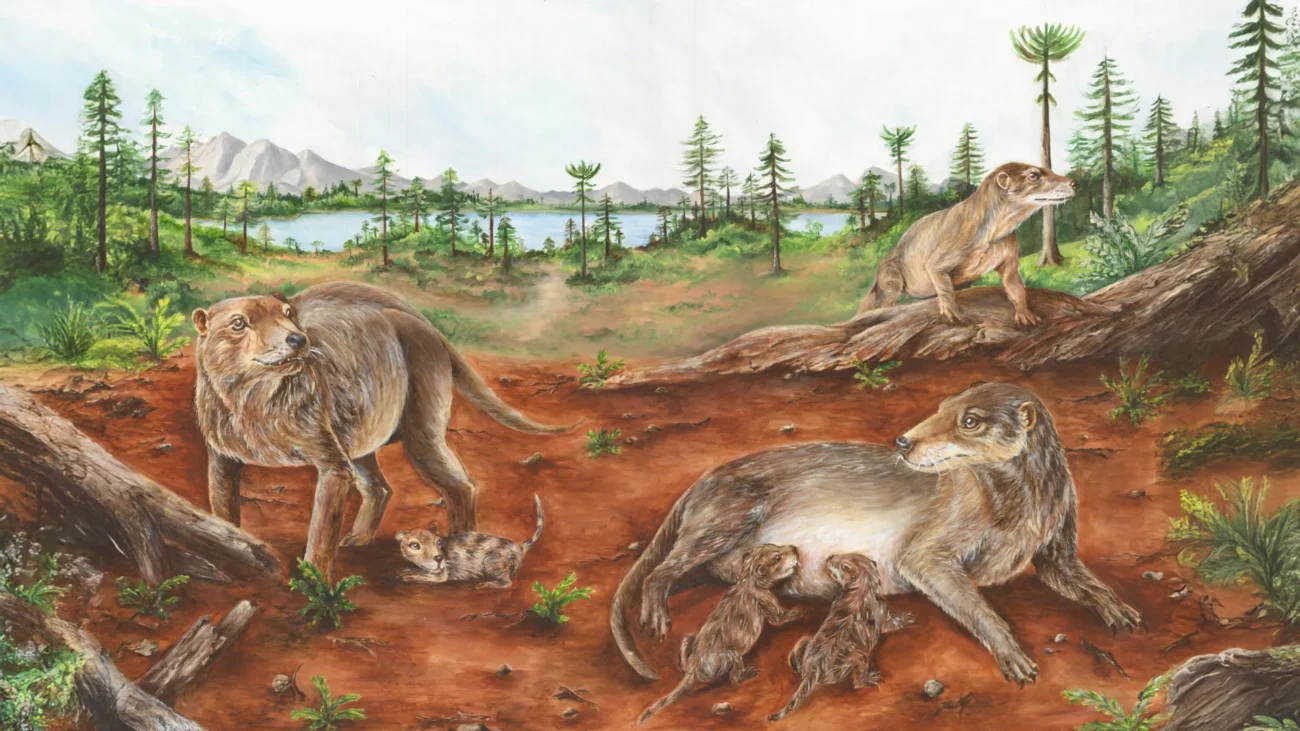
The evolutionary timeline of mammalian reproduction is undergoing a radical reassessment following the publication of a groundbreaking study in the journal Frontiers in Mammal Science. According to international researchers analyzing fossil records from Argentina, at least one ancient mammalian ancestor—the cynodont Chiniquodon theotonicus—gave birth to live young approximately 236 million years ago. This monumental discovery pushes back the origin of viviparity, or live birth, within the mammalian lineage by an estimated 95 to 90 million years.
For decades, paleontologists operated under the consensus that early precursors to mammals relied heavily on egg-laying, mirroring the reproductive strategies of modern reptiles and birds. However, by uncovering microscopic growth markers within fossilized bone structures, a team of researchers from the National Scientific and Technical Research Council (CONICET) in Argentina and the University of Buenos Aires has upended conventional wisdom. The findings suggest that the physiological mechanisms associated with modern mammal reproduction were already emerging during the Triassic period, forcing scientists to reconsider the evolutionary pressures that shaped early mammalian traits.
Unlocking a Paleontological Mystery
The investigation into the reproductive biology of Chiniquodon theotonicus began during an advanced postgraduate paleontology course in Argentina. Researchers were examining the microscopic bone structure of a fully grown C. theotonicus specimen unearthed in the fossil-rich terrains of northwestern Argentina. Upon closer inspection, they identified a distinct, unusual growth mark embedded deep within the bone matrix.
Drawing comparisons with histological studies of living vertebrates, the team identified the feature as a neonatal line. In contemporary mammals, reptiles, and birds, neonatal lines form in bones and teeth as a direct physiological response to the abrupt and dramatic acceleration of growth that occurs immediately following birth or hatching.
To confirm whether this interpretation held weight, the research team devised a novel analytical framework. They calculated the estimated body mass of the individual both at birth—using the dimensional cues provided by the neonatal line—and at the time of death, which was reflected in the fossil’s outer bone dimensions. Their calculations revealed that the animal weighed roughly 1.7 kilograms at birth and grew to approximately 12 kilograms by the time it reached maturity.
This placed the neonate-adult body mass ratio at an impressive 14 percent. When the researchers compared these metrics against a comprehensive dataset encompassing thousands of modern mammals, non-avian reptiles, and birds, the results were unequivocal. The birth pattern of Chiniquodon theotonicus aligned closely with modern placental mammals, while remaining fundamentally distinct from the reproductive traits of extant reptiles and avian species.
Comparative Data and Reproductive Ratios
The statistical disparity between the reproductive output of C. theotonicus and contemporary non-mammalian amniotes provided the cornerstone of the study’s conclusions. In the animal kingdom, the ratio of a newborn’s weight to an adult’s weight serves as a vital indicator of reproductive strategy and maternal investment.
Modern reptiles, such as snakes, turtles, and crocodilians with adult body masses ranging between 8 kilograms and 14.5 kilograms, typically produce exceptionally small hatchlings weighing merely 9 to 53 grams. Consequently, their neonate-to-adult body mass ratios hover between a diminutive 0.1 percent and 0.6 percent.
Birds exhibit a similarly conservative mass distribution for their offspring. Avian species such as pelicans, cranes, and vultures with adult body masses between 8 kilograms and 21.5 kilograms produce hatchlings ranging from 110 grams to 357 grams. This yields neonate-to-adult mass ratios spanning approximately 1.3 percent to 4.5 percent.
In stark contrast, modern placental mammals of equivalent adult body mass—weighing between 8 kilograms and 15 kilograms—routinely invest heavily in fewer, larger offspring. These mammals give birth to young weighing anywhere from 35.5 grams to nearly 1.87 kilograms, with neonate-adult body mass ratios reaching as high as 18.77 percent. A prime contemporary parallel is the bay duiker antelope, which produces offspring comparable in relative mass to the calculated neonatal weight of C. theotonicus.
By deliberately excluding non-placental mammals—such as monotremes that lay eggs and marsupials that rely on pouch gestation and yield underdeveloped young—the researchers demonstrated that C. theotonicus grouped securely with extant placental mammals. This unexpected alignment signaled a profound departure from traditional evolutionary timelines.
Environmental Pressures of the Triassic Period
To understand why viviparity might have evolved so early in the mammalian lineage, researchers examined the ecological context of the Triassic period, which spanned from approximately 252 million to 201 million years ago. This geological epoch followed the Permian-Triassic extinction event, the most devastating mass extinction in Earth’s history, which wiped out roughly 70 percent of terrestrial vertebrate species.
As ecosystems slowly recovered and restructured, cynodonts emerged as successful, highly adaptable competitors. However, the Triassic environment presented severe biological challenges, characterized by heightened competition for limited resources, intense predatory pressures, and a global trend toward severe aridity and extreme seasonality.
According to senior study author Adriana Mancuso, a CONICET researcher specializing in terrestrial ecosystem evolution, these harsh environmental factors likely favored the development of internal gestation. In arid and competitive landscapes, embryos developing inside the mother’s body receive constant thermal regulation, moisture, and protection from predators, offering a distinct survival advantage over eggs exposed to environmental hazards in nests.
This hypothesis suggests that viviparity was not merely a late-stage biological luxury, but rather an adaptive response to ecological stress that helped early mammalian ancestors navigate a volatile world.
Expert Perspectives and Methodological Breakthroughs
The study’s lead author, Dr. Leandro Gaetano of CONICET, emphasized the methodological hurdles the team had to overcome to reach their conclusions. For generations, determining whether ancient mammalian ancestors laid eggs or gave birth to live young was widely regarded as an inscrutable mystery, largely because soft tissues rarely fossilize, leaving virtually no direct physical record of embryonic development.
"We show for the first time that live birth was present in at least one mammalian ancestor, Chiniquodon theotonicus, which lived approximately 236 million years ago," Dr. Gaetano stated. "This implies that viviparity among early cynodonts originated in the mammalian lineage at least 95 to 90 million years earlier than previously thought."
Co-author María Miceli Baro, a graduate student at the University of Buenos Aires who contributed to the histological analyses, highlighted the rarity of the findings. "In cynodonts, embryonic tissues were never observed before, let alone a neonatal line," Baro noted. Through meticulous examination of the fossil’s microstructures, the team identified a trait traditionally linked to evolutionary success in animals that existed millions of years before true mammals walked the Earth.
Broader Implications for Evolutionary Biology
The revelation that Chiniquodon theotonicus practiced viviparity sends ripples across multiple disciplines within evolutionary biology and paleontology. Historically, textbook models of mammalian evolution posited a gradual, stepwise accumulation of modern traits, with live birth traditionally viewed as a relatively recent adaptation that arrived alongside or after the emergence of true mammals during the Mesozoic era.
By demonstrating that complex reproductive strategies were already active nearly 236 million years ago, the study forces scientists to rethink the sequence in which mammalian characteristics evolved. It raises provocative questions about whether other physiological traits traditionally assigned to later mammalian milestones—such as specialized lactation mechanisms, high metabolic rates, and complex thermoregulation—may also have roots deeper in the cynodont lineage than previously assumed.
Furthermore, paleontologists emphasize that Chiniquodon theotonicus may not represent an evolutionary anomaly. Because the physiological conditions necessary for viviparity are tied to broader metabolic and systemic shifts, the researchers hypothesize that live birth could have been a widespread reproductive strategy among various cynodont groups during the Triassic.
Confirming this hypothesis, however, will require additional fossil discoveries and the application of similar histological techniques to other specimens from the same era. As researchers scour museum collections and field sites for more microscopic evidence, the boundary line separating modern mammals from their ancient, egg-laying forebears continues to blur, painting a much more dynamic picture of early vertebrate evolution.

