


For much of evolutionary history, the dominant reproductive strategy across the animal kingdom was remarkably straightforward: organisms would produce offspring and immediately leave them to fend for themselves, relying entirely on raw environmental survival rather than direct maternal or paternal investment. Yet, over millions of years, complex caregiving behaviors—ranging from avian nest maintenance and mammalian lactation to insect brood-tending—emerged independently across widely separated lineages. A landmark study recently published in the prestigious journal Nature offers a compelling and scientifically revolutionary explanation for how this monumental behavioral shift occurred, pointing to the evolutionary recycling of ancient neural pathways originally dedicated to hunger and feeding.
Researchers investigating the social structure and neurobiology of clonal raider ants have discovered that evolution rarely invents entirely novel brain systems from scratch to facilitate complex social care. Instead, it appears to have subtly hijacked and repurposed ancient chemical signaling networks that once governed purely individual survival needs—specifically, the physiological drives to locate, consume, and process food. By adapting these primordial feeding circuits, nature apparently paved the way for animals to direct their internal resources and behavioral motivations toward the sustenance and protection of their offspring.
Decoding the Neurobiology of Social Care in Simple Organisms
The quest to understand the neurological underpinnings of parenting has long challenged behavioral neuroscientists. While parental care is widespread, proving the exact molecular pathways responsible for its emergence has proved methodically difficult. Traditional laboratory models in neuroscience, such as fruit flies (Drosophila melanogaster) and roundworms (Caenorhabditis elegans), exhibit virtually no parental investment in their progeny. Conversely, mammalian models like mice display rich and intricate caregiving repertoires, and scientists have successfully identified several neuropeptides—small signaling molecules used by neurons to communicate—implicated in these actions. However, the sheer biological complexity of the mammalian brain, which contains roughly 100 million neurons in a mouse and billions in a human, makes mapping precise causal circuits exceptionally challenging.
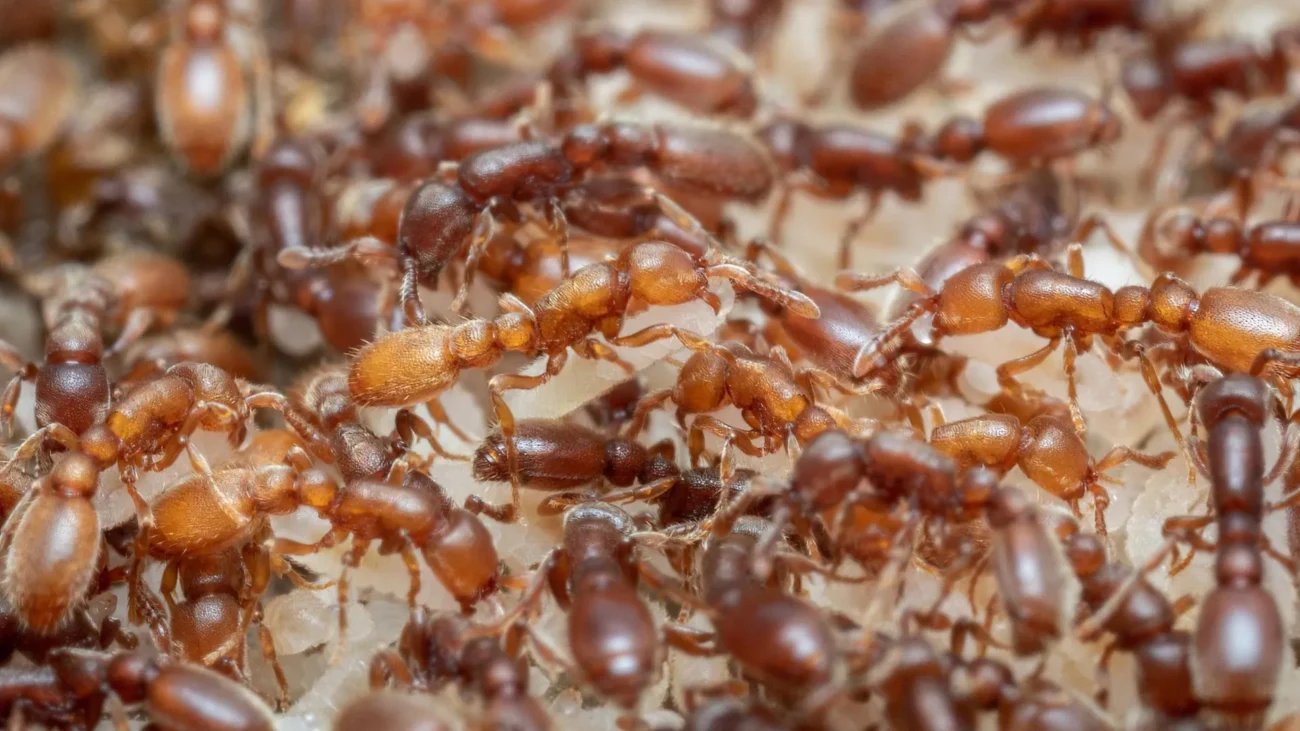
To circumvent this hurdle, a research team led by scientists at The Rockefeller University turned to the clonal raider ant (Cerapachys biroi). The anatomy of an ant brain offers a stark contrast to that of a mammal, comprising a modest 60,000 cells. This simplicity allows researchers to examine underlying neural circuits with microscopic precision and unprecedented experimental speed, all while maintaining a remarkably sophisticated repertoire of social behaviors. Furthermore, ants and mammals share ancient, highly conserved brain signaling systems that govern social organization, making the insect an ideal translational model for studying broader evolutionary mechanisms.
Tracking Caregiving Dynamics One Ant at a Time
To uncover how brain chemistry dictates social roles, the research team engineered an advanced automated behavioral monitoring system. This technology placed individual ants in controlled environments alongside individual larvae, allowing the automated setup to meticulously record hundreds of distinct caregiving interactions over extended periods.
With the behavioral platform established, the scientists focused on identifying and mapping the complete set of neuropeptides produced within the ant brain—a catalog known as the neuropeptidome. Through exhaustive biochemical analysis, the team successfully identified 70 distinct neuropeptides. They then synthesized these chemical messengers in a laboratory setting and systematically tested each molecule to observe whether—and how—it altered the ants’ tendency to nurture developing larvae.
This meticulous tracking coincided with a well-documented biological phenomenon: clonal raider ant colonies operate under a strict, age-dependent division of labor. Young ants typically remain sheltered deep within the safety of the nest, dedicating their time entirely to nursing and tending to the brood. As these insects age and mature, a physiological transition occurs, prompting them to abandon nest-bound duties and venture out into hazardous environments as foragers searching for sustenance. The researchers sought to determine whether this behavioral shift was directly orchestrated by fluctuations in internal brain chemistry.
Two Master Molecules: Balancing Nurture and Foraging
The experimental results revealed that ant caregiving is fundamentally regulated by brain systems historically linked to hunger and energy balance. Specifically, two distinct neuropeptides emerged as master regulators, pushing an ant’s behavior in opposite directions depending on its age, physiological state, and internal metabolic needs.
The first molecule, Neuropeptide F (NPF), actively encouraged ants to engage in larval care. When NPF levels were high, ants showed an increased affinity for feeding, grooming, and protecting the brood. Conversely, the second molecule, Allatostatin A (AstA), drove the exact opposite behavioral response, prompting the insects to abandon the larvae and transition into active foraging roles outside the nest.
A clear chemical dichotomy matched the ants’ natural life cycle. Younger ants naturally exhibited elevated concentrations of NPF and diminished levels of AstA within critical sensory and processing centers of the brain. Older ants displayed the precise inverse chemical profile—low NPF and high AstA—mirroring their structural progression from nest nurses to external food gatherers. When the researchers experimentally manipulated the activity levels of either neuropeptide, the insects rapidly altered their behavior, proving that these molecules were not merely correlated with social roles, but actively dictated whether an ant nurtured young or hunted for food.
From Personal Hunger to Parental Provisioning
To test whether these neuromodulatory systems remained tethered to ancient feeding mechanisms, the research team subjected ants to varying nutritional states, comparing well-fed colonies with groups that had been experimentally deprived of food.
The findings established a direct metabolic bridge between hunger and social care. Starved ants experienced a surge in Neuropeptide F and a drop in Allatostatin A, driving them to behave more intensely like caregivers, even though they lacked adequate energy for themselves. Once these starved ants were provided with food, the internal chemical balance inverted, causing them to immediately divest from larval care and pivot toward external foraging.
"We learned that parental behaviors build on the neural circuitry for feeding, and that makes a lot of sense," notes Daniel Kronauer, head of the Laboratory of Social Evolution and Behavior at Rockefeller University. "Parental behavior is a lot about feeding—not just yourself, but your offspring."
This discovery supports the overarching evolutionary theory that nature did not invent complex parental care out of a vacuum. Instead, it co-opted pre-existing physiological mechanisms designed to detect resource scarcity and drive food consumption. By expanding these survival pathways, evolution successfully motivated animals to extend their provisioning instincts to their offspring.
Implications for Mammalian Evolution and Shared Behavioral Blueprints
The discovery of shared chemical regulators across such evolutionarily distant species points to profound implications for the broader scientific community. Mammals utilize analogous neuropeptide systems—including molecules functionally related to Neuropeptide F—during maternal and paternal caregiving behaviors. By mapping the specific neural pathways influenced by NPF and AstA in ants, researchers hope to construct a universal blueprint for how complex social behaviors evolve.
"It amazes me that similar parenting behaviors have evolved so many times in so many distinct animal lineages," observes Dr. Kay, a key contributor to the research. "Our paper suggests that the evolutionary routes to these sorts of behaviors are far more constrained than we may have naively imagined. That’s very exciting, because it may eventually lead to a blueprint of how these complex social behaviors evolve."
This conservation of biological machinery suggests that nature relies on a relatively narrow toolkit of ancient molecular pathways to construct diverse social architectures, regardless of whether the organism possesses 60,000 neurons or 100 billion.
Beyond Parenting: Shedding Light on Normal Brain Aging
While the primary focus of the research centered on the origins of caregiving, the unique life history of clonal raider ants offers an exceptional secondary benefit: a natural model for studying healthy brain aging.
Contemporary neurological research is heavily weighted toward investigating late-stage neurodegenerative disorders such as Alzheimer’s and Parkinson’s disease. Consequently, science possesses a significant knowledge gap regarding the subtle, progressive neurological changes that occur across a normal, healthy lifespan in humans and other animals. Because the predictable behavioral transition from nurse to forager is an intrinsic component of ant colony organization, these insects provide an accessible living laboratory to observe how brain chemistry gradually alters behavioral proclivities over time.
Kronauer emphasizes the broader significance of utilizing social insects to understand lifelong neural dynamics. "There’s a lot of research and funding invested in studying late-stage neurodegenerative diseases, but we actually know very little about how the brain changes throughout the normal healthspan of an individual," he states. "In ant colonies, these dynamics are central to the organization of the society. Our discovery provides a striking demonstration that neuromodulators can produce age-dependent changes in behavioral proclivities in ants, and I suspect that that’s the case in other animals as well, including in humans."
Future Directions and Comprehensive Analytical Framework
As the scientific community digests these findings, the Rockefeller research team is already mapping out the next phases of investigation. Future studies will aim to isolate the exact downstream neural circuits activated by Neuropeptide F and Allatostatin A, tracing how localized chemical signals translate into complex, whole-organism behaviors.
By continuing to bridge the gap between simple invertebrate models and complex mammalian systems, this line of inquiry promises to decode not only how maternal and paternal instincts first blossomed millions of years ago, but also how neurochemical systems maintain behavioral flexibility throughout life. Ultimately, the clonal raider ant has proven that answers to some of humanity’s most complex evolutionary and neurological questions may lie hidden within the microscopic workings of an insect brain.

