


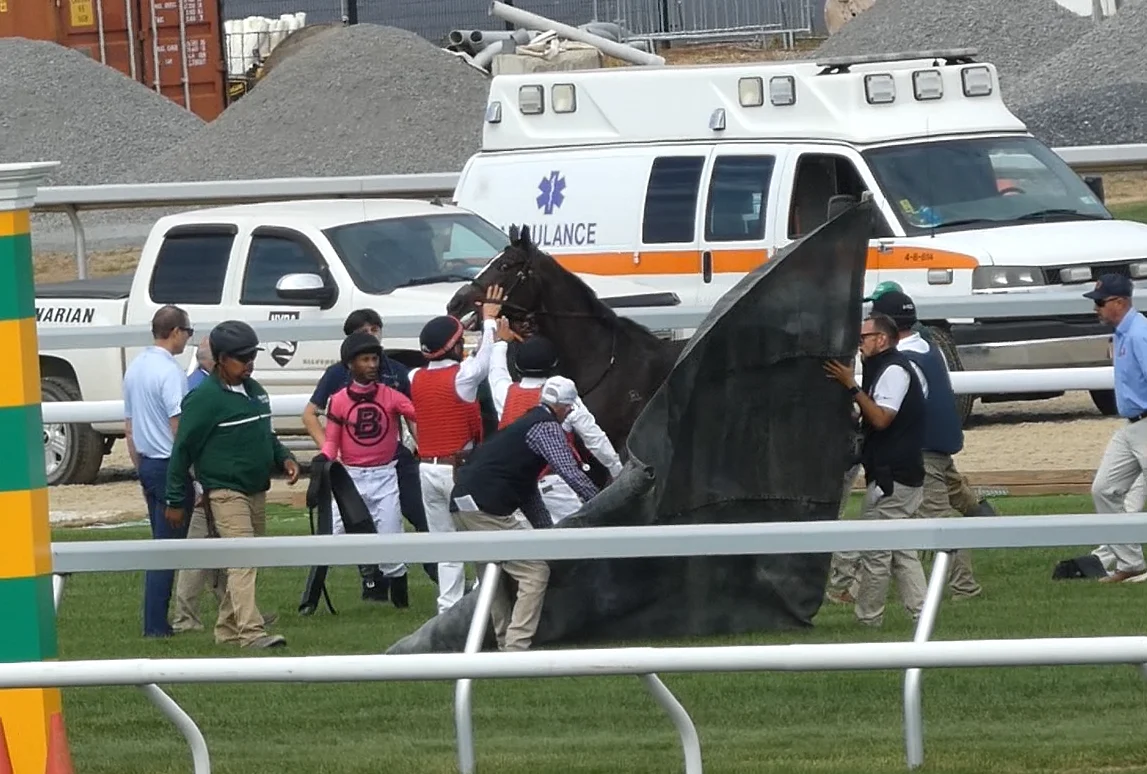
The grand reopening of New York’s historic Belmont Park, fueled by a massive $550 million modernization project, was overshadowed by tragedy on Saturday, September 19, 2026. During a sprint race on the opening weekend of the revamped venue, a standout mare named Heat Missile sustained catastrophic injuries to her left front leg, bringing the celebratory atmosphere to an abrupt and grim halt. The incident, captured on video by animal welfare advocates from People for the Ethical Treatment of Animals (PETA), has reignited fierce debates regarding equine safety, the ethics of commercial horse racing, and the heavy financial involvement of taxpayers in funding racetrack infrastructure.
Compounding the weekend’s bleak narrative, a simultaneous disaster unfolded hundreds of miles away at Churchill Downs in Kentucky. A multi-horse crash resulted in a fatal injury for a two-year-old colt named Lutkenhaus and sent multiple jockeys to the hospital. These back-to-back incidents at two of America’s most iconic Triple Crown venues have triggered intense scrutiny from oversight bodies, animal rights organizations, and the public, casting a long shadow over the multi-billion-dollar racing industry.
Catastrophe at the New Belmont Park
The newly renovated Belmont Park was designed to usher in a modern era for New York horse racing. Backed significantly by a $455 million taxpayer-funded loan authorized by New York State, the New York Racing Association (NYRA) invested a total of $550 million into upgrading the facility’s grandstand, track surfaces, and surrounding amenities. The goal was to reclaim Belmont’s status as a premier global destination for the sport.
However, the festivities of the opening weekend were marred during a preliminary sprint race on Saturday afternoon. Heat Missile, who had entered the race as the heavy betting favorite, suffered a catastrophic breakdown. Veterinary assessments later confirmed she sustained fractured sesamoid bones in her left front leg alongside a severe dislocation of the fetlock joint.
Eyewitness accounts and video documentation reveal the immediate aftermath: track personnel rushed to the injured animal, cradling her mangled limb while a veterinarian prepared a lethal dose of euthanasia medication. As Heat Missile reacted with wide-eyed panic, workers swiftly erected privacy screens around the stricken horse to obstruct the view of spectators in the grandstand. Her eyes were covered before the final injection was administered. Moments later, the race favorite was dead.
Remarkably, once Heat Missile’s remains were cleared from the racing surface by track maintenance crews, the afternoon’s schedule proceeded without interruption. Wagering, spectator festivities, and subsequent races continued as though the fatal breakdown had not occurred.
The Carnage at Churchill Downs
While racing officials at Belmont managed the aftermath of Heat Missile’s death, a far more chaotic scene unfolded at Churchill Downs in Louisville, Kentucky. Two-year-old colt Lutkenhaus suffered a fatal, catastrophic injury to his left front leg during a race, causing him to collapse directly onto the dirt track.
The sudden fall triggered a terrifying chain reaction. Five other two-year-old horses—identified as Ritornello, Midnight Rumble, Shacklebolt, Steve Wood, and Industrious—tripped and fell over one another in a massive multi-horse pileup. Observers on the scene and analysts reviewing subsequent footage described the track as resembling a war zone.
Lutkenhaus was euthanized on the track due to the severity of his injuries. Two other participants, Industrious and Shacklebolt, were severely injured and required transport via equine ambulance for emergency medical evaluation. The incident also exacted a heavy toll on human participants, resulting in three jockeys sustaining injuries severe enough to require hospitalization. Footage of the chaotic pileup and its immediate aftermath quickly circulated on social media platform X, amplifying public outrage and drawing immediate demands for accountability from racing regulators.
Financial Footing and Public Accountability
The timing of the Belmont Park breakdown has brought intense political and financial scrutiny to the relationship between NYRA and New York State. The $455 million public loan that served as the cornerstone of the Belmont renovation has long faced criticism from fiscal watchdogs and community advocates who question the propriety of subsidizing private entertainment ventures with public funds.
Following the death of Heat Missile, PETA and various civic groups have formally demanded transparency regarding the exact terms of the repayment plan agreed upon by NYRA and the state. Critics argue that if taxpayers are shouldering the financial risk for modernizing facilities, they should not simultaneously be subsidizing an enterprise where animals suffer fatal injuries on opening days intended to showcase state-of-the-art safety standards.
Furthermore, the utilization of privacy screens—frequently deployed at major tracks to shield the dying moments of horses from paying patrons—has become a central point of contention. Animal advocates argue that these screens serve as a mechanism of deliberate obfuscation, designed to maintain betting handles and ticket sales by hiding the lethal human cost of the sport from public view.
Industry Ethics and Animal Welfare Concerns
The weekend tragedies have forced a broader conversation regarding the inherent nature of horse racing and the welfare of thoroughbreds. Ethologists and animal behaviorists note that horses possess sophisticated emotional ranges, intellectual capabilities, and social needs that are frequently compromised by the traditional methods of the racing industry.
In commercial training environments, social herd animals are often subjected to prolonged periods of isolation and confinement in stalls. While horses possess a natural propensity for running, animal welfare organizations emphasize that they do not possess an inherent desire to "race" under duress, nor can they provide consent to participate in high-speed competition that frequently results in exercise-induced pulmonary hemorrhage (bleeding lungs), catastrophic joint failures, and sudden death.
The physical demands placed on juvenile horses—such as the two-year-olds injured at Churchill Downs—remain a primary concern for veterinary experts. The skeletal systems of two-year-old horses are still developing, making them exceptionally vulnerable to the high-impact stresses of competitive racing on modern track surfaces.
Calls for Comprehensive Reform
In the wake of the September 19 incidents, pressure is mounting on industry leaders to adopt aggressive, mandatory safety protocols. PETA and allied organizations are pushing for the nationwide implementation of standardized track maintenance, independent veterinary oversight panels, restrictions on the racing of young horses, and stricter limits on medication use that can mask pre-existing injuries.
The events at Belmont Park and Churchill Downs serve as a stark reminder of the persistent dangers embedded within commercial horse racing. As regulatory bodies in New York and Kentucky review the catastrophic events of opening weekend, the future of the sport increasingly hinges on its ability—or willingness—to prioritize animal welfare over spectator entertainment and financial profit. For many critics and former fans, the message of the weekend is unambiguous: until fundamental reforms eliminate track fatalities, participation in, wagering on, and attendance at horse races remain ethically indefensible.

