


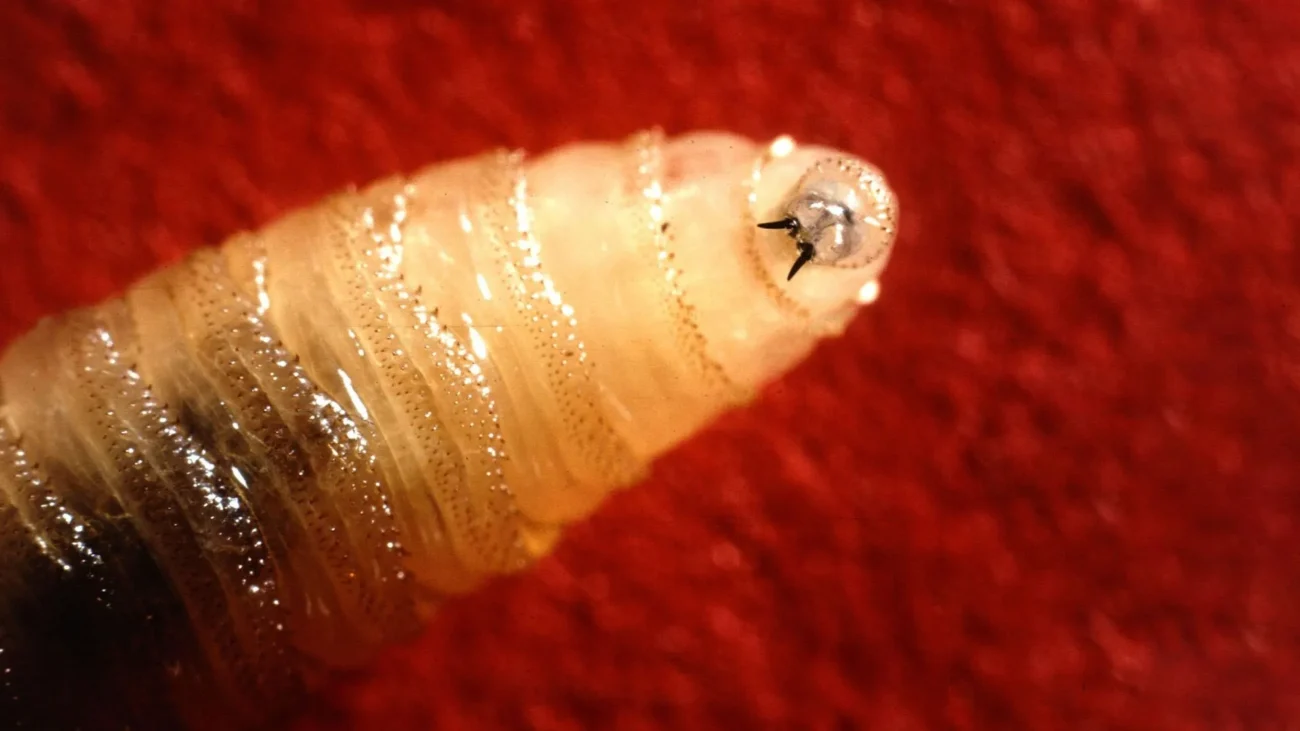
The New World screwworm, a devastating parasitic insect whose larvae consume the living tissue of warm-blooded animals, is quietly advancing northward once again, prompting an urgent technological and biological response from public health officials and academic researchers. Recent detections of the flesh-eating pest in Texas and New Mexico have ignited deep concerns across agricultural, veterinary, and public health sectors. While livestock producers bore the brunt of historical infestations in the mid-twentieth century, the modern resurgence poses a multifaceted threat to domestic livestock, fragile wildlife populations, household pets, and, in rare instances, human beings.
In response to this rapidly escalating peril, specialists at the University of California San Diego (UC San Diego), in close collaboration with the County of San Diego Health and Human Services Agency (HHSA) Public Health Services, have engineered an innovative tracking and predictive dashboard. This sophisticated tool is specifically designed to monitor the parasitic fly and its destructive larvae, synthesizing diverse data streams to generate regional risk profiles. By bridging the critical gap between traditional, slow-moving epidemiological reporting and real-world environmental threats, this cutting-edge system aims to provide authorities with the foresight necessary to stay ahead of the biological curve.
Historical Context and the Threat of the New World Screwworm
To understand the gravity of the current situation, one must look back to the agricultural crisis of the 1950s. During that era, New World screwworm infestations inflicted catastrophic financial and operational losses upon livestock producers throughout the United States. In the American Southwest alone, the pest was responsible for an estimated $50 million to $100 million in annual damages—a staggering sum at the time. The crisis ultimately catalyzed one of the most successful biological control campaigns in agricultural history.
Through a coordinated national effort, authorities deployed the sterile insect technique, releasing millions of radiation-sterilized male flies into the wild. Because wild females mated only once, the introduction of sterile males caused reproduction rates to plummet, eventually eradicating the pest from the United States and pushing its active range south toward Panama. For decades, the barrier maintained by agricultural authorities kept the screwworm at bay, sparing generations of farmers and ranchers from its destructive impact.
However, the biological reality of the pest has not changed, and its return highlights the persistent vulnerability of modern ecosystems and agricultural supply chains. Unlike standard blowfly maggots, which feed exclusively on dead, necrotic, or decomposing organic matter, New World screwworm larvae target healthy, living tissue. Adult female flies are attracted to open wounds, abrasions, or natural body openings, where they deposit their eggs.
Once hatched, the microscopic larvae burrow deep into the flesh, feeding continuously and expanding the wound. This dynamic creates deep tissue pockets that are highly susceptible to secondary bacterial infections. Without immediate and aggressive medical or veterinary intervention, severe infestations can rapidly debilitate or prove fatal to livestock, native wildlife, and domestic pets.
While human infections remain rare, they do occur. The parasite does not transmit directly from person to person like an airborne virus or respiratory pathogen; rather, humans are infected when flies deposit eggs into exposed cuts or mucous membranes. If left unchecked, the larvae can cause extensive localized tissue destruction, requiring prompt manual extraction and medical management.
A Novel Technological Defense: The Predictive Risk Dashboard
Recognizing the accelerated northern migration of the screwworm—which surpassed the expectations of seasoned epidemiologists following initial border-region detections in 2023—local public health leaders turned to academic innovators for analytical support. The result is a specialized geospatial and predictive dashboard developed under the umbrella of Resilient Shield, a CDC-funded center housed at UC San Diego.
"Our County public health partners alerted us to the need for better situational awareness of New World screwworm," explained Dr. Eliah Aronoff-Spencer, professor of medicine at UC San Diego School of Medicine and an affiliate of the UC San Diego Design Lab and Qualcomm Institute. "We built a dashboard to generate regional risk profiles. This is just one example of how we are responding to County needs with a focus on real-world issues. It’s a model that has brought us great success, like the Tijuana River Crisis Environmental Dashboard."
The newly developed tracking tool operates by aggregating multiple layers of complex information. It integrates confirmed entomological detections, precise environmental and meteorological conditions that favor the biological lifecycle of the fly, and, uniquely, real-time media reports.
Dr. Seema Shah, medical director of the Epidemiology and Immunization Services Branch for San Diego County’s Public Health Services Department, emphasized that incorporating media monitoring was a deliberate and strategic design innovation. Traditional public health reporting mechanisms are notoriously bureaucratic and slow, often requiring days or weeks for laboratory confirmations to clear administrative hurdles. By sweeping news articles and digital dispatches for early indicators, the dashboard allows epidemiologists to flag potential incursions before official surveillance networks formally register them.
"Traditional reporting mechanisms for public health are often delayed," Dr. Shah noted. "Lab confirmation can take days or weeks. By incorporating media reports, we can identify potential threats sooner and stay one step ahead."
Complementing this perspective, Dr. Mark Beatty, assistant medical director for the County’s Epidemiology and Immunization Services Branch, underscored the tactical value of the predictive metrics. "The tool gives you a sense of where you might expect to see cases next," Dr. Beatty said. "That’s helpful in determining how we should be preparing. Is the threat imminent, or do we have six months? We’re in a very concerning phase right now, and the tool backs that up."
Currently, access to the dashboard is restricted strictly to public health officials, municipal partners, and authorized researchers directly involved in the project. However, the development team has expressed intentions to release a streamlined, publicly accessible version in the future to empower private veterinarians, livestock owners, and citizens with localized risk awareness.
Reviving the Sterile Insect Technique and Modern Eradication Strategies
As the screwworm re-establishes a foothold in regions it historically inhabited, federal and state agricultural bodies are mobilizing a multi-layered counter-offensive that mirrors the historic successes of the twentieth century. The U.S. Department of Agriculture (USDA) is currently spearheading a modern eradication campaign. This comprehensive strategy relies on a combination of targeted sterile insect releases, the strategic application of approved pesticides, and strict quarantine protocols designed to halt the interstate and cross-border movement of potentially infected animals.
Simultaneously, regulatory authorities are reviewing advanced biological tools. Officials are currently seeking approval from the U.S. Environmental Protection Agency (EPA) to deploy a genetically modified, all-male strain of the fly that has shown promising results in field trials. At the academic level, researchers at UC San Diego are concurrently engineering next-generation genetic technologies designed to enhance future containment and eradication frameworks.
At the state level, regional veterinary networks are being mobilized to ensure front-line medical professionals can identify and report suspect cases before the parasite can establish deep regional reservoirs.
"We are working closely with the California Department of Food and Agriculture to connect local veterinarians with screwworm resources for surveillance in our region," said Dr. Emily Trumbull, a veterinarian and lead for the Epidemiology Unit’s One Health Program. "The flies can affect any warm-blooded animal, so working together with veterinarians serving livestock, pets and wildlife is critical for identifying suspect cases and preventing cases in people. The dashboard takes into account environmental factors that can help us understand how the risk to our local region is changing before the fly arrives. That’s why the dashboard is valuable."
Collaborative Public Health Models Through Insight Net
The creation of the screwworm dashboard is not an isolated academic exercise; it represents the operational embodiment of Resilient Shield, a core facility operating within the U.S. Centers for Disease Control and Prevention’s (CDC) newly established Insight Net network. Insight Net connects academic research institutions with regional public health departments across the United States to model disease outbreaks, forecast biological threats, and rapidly build bespoke technological solutions.
The foundational philosophy of Insight Net diverges sharply from traditional academic research models. Rather than universities attempting to predict what tools public health agencies might find useful, municipal and state health departments submit immediate, real-world operational challenges directly to research centers. Engineers and mathematicians then construct modular, scalable software and analytical tools tailored to those exact specifications.
This collaborative pipeline has already proven its efficacy. The very first project requested under this framework involved influenza tracking, co-led by Resilient Shield co-principal investigator Ruy Ribeiro at Los Alamos National Laboratory. For the screwworm initiative, Dr. Aronoff-Spencer partnered closely with mathematical epidemiologist Dr. Natasha Martin, professor of medicine and vice chief in the Division of Infectious Diseases and Global Public Health at UC San Diego School of Medicine.
Furthermore, Resilient Shield has engineered a modular resource hub in partnership with major technological entities such as Google and MITRE. This platform aggregates heterogeneous data types—spanning human health metrics, veterinary records, environmental telemetry, weather patterns, and social media listening data. When a new public health crisis arises, researchers can rapidly assemble custom technological applications, whether they require public awareness portals, secure computing infrastructure, advanced epidemiological simulation engines, or artificial intelligence components.
"Our central innovation is the true convergence of partner priorities with scalable engineering," Dr. Aronoff-Spencer concluded. "We do not build in a vacuum. Our infrastructure is built directly on the priorities dictated by our partners. In addition, because our platform is built on an open, modular architecture, every solution we develop strengthens the system and makes it more adaptable for the next public health challenge."
As the New World screwworm continues its northward press into the American landscape, the integration of high-performance epidemiological modeling, open-architecture technological design, and historic biological control methods provides a vital shield for the nation’s agricultural economy and public health infrastructure.

