


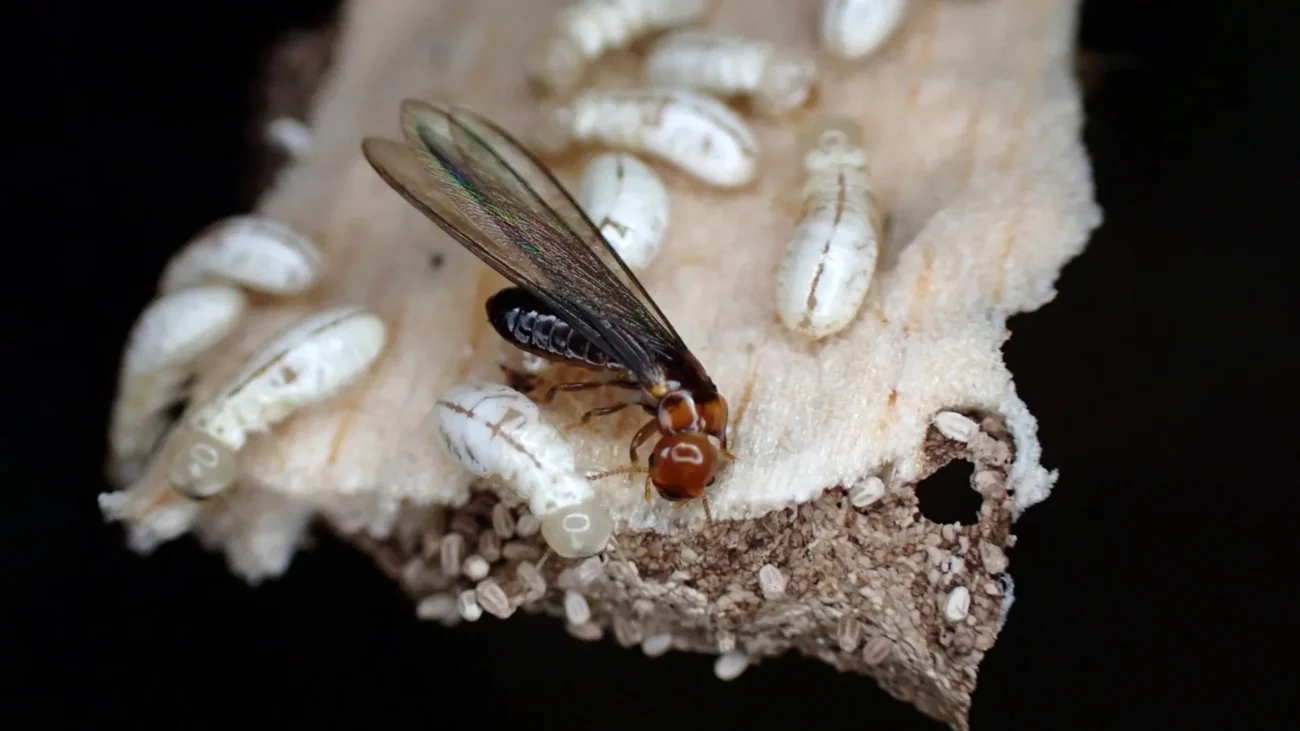
For decades, property owners and pest management professionals have waged a difficult war against one of nature’s most effective hiders: the western drywood termite. Unlike their subterranean counterparts, which maintain permanent connections to the soil through complex mud tubes, drywood termites live entirely within the structural timber they consume. Beams, floor joists, furniture, and framing serve simultaneously as their home, food source, and fortress. Because they leave few external signs until structural damage becomes extensive, combating them has historically required drastic, whole-building solutions such as structural fumigation.
However, recent scientific breakthroughs emerging from the University of California, Riverside (UCR) Department of Entomology are challenging conventional paradigms in pest management. By systematically investigating the biological vulnerabilities, behavioral quirks, and microbial signatures of western drywood termites, a team of researchers is paving the way for targeted, low-impact, and potentially localized alternatives to traditional fumigation.
The Core Discovery: Weaponizing the Termite Molting Process
At the center of the UCR research team’s recent findings is bistrifluron, an insect growth regulator (IGR) that targets a fundamental biological necessity for all insects: the molt. Published in the Journal of Economic Entomology, a pivotal 2025 study led by doctoral student Nicholas Poulos and senior author Professor Dong-Hwan Choe revealed that bistrifluron can achieve near-total mortality rates among western drywood termites.
Unlike conventional fast-acting neurotoxins that kill insects within hours of contact, chitin synthesis inhibitors like bistrifluron operate on a delayed schedule. Mammals possess internal skeletal systems, but insects rely on a rigid external skeleton, or exoskeleton, which requires chitin—a durable natural polymer shared by fungal cell walls, fish scales, and the beaks of cephalopods. For a growing drywood termite, this protective armor cannot stretch indefinitely. Throughout their lifecycles, these insects must molt approximately seven times, shedding their old exoskeleton to accommodate a larger body.
Bistrifluron disrupts this unavoidable biological cycle. When exposed to the compound, termites cannot manufacture adequate chitin for their upcoming molt.
"Once the termites reach a certain stage, they have to molt. They cannot avoid that," Professor Choe explained. "With a lethal dose of this chemical, they’ll try to shed their old exoskeleton but won’t have a new one ready to protect them."
In controlled laboratory evaluations, the efficacy of the chemical proved remarkably high. When termites were given a direct choice between treated and untreated wood, bistrifluron produced a mortality rate of 95.7 percent. When continuously exposed to treated wood without an alternative, mortality reached approximately 99 percent. Furthermore, the chemical offers an environmental advantage over traditional compounds. Because it specifically targets chitin synthesis—a biological mechanism absent in humans and other mammals—it minimizes risks to human health.
A Timeline of Innovation and Discovery
The recent breakthroughs at UCR did not happen overnight; they represent the culmination of years of targeted research into termite biology, chemical ecology, and microbial diagnostics.
- May 2024: UCR researchers published findings demonstrating that pinene, a fragrant organic compound naturally emitted by trees, could be utilized to lure western drywood termites away from secure areas and toward localized insecticide deposits, significantly boosting mortality rates from 70 percent to over 95 percent.
- April to October 2025: A University of California patent application was filed and subsequently published, detailing the integration of alpha and beta pinene into localized insecticide injections. The innovation proposed that scent-based attraction could enable pest control technicians to space treatment holes further apart, reducing labor costs and chemical volumes.
- 2025 (Journal of Economic Entomology): The publication of the landmark study detailing the efficacy of bistrifluron and other chitin synthesis inhibitors against western drywood termites.
- 2026: UCR researchers released detailed imaging and video documentation capturing proctodeal trophallaxis—a specialized social feeding behavior wherein termites exchange hindgut fluids to share essential nutrients and wood-digesting microbes. This behavioral insight provided a mechanical explanation for how slow-acting insecticides propagate through concealed colonies.
- Late 2026: Subsequent research focused on bacterial DNA degradation in termite fecal pellets, establishing a foundation for biological clocks that can distinguish between active infestations and old, abandoned damage.
The Power of Social Proximity and Trophallaxis
One of the most consequential discoveries made by the UCR research team involves the social transmission of the chemical. Termites are eusocial insects that rely heavily on mutual grooming, feeding, and the exchange of internal fluids to sustain the colony.
When researchers exposed a small percentage of a termite group to bistrifluron and introduced them back to untreated nestmates, the results were striking. Utilizing colored food tracers to monitor material transfer, the team observed that substances passed from exposed individuals to unexposed nestmates within 24 to 48 hours. Most impressively, colonies in which only 5 percent of the population initially encountered bistrifluron experienced 100 percent mortality by day 90. Groups with 50 percent initial exposure exhibited similar ultimate mortality patterns.
This phenomenon relies on a unique physiological process known as proctodeal trophallaxis, which researchers highlighted through high-resolution imaging and video analysis. During this exchange, one termite receives fluid directly from another’s hindgut. While this mechanism normally ensures that vital gut microbes and nutrients circulate through the colony to aid in cellulose digestion, it effectively becomes an Achilles’ heel when slow-acting chemical agents are introduced.
Because bistrifluron does not kill immediately, contaminated individuals have ample time to return to the heart of the colony, interact with nestmates, and propagate a lethal dose to individuals that never directly encountered the treated timber.
Broader Industry Implications and Economic Analysis
The implications of these findings could reshape the structural pest control industry, particularly in regions like California, where native western drywood termites inflict hundreds of millions of dollars in structural damage and remediation costs annually.
Currently, structural fumigation remains the industry standard for widespread, severe drywood termite infestations. While effective at blanketing an entire building, fumigation carries notable drawbacks. It requires residents to temporarily vacate their properties, demands extensive preparation including the removal or sealing of food and medications, and—critically—leaves behind no residual protection. Once a fumigated building is cleared, newly arrived winged swarmers can immediately begin a fresh infestation.
In contrast, localized spot treatments powered by chitin synthesis inhibitors like bistrifluron offer a persistent defense mechanism.
"Low-impact strategies like this one will become an attractive option in many cases. Furthermore, the chemical may stay active in the wood for some time, potentially providing protection from future infestations," noted Choe.
However, moving from laboratory success to commercial application requires overcoming several practical obstacles. In their controlled experiments, researchers dissolved bistrifluron in acetone, allowing the solvent to evaporate before introducing insects. While effective for laboratory protocols, acetone is highly flammable and possesses a pungent odor that renders it impractical for standard residential applications. Formulating a safe, stable, and easily deployable carrier remains a primary objective for the UCR team.
Solving the Diagnostic Dilemma: Termite Droppings as Biological Clocks
Complementing their work on chemical elimination, the UCR researchers have tackled another persistent challenge in pest management: accurately determining whether an infestation is active.
Drywood termites frequently eject tiny, hard, hexagonal fecal pellets from their galleries. For decades, these piles served as a primary visual indicator for homeowners. However, old pellets can persist inside wall voids and framing long after a colony has died or relocated, leading to unnecessary and costly treatments.
To resolve this ambiguity, Poulos and his colleagues analyzed bacterial DNA within fecal pellets across varying timeframes—comparing fresh samples against those aged for three months, six months, and one year. Their findings revealed that bacterial DNA levels dropped dramatically as pellets aged, declining by up to 190-fold over a 12-month period in hardwood-fed samples. Furthermore, specific bacterial families present in fresh pellets consistently disappeared as the biological material degraded.
These discoveries open the door to developing rapid diagnostic tools for pest control professionals. By testing the microbial profile of frass samples found on a property, technicians could objectively verify whether an infestation is current, ensuring treatments are deployed only when actively warranted.
Global Spread and Future Outlook
As international trade and the transport of lumber, furniture, and wooden goods continue to expand, the geographical footprint of the western drywood termite is no longer confined to the southwestern United States and northwestern Mexico. Established populations have already been documented across the globe, including in Hawaii, Florida, parts of Canada, Asia, and Australia. Climate shifts further threaten to make new regions habitable for the species, escalating the urgency for innovative management strategies.
By synthesizing insights from chemical ecology, insect physiology, social behavior, and molecular microbiology, the University of California, Riverside research team is outlining a comprehensive blueprint for the future of pest control. While laboratory methods require further commercial development before reaching the residential market, the integration of targeted growth regulators, scent-based attractants, and microbial diagnostics promises a shift away from disruptive whole-building fumigation toward precision-engineered, biology-driven defense systems.

