


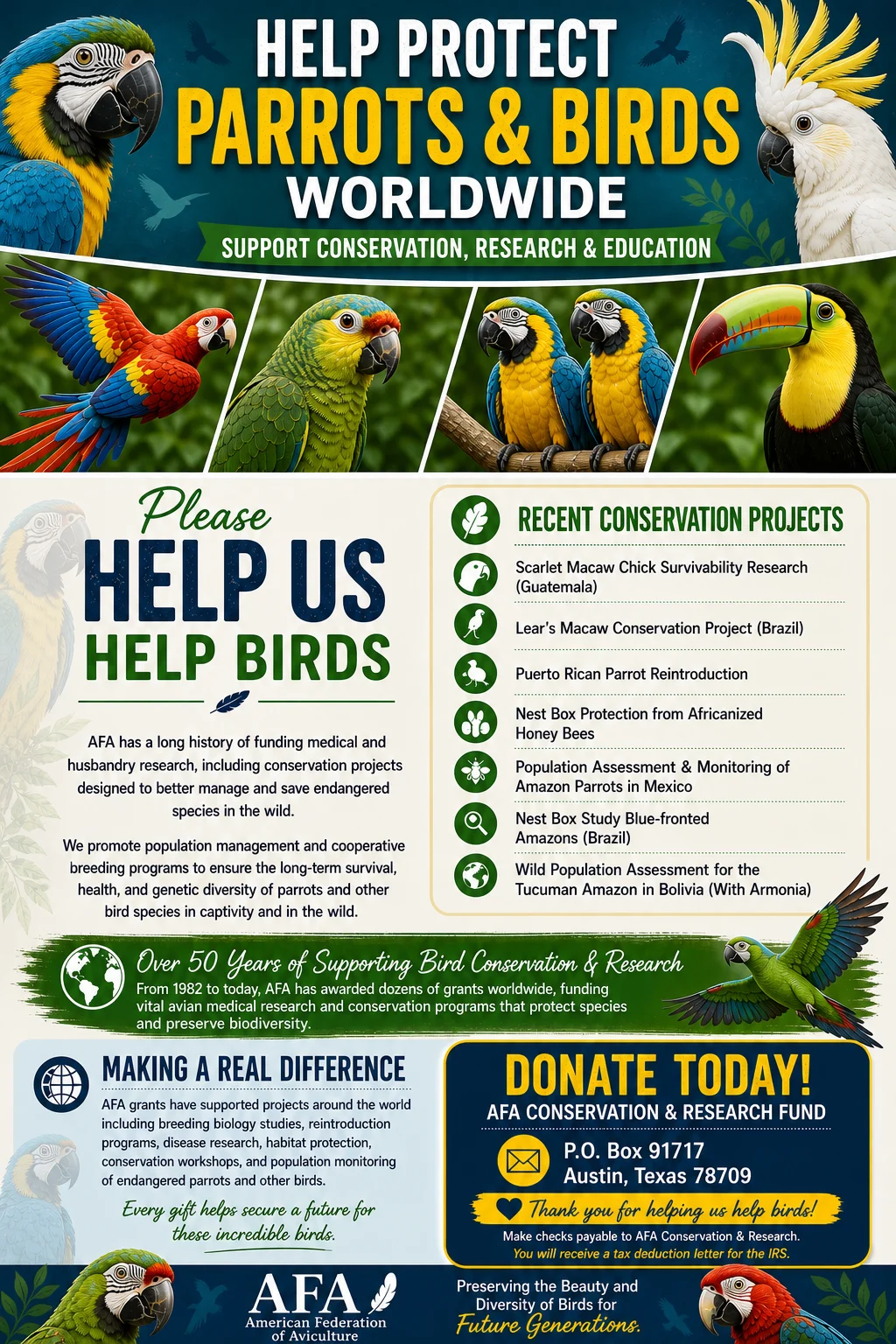
The American Federation of Aviculture (AFA), in close collaboration with industry leaders such as Harrison’s Bird Foods and major conservation NGOs, has announced an expansion of its multi-year international avian protection and research initiatives. The newly reinforced program combines targeted field grants for wild parrot habitats with rigorous oversight of domestic captive breeding networks and international trade policies. Designed to bridge the gap between private aviculture and field-level conservation biology, the initiative aims to safeguard endangered psittacine populations across Latin America while ensuring compliance with complex federal frameworks, including the Wild Bird Conservation Act (WBCA) and the Endangered Species Act (ESA).
Main Facts and Current Conservation Initiatives
At the core of the AFA’s latest conservation cycle is a series of strategic funding partnerships and field interventions directed at critically threatened wild parrot habitats. Funded in part by a recent $25,000 contribution from Harrison’s Bird Foods, the AFA is actively soliciting and reviewing small grant proposals for conservation projects operating within native habitats.

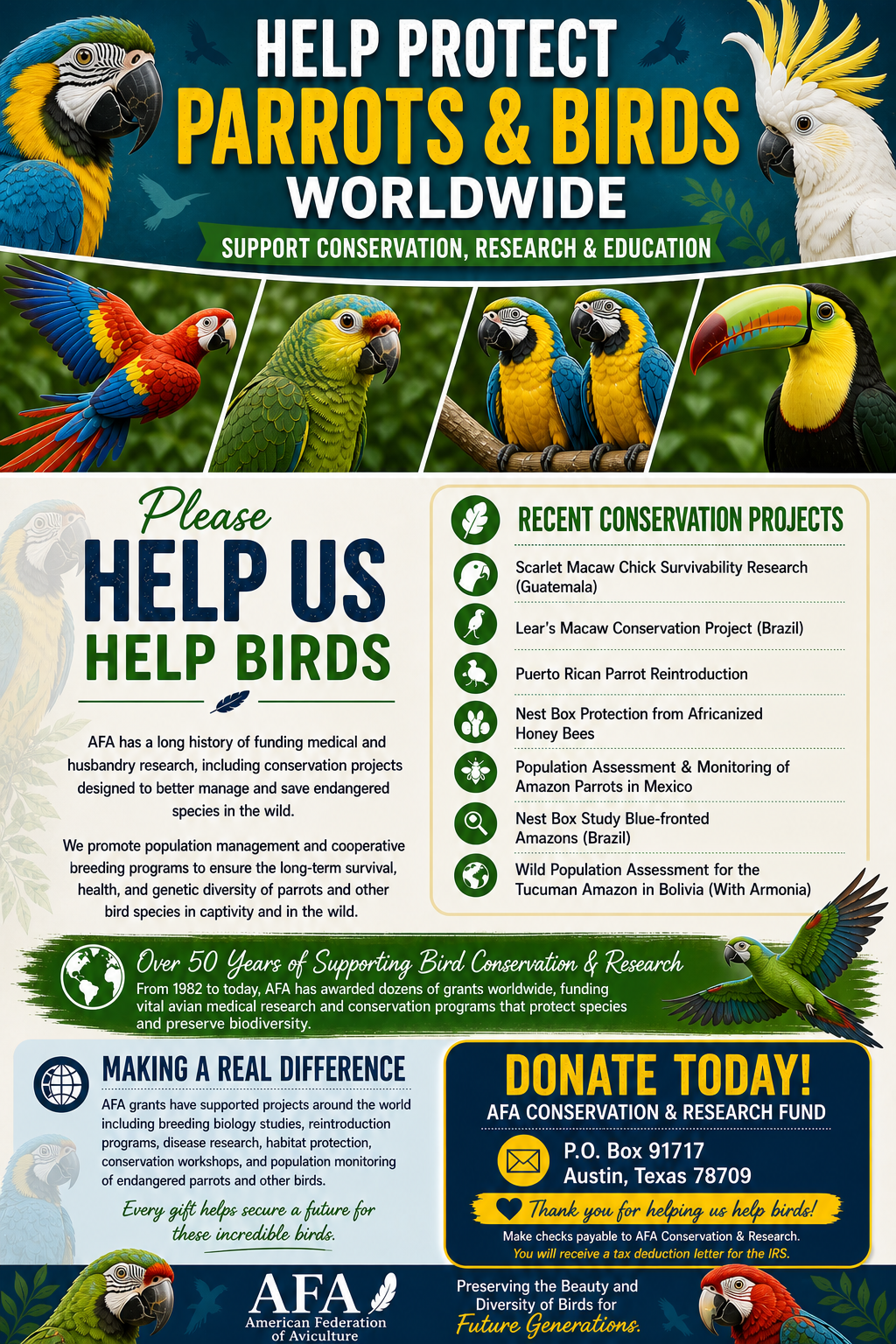
Among the primary beneficiaries of this funding cycle is the Chajul Biology Station, operated by Natura Mexicana in the Lacandon rainforest of southern Mexico. Historically plagued by poaching for both local and international pet trades, nest production for wild scarlet macaws in the region faced near-total reproductive failure without human intervention. Through intensive nest monitoring, hatchling identification, and the controlled hand-rearing and release of wild-hatched chicks, station biologists have successfully fledged more than 150 scarlet macaws back into the rainforest. Current fundraising targets aim to secure $5,000 to equip the station with critical medical supplies, gram scales, brooders, and portable incubators.
Concurrently, the AFA supports the Selva Maya Living Landscape Program led by the Wildlife Conservation Society (WCS) in Guatemala. Active in the Maya Biosphere Reserve since 2002, WCS deploys threat-based interventions and experimental population enhancements to boost chick survivability among wild scarlet macaws, cementing the species as a focal point of regional biodiversity conservation.
In Peru, the AFA assists the Tambopata Macaw Project, providing critical funding to gather longitudinal data on the nutritional, nesting, behavioral, and general ecological requirements of wild macaws. Complementing this behavioral research, a dedicated health investigation led by veterinary researchers J. Jill Heatley, Lizzie Ortiz-cam, and Donald Brightsmith utilizes field-side i-STAT analyzers to establish vital physiological baselines for growing nestlings and free-flighted adults. The team is currently processing over 100 biological samples to complete differential white blood cell counts, data that simultaneously informs avian veterinary medicine and wild population health assessments.
Furthermore, the AFA addresses human-wildlife conflict through specialized initiatives, such as the Lear’s Macaw Corn Subsidy Program in Brazil, which compensates local farmers for crop losses to mitigate retaliatory actions against wild populations. The organization also supports innovative preventative protocols, such as the "push-pull" method developed by researcher Caroline A. Efstathion, which uses bird-safe permethrin repellents and pheromone-baited traps to protect natural and artificial parrot nest boxes from destructive colonization by Africanized honey bees.
Chronology and Historical Context of the AFA
The American Federation of Aviculture was established in March 1974 in Southern California, born out of an urgent regulatory and public health crisis. During an outbreak of Exotic Newcastle Disease in the early 1970s, the United States Department of Agriculture (USDA) ordered the euthanasia of thousands of healthy exotic birds held in private collections. This sweeping action galvanized bird owners, regional clubs, and breeders to form a unified umbrella organization capable of representing avicultural interests before state and federal regulators.
Incorporated as a non-profit 501(c)(3) educational organization with its business headquarters in Austin, Texas, the AFA rapidly expanded its mandate beyond domestic advocacy. Throughout the 1980s and 1990s, the organization awarded more than 40 distinct research grants, laying the groundwork for modern captive husbandry standards and cooperative population management. Over the decades, the AFA evolved into an essential non-governmental observer (NGO) at meetings of the Convention on International Trade in Endangered Species of Wild Fauna and Flora (CITES), frequently consulting with the U.S. Fish and Wildlife Service (USFWS) on psittacine trade management and conservation policy.
Navigating the Wild Bird Conservation Act of 1992

The legal landscape governing exotic bird management in the United States shifted fundamentally with the enactment of the Wild Bird Conservation Act (WBCA) on October 23, 1992. Designed to halt the mass importation of wild-caught birds destined for the U.S. pet trade, the statute initially covered species listed under CITES Appendices I and II. Subsequent legal challenges brought by conservation groups expanded these restrictions to encompass all CITES-listed parrot species within the family Psittacidae.
While the WBCA instituted a virtual moratorium on commercial bird imports from neighboring countries like Canada and Mexico as well as international origins, it built two crucial pathways for legal acquisition: Cooperative Breeding Programs (CBPs) and the "clean list" of exempt captive-bred species.
Cooperative Breeding Programs allow qualified avicultural clubs, zoos, and breeders to petition the USFWS for limited import quotas of underrepresented species. The primary objective of a CBP must be the long-term conservation and establishment of a sustainable, genetically diverse captive population rather than commercial supply for the pet trade. Program managers are legally mandated to submit biannual reports tracking the status of imported stock and their offspring. Historically, the AFA has served as the official overseer for several successful CBPs, including those for the Red Siskin, Blue-headed Macaw, Javan Hill Mynah, Red-crested Cardinal, and various conure species. More recently, the AFA has overseen the Blue-eyed Cockatoo (Ophthalmica) CBP, spearheaded by Dr. Susan Clubb, which has since been expanded to include permitted black cockatoo species such as the Gang-gang, Red-tailed, Yellow-tailed, and Glossy black cockatoos.
Complementing CBPs is Title 50, Part 15, Subsection 15.33 of the Code of Federal Regulations, which outlines species exempted from import bans because they are reliably bred in captivity globally without driving wild harvest. This list includes common avicultural subjects such as the budgerigar, cockatiel, peach-faced lovebird, and various rosellas and parakeets.

The Interplay Between CITES and the U.S. Endangered Species Act
In tandem with the WBCA, the U.S. Endangered Species Act (ESA)—signed into law by President Richard Nixon in December 1973—serves as a primary federal shield against the extinction of vulnerable wildlife. The ESA empowers the USFWS to list domestic and exotic species threatened by habitat loss or overutilization in commerce.
For aviculturists, the ESA introduces distinct regulatory compliance measures. While mere possession of a legally acquired, listed exotic bird does not require a federal permit for in-state owners, any interstate commerce, sale, or barter of an ESA-listed species demands specific federal authorization, such as an Interstate Commerce Permit or a Captive-bred Wildlife (CBW) registration. Exemptions apply to certain popular avicultural species, such as Moluccan and Umbrella cockatoos, though state-level restrictions may still apply depending on local jurisdictions.
Official Statements and Operational Implications
Leadership within the AFA emphasizes that rigorous regulatory compliance and active field conservation are mutually reinforcing goals. By maintaining transparent communication channels with federal regulators and international bodies, the avicultural community ensures that captive populations serve as genetic reservoirs for endangered species while discouraging illegal wildlife trafficking.
"Our mission is to advance aviculture through education, ethical husbandry, scientific research, and active habitat conservation," noted an AFA representative. "By aligning our grant programs with trusted field stations and participating directly in CITES Animal Committee discussions, we provide a credible, science-based voice for the preservation of avian biodiversity worldwide."
Researchers, bird clubs, and conservation organizations seeking to apply for the upcoming AFA conservation grant cycle must submit their project proposals and funding requests to the AFA office by September 15 for consideration in the subsequent funding year. Detailed submission guidelines, proposal forms, and contact information for AFA conservation coordinator Rick Jordan are publicly available via the official American Federation of Aviculture digital portal.

