


A minuscule parasitic worm, capable of launching itself into the air up to 25 times its own body length, employs a sophisticated electrostatic mechanism to latch onto flying insects, according to groundbreaking research published in the prestigious journal Proceedings of the National Academy of Sciences (PNAS). This remarkable discovery, a collaborative effort between scientists at Emory University and the University of California, Berkeley, sheds new light on the intricate and often surprising strategies employed by small organisms for survival.
The nematode Steinernema carpocapsae, a creature barely visible to the naked eye, has evolved an extraordinary method of predation. When sensing a potential insect host overhead, it coils into a tight loop before executing a powerful, upward leap. This prodigious jump, equivalent to a human clearing a 10-story building, is not merely a feat of biomechanical prowess but a carefully orchestrated maneuver that leverages the invisible forces of electrostatics.
The Science Behind the Leap: Electrostatic Attraction
At the heart of this worm’s success is its ability to exploit the electrical fields generated by its insect prey. As insects, particularly those with fluttering wings like fruit flies, navigate the air, their movement creates friction that can build up a significant electrical charge. Researchers have determined that these charges can reach several hundred volts.
The new study, led by Emory University physicist Justin Burton and UC Berkeley biomechanics expert Victor Ortega-Jiménez, reveals that this ambient electrical field from the insect induces an opposing electrostatic charge in the Steinernema carpocapsae worm. This induced charge creates an attractive force, a kind of invisible tether, that pulls the worm towards the insect, dramatically increasing the probability of a successful capture.
"We’ve identified the electrostatic mechanism this worm uses to hit its target, and we’ve shown the importance of this mechanism for the worm’s survival," stated co-author Justin Burton, a professor of physics at Emory University whose lab spearheaded the mathematical analyses underpinning the research. "Higher voltage, combined with a tiny breath of wind, greatly boosts the odds of a jumping worm connecting to a flying insect."
The research team meticulously demonstrated that this electrostatic induction is the primary driver behind the worm’s aerial hunting success. Without this electrostatic assistance, the worm’s impressive leaps would be far less effective, rendering the energy expenditure a potentially wasteful endeavor.
A Collaborative Endeavor: From Theory to High-Speed Observation
The genesis of this research can be traced back to a shared curiosity about the underappreciated role of physics in the natural world. Victor Ortega-Jiménez, the co-lead author and assistant professor of biomechanics at UC Berkeley, who spearheaded the experimental work, commented, "You might expect to find big discoveries in big animals, but the tiny ones also hold a lot of interesting secrets."
His laboratory was equipped with high-speed microscopy, a crucial tool that allowed the scientists to capture incredibly detailed footage of the needle-tip-sized worms launching themselves toward electrically charged fruit flies. These observations provided the visual evidence needed to understand the dynamics of the worm’s jump and its interaction with the insect’s electrical field.
Meanwhile, Justin Burton’s physics lab at Emory University focused on the mathematical modeling and theoretical underpinnings of the electrostatic interaction. Ranjiangshang Ran, a co-lead author and postdoctoral fellow in Burton’s lab, played a pivotal role in digitizing and analyzing the experimental data. His work involved sophisticated statistical methods, including Markov chain Monte Carlo (MCMC) algorithms, to model the complex interplay of forces at play.
"Using physics we learned something new and interesting about an adaptive strategy in an organism," said Ran. "We’re helping to pioneer the emerging field of electrostatic ecology."
The collaborative spirit extended beyond Emory and UC Berkeley, with contributions from Saad Bhamla and Sunny Kumar at the Georgia Institute of Technology, who brought their expertise in biomechanics, and Adler Dillman, a nematode biologist at the University of California, Riverside, who provided crucial insights into the worm’s biology.
The Shocking Lives of Tiny Creatures: Electrostatics in the Microcosm
This discovery about Steinernema carpocapsae is part of a growing body of research revealing the profound impact of static electricity on the behavior and survival of small organisms. Static electricity, the familiar spark we experience when touching a doorknob, arises from the buildup and sudden discharge of electrons. While often a minor nuisance for humans, for many tiny creatures, it is a fundamental force shaping their interactions with the environment.
The phenomenon of electrostatic attraction has been observed in various ecological contexts:
- Spider Webs: In 2013, Victor Ortega-Jiménez himself discovered that spider webs can harness the electrical charges of passing insects, using electrostatic forces to draw them in and ensure their capture.
- Pollen Collection: Bees utilize electrostatic forces to efficiently gather pollen, with pollen grains adhering to their fuzzy bodies due to electrical attraction.
- Parasitic Adherence: Flower mites have been shown to cling to hummingbirds through electrostatic attraction, hitching rides on these aerial navigators.
- Arachnid Ballooning: Certain species of spiders employ charged silk to drift across vast distances, utilizing atmospheric electrical fields for dispersal.
Burton and Ortega-Jiménez have also explored the role of electrostatics in the lives of ticks, co-authoring a recent commentary in Trends in Parasitology. They highlight how ticks can be inadvertently lifted from the ground by the static electricity generated by the fur of passing animals.
Painstaking Experiments: Unraveling the Worm’s Secrets
The researchers designed a series of meticulous experiments to isolate and quantify the electrostatic influence on the worm’s hunting success. A key challenge was replicating the natural conditions that generate significant electrical charges in flying insects. In nature, the rapid movement of insect wings through the air, interacting with atmospheric ions, can build up hundreds of volts.
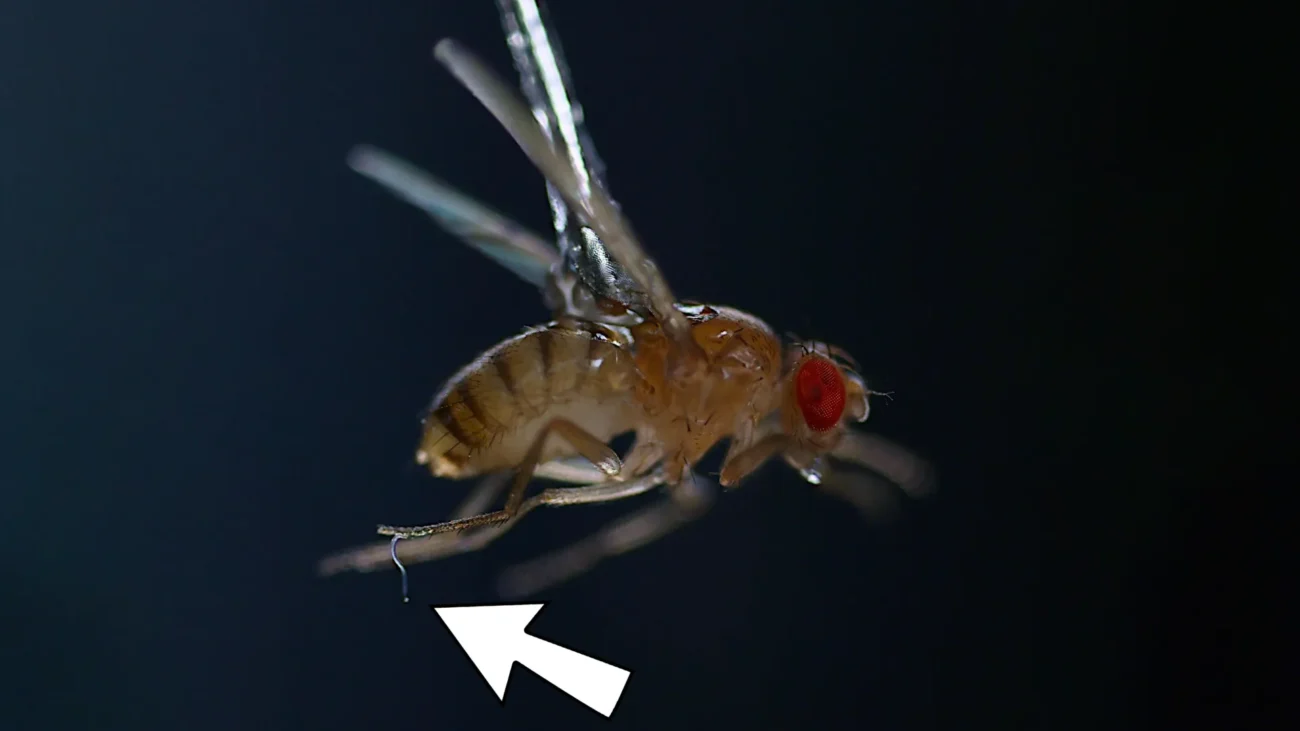
To precisely control the electrical charge of their insect targets, the scientists employed a novel technique. Victor Ortega-Jiménez painstakingly attached a tiny wire, connected to a high-voltage power supply, to the back of each fruit fly used in the experiments. This delicate procedure, often taking upwards of half an hour per fly, was essential for ensuring accurate voltage manipulation.
"It’s very difficult to glue a wire to a fruit fly," Ortega-Jiménez admitted. "Usually, it took me half an hour, or sometimes an hour."
Another hurdle was creating the optimal environment to encourage the worms to jump. This involved using a substrate of moistened paper, carefully calibrated to be neither too wet nor too dry. Furthermore, a gentle puff of air or a minor mechanical disturbance was often needed to prompt the worms to launch themselves towards the suspended, electrically charged fruit flies.
Ortega-Jiménez conducted dozens of these experiments, meticulously recording each leap with a specialized high-speed camera. This camera, capable of capturing 10,000 frames per second, was crucial for tracking the submillimeter worms, essentially invisible to the naked eye, during their acrobatic midair trajectories. In some trials, a miniature wind tunnel was employed to analyze the impact of ambient air currents on the worm’s success rate.
Digitizing the Data: The Power of Computational Analysis
Once the experimental footage was gathered, the complex task of data analysis began. Ranjiangshang Ran was responsible for digitizing the trajectories of approximately 60 experimental videos. This was a labor-intensive process, particularly when worms moved out of the camera’s focal plane, blurring their image and requiring manual positional tracking.
To interpret this vast dataset, Ran employed a sophisticated statistical algorithm known as Markov chain Monte Carlo (MCMC). This method, which involves random exploration of various parameters, allows researchers to estimate the probability of a specific outcome. In this context, Ran used MCMC to determine the likelihood of a worm successfully hitting its target based on factors such as the insect’s voltage, the worm’s physical dimensions, and its launching velocity.
The analysis revealed a stark contrast in success rates with and without electrostatic assistance. In scenarios where electrostatics were absent, only one out of every 19 worm trajectories resulted in a successful capture. However, when a charge of a few hundred volts, a magnitude commonly found in flying insects, was present, the probability of success dramatically increased.
The model indicated that a charge of just 100 volts boosted the probability of hitting the target to less than 10%. In contrast, an 800-volt charge propelled the success rate to an impressive 80%. This data powerfully underscored the indispensable role of electrostatics in the worm’s predatory strategy.
The Evolutionary Imperative: Why Electrostatics Matter
The significant energy expenditure involved in these jumps, coupled with the risks of predation or desiccation while suspended in the air, raises a critical evolutionary question: why would such a demanding behavior evolve if it were not reliably effective?
"Our findings suggest that, without electrostatics, it would make no sense for this jumping predatory behavior to have evolved in these worms," Ran concluded. The electrostatic attraction, therefore, transforms a high-risk, high-energy jump into a highly efficient hunting mechanism.
Echoes of Maxwell: Connecting Ancient Physics to Modern Biology
The researchers’ investigation into electrostatic induction led them to revisit the foundational work of Scottish physicist James Clerk Maxwell. They discovered that their mathematical model for the worm’s charging mechanism aligned remarkably with a prediction Maxwell had made about electrostatic induction in 1870.
"Maxwell, one of the most prolific physicists of all time, had a wild imagination, similar to Einstein," Ran noted, highlighting the serendipitous connection between historical scientific inquiry and contemporary biological discovery. "It turns out that our model for the worm-charging mechanism agreed with a prediction for electrostatic induction that Maxwell made in 1870. There are many buried treasures in scientific history. Sometimes being a scientist is like being an archeologist."
Another crucial factor considered in the study was drag force, which significantly influences the trajectory of such small organisms. The researchers analogized this to the difference between a bowling ball and a feather in flight, emphasizing how the worm’s tiny size makes it highly susceptible to air resistance.
Simulations incorporating electrostatic charge and various wind speeds revealed that even the faintest breeze, as low as 0.2 meters per second, when combined with higher insect voltages, further enhanced the worm’s chances of a successful capture.
The Future of Electrostatic Ecology: Unveiling New Mysteries
This research not only elucidates the remarkable survival strategy of Steinernema carpocapsae but also lays the groundwork for a new field of scientific inquiry: electrostatic ecology. The study provides a robust framework for investigating the pervasive but often overlooked influence of electrical forces in ecological interactions.
"We live in an electrical world, electricity is all around us, but the electrostatics of small organisms remains mostly an enigma," stated Victor Ortega-Jiménez. "We are developing the tools to investigate many more valuable questions surrounding this mystery."
The work was generously supported by grants from the W.M. Keck Foundation and the Tarbutton Postdoctoral Fellowship of Emory College of Arts and Sciences, enabling these pioneering investigations into the unseen forces that shape life on Earth.

