


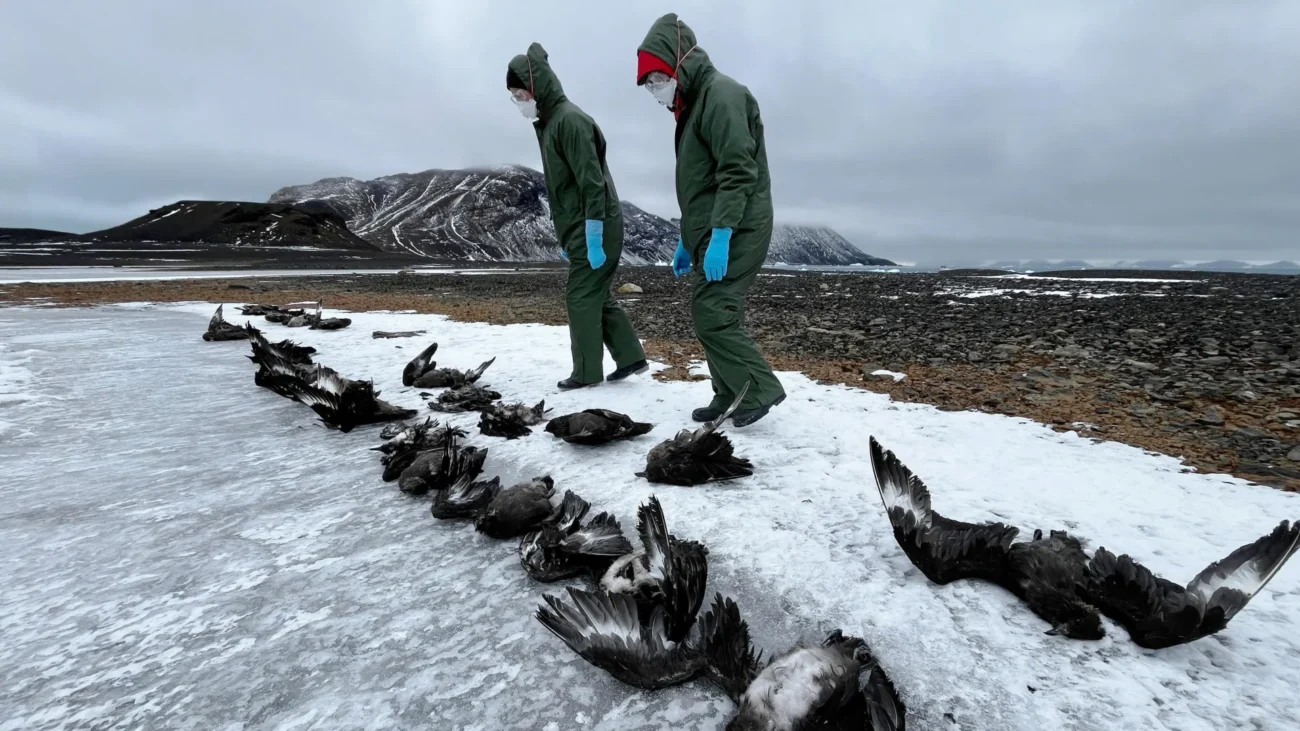
The pristine and isolated continent of Antarctica has reported its first confirmed wildlife die-off linked to the highly pathogenic avian influenza virus H5N1. Over 50 skuas, a species of large seabird, succumbed to the virus during the austral summers of 2023 and 2024. This grim discovery, detailed in a recent study published in the journal Scientific Reports, was spearheaded by a collaborative effort between Erasmus MC in the Netherlands and the University of California, Davis. The findings underscore a significant ecological event, highlighting the virus’s relentless global march and its potential to disrupt vulnerable ecosystems.
Skuas, which are avian predators and scavengers closely related to gulls, inhabit polar and subpolar regions. Their ecological role in consuming carcasses could inadvertently facilitate the spread of the virus across the Antarctic landscape, researchers suggest. Prior to this definitive study, evidence of H5N1 in Antarctic wildlife was limited. In early 2024, scientists had detected the virus in a kelp gull and two skuas found deceased in January and February. However, these initial findings lacked conclusive proof that H5N1 was the direct cause of mortality.
“We knew there were animals with the infection, but this is the first study to show they died of the viral infection,” stated co-senior author Ralph Vanstreels, a wildlife veterinarian affiliated with the UC Davis One Health Institute within the School of Veterinary Medicine. He emphasized the critical distinction: “It’s an important distinction in the early days of an outbreak.” This confirmation marks a turning point in understanding the impact of H5N1 on the Antarctic ecosystem.
Antarctic Expedition Uncovers Avian Influenza’s Deadly Reach
In response to escalating concerns, a dedicated research expedition journeyed to Antarctica in March 2024, shortly after the conclusion of the skua and penguin breeding season. The team meticulously surveyed ten distinct sites, spanning the South Shetland Islands, the northern Weddell Sea, and the Antarctic Peninsula. Their mission was to investigate the health of wildlife and collect vital samples.
At each location, scientists encountered sick or deceased animals. Comprehensive necropsies were performed on tissue samples and environmental specimens were collected to ascertain the cause of death. The expedition examined the remains of several species, including gentoo penguins, Adélie penguins, and Antarctic fur seals. However, H5N1 was not identified as the causative agent in these species.
“As the expedition progressed, it became obvious quickly that skuas were a major victim,” Vanstreels observed, noting the disproportionate impact on this particular avian group. The virus was subsequently confirmed in skuas at three specific locations: Hope Bay, Devil Island, and Beak Island. Beak Island, in particular, experienced a substantial die-off among its population of south polar skuas.
First author Matteo Iervolino, a Ph.D. candidate at Erasmus MC, recounted the stark reality he witnessed: “We diagnosed high pathogenicity avian influenza as the cause of death for nearly all of the dead skuas we found at Beak Island. There, I could really see with my eyes the impact this virus can have on these populations.”
The Devastating Neurological Impact of H5N1
Vanstreels described the observed symptoms as indicative of a “crisis in animal suffering.” The H5N1 virus, known for its neurotropic properties, directly attacks the avian brain. This leads to severe neurological dysfunction, manifesting as distorted neck postures, extreme body contortions, and disorientation. Infected birds were observed exhibiting circular swimming or walking patterns, colliding with objects, and in some instances, falling from the sky due to loss of coordination. The researchers underscored that human activities played a pivotal role in the virus’s emergence and continue to be crucial in efforts to curb its spread.
A Global Pandemic of Avian Influenza
The history of H5N1 is a stark reminder of how viruses can emerge and spread with devastating consequences. First identified in 1996 on a domestic goose farm in Southeast China, the virus circulated largely unchecked within poultry populations for several years. This initial phase provided fertile ground for the virus to adapt and eventually spill over into wild bird populations.
From its origins, H5N1 embarked on a relentless global journey. It spread across Europe, the Middle East, and Africa, before crossing the Atlantic to reach North and South America. By early 2024, its geographical reach extended to the remote continent of Antarctica, a testament to its extraordinary adaptability and the interconnectedness of global ecosystems.
The same H5N1 strain now impacting Antarctic skuas had previously caused catastrophic losses among marine mammals in Argentina, including significant die-offs of elephant seals and sea lions. Globally, the virus has been responsible for the deaths of over 400 million poultry. Its host range has expanded alarmingly to include mammals such as dairy cows, mink, foxes, bears, otters, and a wide array of other wild birds and mammals.
The threat of H5N1 extends to humans. While human infections are relatively rare, they carry a high mortality rate. Of approximately 1,000 reported human cases worldwide, about half have proven fatal.
“We let the virus slip out through our fingers when it first emerged in the poultry industry,” reflected corresponding senior author Thijs Kuiken, a professor at Erasmus MC. “Once it got into wild bird populations, we lost ability to control this virus. Now it’s established in wild bird populations in all the continental regions of the world except Oceania.” This statement highlights a critical failure in early containment and the subsequent difficulty in managing a virus that has become endemic in wild bird populations.
Escalating Threats to Antarctic Wildlife
The arrival of avian influenza presents a new and formidable challenge to Antarctic wildlife, which already contend with a multitude of environmental pressures. These include the pervasive impacts of climate change, an increase in tourism and associated human activity, the introduction of invasive species, the consequences of overfishing in surrounding waters, and the persistent threat of pollution. The addition of H5N1 to this list of stressors could have cascading effects on the delicate Antarctic food web and biodiversity.
The study strongly advocates for enhanced surveillance and monitoring protocols across the Antarctic region to mitigate the risk of further viral spread and to better understand its long-term ecological consequences. A significant complication in assessing the impact of the current outbreak is the scarcity of recent population data for Antarctic species. For instance, the last comprehensive census of Antarctic skuas was conducted in the 1980s, at which time researchers estimated the global population to be around 800 breeding pairs. Without updated population figures, accurately quantifying the significance of the loss of 50 birds becomes exceptionally difficult.
“Everything points toward this virus spreading further,” Kuiken warned. “If nobody is watching, we won’t know what is happening.” This sentiment underscores the urgent need for sustained and robust monitoring efforts to track the progression of the virus and its impact on Antarctic biodiversity.
The HPAI Australis Expedition, which provided crucial data for this study, was generously funded by the International Association of Antarctica Tour Operators (IAATO) and Ocean Expeditions. Additional support for the research was provided by the European Union, the Consejo Superior de Investigaciones Científicas (CSIC), and PTI Global Health. The collaborative nature of this research highlights the growing international concern and coordinated efforts required to address emergent threats to globally significant ecosystems like Antarctica. The findings serve as a critical alert, emphasizing that no corner of the planet is immune to the far-reaching consequences of emerging infectious diseases.

