


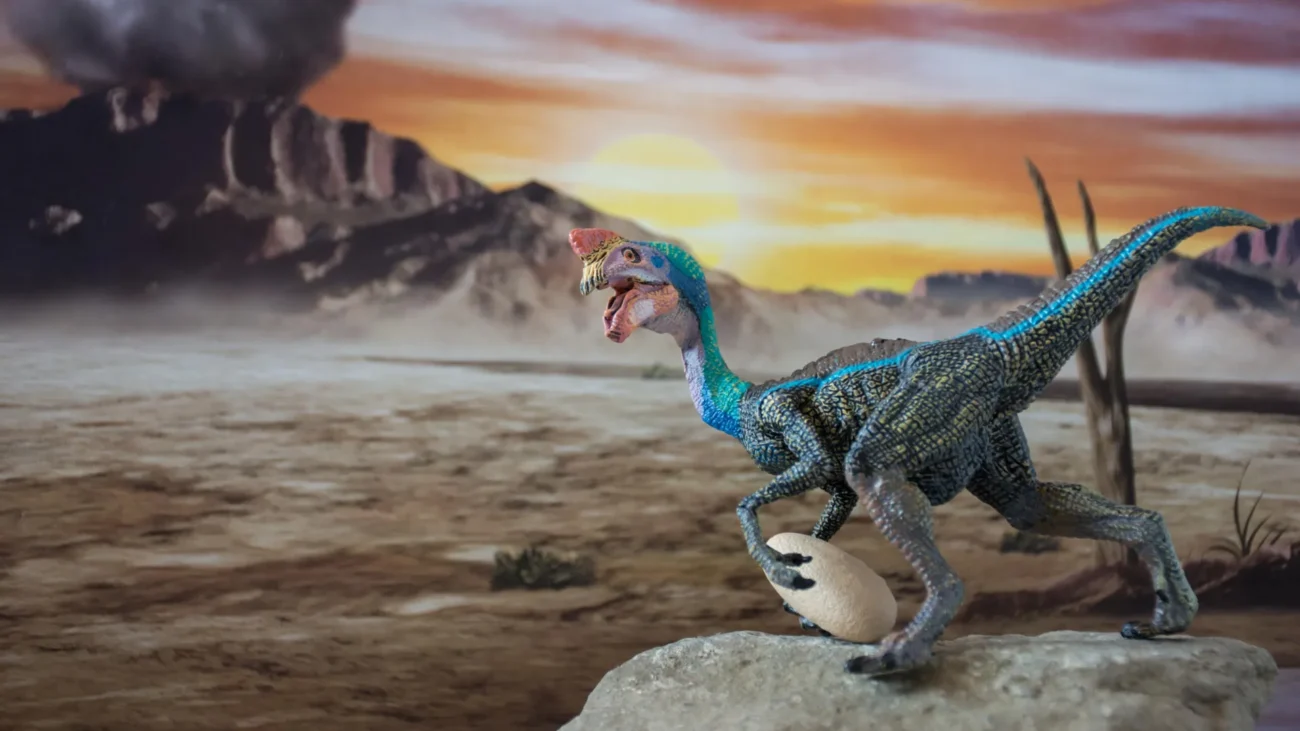
For decades, paleontologists have grappled with a fundamental question regarding oviraptors, the distinctive bird-like yet flightless dinosaurs that roamed ancient Earth: how did they bring their young into the world? The precise incubation strategies of these fascinating creatures, known for their elaborate nests and unique egg shapes, have remained largely elusive. Did they, like modern reptiles such as crocodiles, rely solely on the ambient heat of their surroundings, or did they actively participate in warming their eggs, mirroring the behavior of present-day birds? A groundbreaking new study, published in the esteemed journal Frontiers in Ecology and Evolution, sheds significant light on this enduring enigma, proposing a compelling model of co-incubation where oviraptors partnered with environmental heat to nurture their developing offspring.
The research, spearheaded by a team of scientists in Taiwan, employed a multifaceted approach, ingeniously combining sophisticated heat transfer simulations with practical, hands-on physical experiments. This dual methodology allowed researchers to meticulously dissect the complex interplay between adult oviraptors, their nesting habits, and the thermal dynamics of egg incubation. To achieve this, the team meticulously constructed a life-size model of an oviraptor and a remarkably realistic nest, designed to precisely replicate the conditions of a genuine oviraptor nesting site. Through this innovative setup, they could then meticulously track and analyze how heat moved through the eggs in various scenarios.
"Our findings clearly demonstrate that the observed differences in oviraptor hatching patterns were directly influenced by the relative positioning of the incubating adult to its clutch of eggs," explained senior author Dr. Tzu-Ruei Yang, an associate curator of vertebrate paleontology at Taiwan’s National Museum of Natural Science. This insight suggests that the dinosaur’s physical presence, while not directly warming every egg, played a crucial role in modulating the thermal environment within the nest.
Adding to this revelation, first author Chun-Yu Su, who was a high school student at Washington High School in Taichung when the research was conducted, noted, "Moreover, we were able to derive an estimate of the incubation efficiency of oviraptors, which we found to be significantly lower when compared to that of modern birds." This comparative analysis underscores a fundamental divergence in reproductive strategies between these ancient dinosaurs and their avian descendants.
Reconstructing an Oviraptor Nest: A Monumental Undertaking
The scientific endeavor to understand oviraptor incubation began with the meticulous reconstruction of a typical oviraptor nesting environment. The model was specifically based on Heyuannia huangi, an oviraptor species that inhabited what is now China during the Late Cretaceous period, approximately 70 to 66 million years ago. This particular dinosaur was relatively modest in size, measuring around 1.5 meters in length and weighing approximately 20 kilograms. Fossil evidence indicates that Heyuannia huangi constructed semi-open nests, characterized by a unique arrangement of eggs laid in multiple concentric rings.
Bringing this ancient scene to life required considerable ingenuity and scientific rigor. The torso of the oviraptor model was expertly crafted using a sturdy wooden frame encased in polystyrene foam, providing the structural integrity for the replica. To simulate the soft tissues of the dinosaur, layers of cotton, bubble paper, and fabric were carefully applied, creating a surprisingly lifelike representation. The eggs themselves were meticulously created using casting resin, a material chosen for its ability to mimic the texture and density of fossilized eggs. In the experimental phase, two distinct clutches of these resin eggs were arranged in double rings, a configuration that faithfully mirrored the patterns observed in fossil discoveries.
"A significant part of the challenge in this research lay in accurately reconstructing oviraptor incubation in a realistic manner," commented Su. "For instance, their eggs possess a unique morphology, unlike those of any living species today. Consequently, we had to invent and create these resin eggs to approximate the properties of real oviraptor eggs as closely as we possibly could." This statement highlights the inherent difficulties in studying extinct organisms, where direct comparisons to living analogues are often limited.
The Interplay of Heat, Nest Design, and Hatching Patterns
The core of the study involved systematically testing the influence of both adult presence and prevailing environmental conditions on egg temperatures and, consequently, hatching outcomes. The researchers meticulously monitored how heat was distributed within the nest under different thermal regimes.
In simulated colder conditions, the presence of a brooding adult oviraptor proved to be a significant factor. The study observed temperature variations of as much as 6°C within the outer ring of eggs. Such a considerable thermal gradient is highly likely to have resulted in asynchronous hatching – a phenomenon where eggs within the same nest do not hatch simultaneously. This staggered hatching could have offered evolutionary advantages, perhaps allowing younger hatchlings to benefit from a more established nest environment or enabling the parent to focus on caring for a smaller, more vulnerable group at any given time.
Conversely, in warmer simulated environments, the temperature differential across the outer ring of eggs dropped dramatically to approximately 0.6°C. This finding strongly suggests that in warmer climates, the direct influence of sunlight played a crucial role in homogenizing temperatures within the nest. This more consistent thermal environment would have likely influenced hatching patterns, potentially leading to more synchronized hatching events.
Dr. Yang elaborated on this crucial point, stating, "It is highly unlikely that large dinosaurs like oviraptors would have physically sat directly atop their clutches of eggs in the way that many modern birds do. It is more probable that they relied on external heat sources, such as the warmth of the sun or the heat retained within the soil, to facilitate the hatching of their eggs, much like modern turtles. Given that oviraptor clutches were open to the air, solar radiation likely played a far more significant role in warming the eggs than subterranean heat." This hypothesis directly challenges the long-held assumption of direct parental brooding for all bird-like dinosaurs.
Dinosaur vs. Bird Incubation Efficiency: A Tale of Two Strategies
A pivotal aspect of the research involved a direct comparison of oviraptor incubation strategies with those employed by modern birds. The vast majority of contemporary avian species rely on a method known as thermoregulatory contact incubation (TCI). This strategy is characterized by the adult bird sitting directly on its eggs, providing direct body heat. For TCI to be effective, several conditions must be met: the adult must be able to maintain physical contact with all the eggs simultaneously, act as the primary heat source for the clutch, and ensure consistent temperature regulation.
The study’s findings indicate that oviraptors were likely incapable of meeting these stringent requirements. The characteristic ring-shaped arrangement of their eggs meant that the adult dinosaur could not realistically maintain continuous contact with every egg in the clutch. This physical limitation would have made direct, bird-like TCI an impossible incubation method.
"Oviraptors, due to their nesting configuration, may not have possessed the capability to conduct TCI in the same manner as modern birds," Su observed. Instead, the research posits that these ancient dinosaurs and the ambient environmental heat worked in concert, effectively making them "co-incubators." While this combined approach was demonstrably less efficient than the direct thermal regulation of modern birds, it appears to have been a remarkably well-suited strategy for their specific nesting style. This nesting style, the study notes, may have evolved over time, shifting from more deeply buried nests to the semi-open designs observed in species like Heyuannia huangi.
Dr. Yang offered a nuanced perspective on the evolutionary implications, stating, "Modern birds are not inherently ‘better’ at hatching eggs. Rather, birds living today and oviraptors have adopted fundamentally different approaches to incubation, or more precisely, brooding. There isn’t a hierarchy of better or worse; it’s simply a matter of adaptation to their respective environments and ecological niches." This statement emphasizes the principle of evolutionary fitness, where diverse strategies can be equally successful under different circumstances.
Broader Implications for Dinosaur Parenting and Paleontological Research
While the study offers significant new insights, the researchers prudently acknowledge certain limitations. Their conclusions are based on a reconstructed nest environment and contemporary environmental conditions, which undoubtedly differ from the climatic and ecological landscapes of the Late Cretaceous. These discrepancies could potentially influence the precise thermal dynamics and hatching outcomes. Furthermore, the study suggests that oviraptors likely experienced considerably longer incubation periods than most modern birds, a factor that would have influenced their parental care strategies and the overall reproductive cycle.
Despite these caveats, the research represents a significant leap forward in our understanding of how oviraptors may have nurtured their young. By ingeniously merging the tangible evidence from physical models with the predictive power of sophisticated simulations, this work opens exciting new avenues for future research into the reproductive behaviors of extinct dinosaurs. The ability to recreate and test hypothetical scenarios in a controlled manner offers paleontologists a powerful tool for unraveling the mysteries of prehistoric life.
Concluding on a note of encouragement, Dr. Yang remarked, "This study also serves as a true inspiration for all students, particularly those in Taiwan. While there may be no dinosaur fossils found within Taiwan itself, that does not preclude us from making significant contributions to dinosaur research." This sentiment underscores the universal nature of scientific inquiry and the potential for groundbreaking discoveries to emerge from diverse geographical and academic contexts. The innovative methodology employed in this study not only illuminates the past but also provides a blueprint for future paleontological investigations, demonstrating that even without direct fossil finds, profound insights into the age of dinosaurs are attainable through scientific ingenuity and dedicated research. The findings promise to reshape our perception of dinosaur parenting, revealing a more complex and nuanced picture of these remarkable creatures.

