


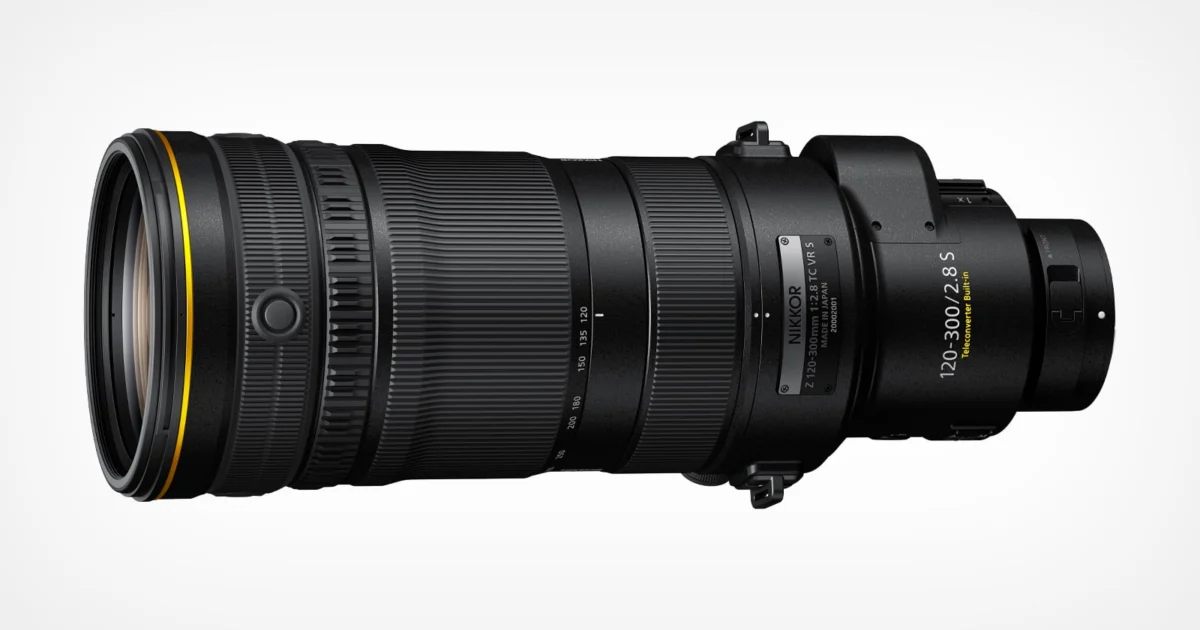
Nikon Corporation has officially confirmed the development of the Nikkor Z 120-300mm f/2.8 TC VR S, a high-performance telephoto zoom lens designed for its full-frame Z-mount mirrorless system. This announcement marks a significant expansion of Nikon’s professional "S-Line" optics, targeting sports, wildlife, and action photographers who require a combination of speed, reach, and versatility. The lens is notable for being the first of its focal range in the Z-mount lineup to feature a built-in 1.4x teleconverter, a hardware integration that allows photographers to instantly toggle between focal lengths without removing the lens from the camera body or exposing the sensor to environmental elements.
While the specific release date and final technical specifications remain under wraps, the development announcement serves as a strategic signal to the professional imaging community. The lens is positioned as the mirrorless successor to the highly acclaimed AF-S Nikkor 120-300mm f/2.8E FL ED SR VR, which was the final professional telephoto zoom released for the Nikon F-mount DSLR system in 2020. By bringing this specific focal range to the Z-mount, Nikon is filling a critical gap for photographers who find the traditional 70-200mm f/2.8 too short and fixed 400mm primes too restrictive for dynamic shooting environments.
The Evolution of the 120-300mm Focal Range
The concept of a 120-300mm f/2.8 lens has long been regarded as a "holy grail" for indoor sports and sideline photography. Historically, photographers had to choose between the versatility of a 70-200mm zoom or the reach and aperture of a 300mm f/2.8 prime. The 120-300mm range bridged this gap, offering the "fast" f/2.8 aperture throughout the zoom range.
When Nikon released the F-mount version in early 2020, it was lauded for its "prime-like" sharpness. Benchmarks at the time indicated that the zoom lens performed as well as, if not better than, the legendary 300mm f/2.8 prime lens in terms of resolving power and chromatic aberration control. However, the F-mount version was released just as the industry was pivoting decisively toward mirrorless technology. Despite its excellence, many professionals hesitated to invest $9,500 in a DSLR lens, opting instead to wait for a native Z-mount equivalent.
The upcoming Nikkor Z 120-300mm f/2.8 TC VR S goes a step further than its predecessor by incorporating the internal teleconverter. When the 1.4x TC is engaged via a physical switch on the lens barrel, the focal range shifts to 168-420mm with a maximum constant aperture of f/4. This dual-purpose nature effectively provides photographers with two lenses in one: a fast 120-300mm f/2.8 for low-light indoor arenas and a 168-420mm f/4 for outdoor field sports or wildlife.
Technical Analysis and Design Observations
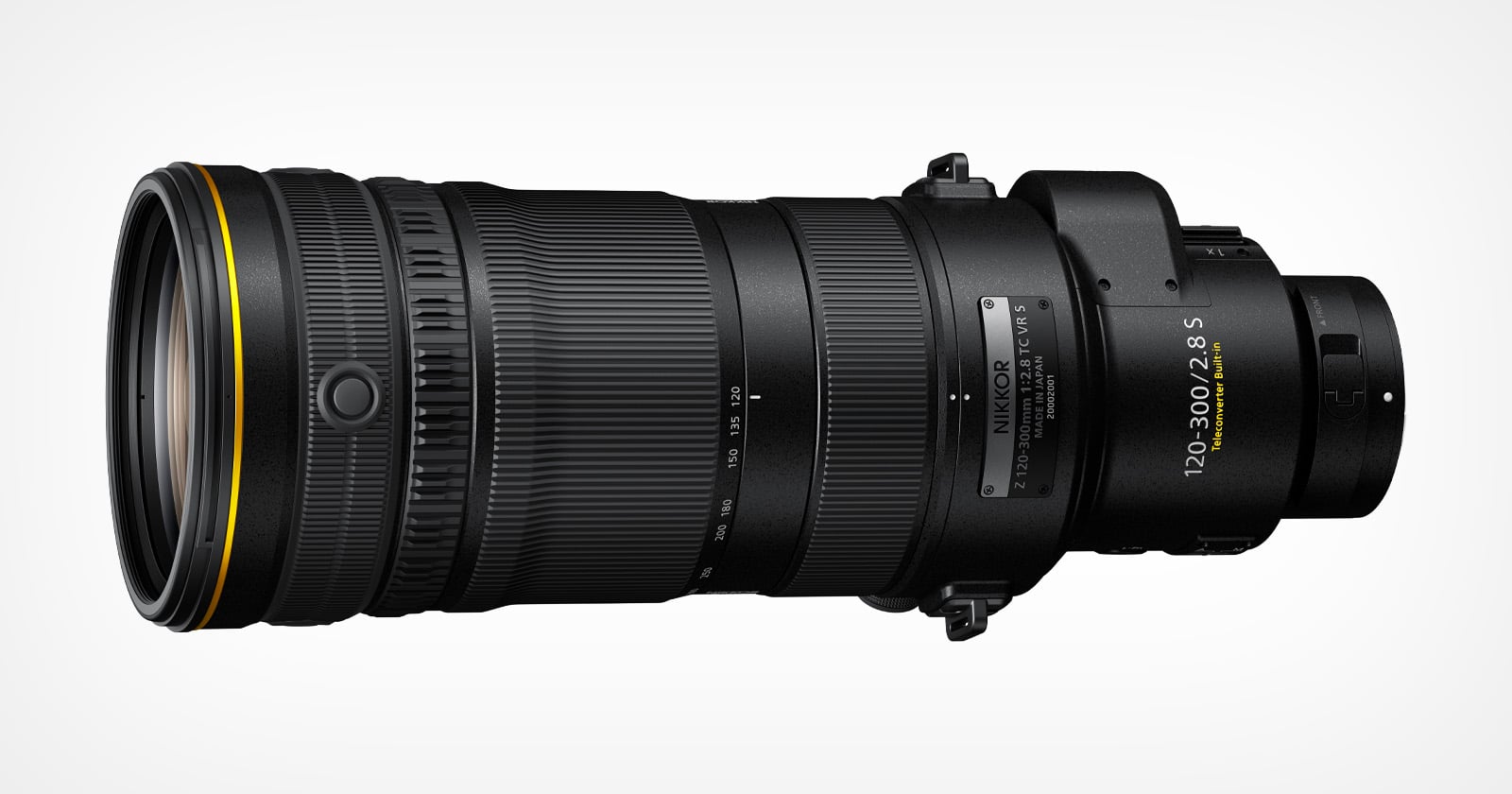
Based on the preliminary product imagery released by Nikon, the Nikkor Z 120-300mm f/2.8 TC VR S adheres to the design language established by recent flagship Z-mount telephotos, such as the Z 400mm f/2.8 TC VR S and the Z 600mm f/4 TC VR S. Several key physical features can be identified from the development prototype:
Control Interface and Ergonomics
The lens features a robust array of tactile controls. Near the mount, a prominent toggle switch for the 1.4x teleconverter is visible, designed for blind operation while the photographer’s eye remains on the viewfinder. The lens barrel includes a dedicated manual focus ring, a large zoom ring, and a third customizable control ring typically used for aperture, ISO, or exposure compensation. Additionally, multiple L-Fn (Lens Function) buttons are distributed around the barrel, allowing for consistent access to programmed settings regardless of whether the camera is held in a horizontal or vertical orientation.
Optical Construction and Filtering
The "S" designation confirms that this lens meets Nikon’s most stringent standards for resolution and build quality. It is expected to utilize advanced coatings, including Meso Amorphous Coat and ARNEO Coat, to minimize ghosting and flare. A significant design detail is the inclusion of a drop-in filter slot near the rear of the lens. This is a standard feature for large-aperture professional telephotos where the front element diameter is too large for traditional screw-on filters. This slot will likely accommodate 46mm filters, including circular polarizers and neutral density filters.
Stabilization and Autofocus
The "VR" (Vibration Reduction) in the name indicates an integrated optical stabilization system. When paired with the in-body image stabilization (IBIS) of cameras like the Nikon Z8 or Z9, the lens will likely support Synchro VR, potentially offering up to 5.5 or 6.0 stops of compensation. Regarding autofocus, industry analysts expect Nikon to employ its "Silky Swift" Voice Coil Motor (VCM) technology, which provides the high-speed, silent, and precise focusing necessary for tracking fast-moving subjects in 8K video or high-speed burst photography.
Chronology of Nikon Professional Telephoto Development
To understand the impact of this lens, it is helpful to look at the timeline of Nikon’s transition from F-mount to Z-mount professional optics:
- August 2018: Nikon officially launches the Z-mount system with the Z6 and Z7 cameras.
- September 2019: Nikon announces the development of the AF-S 120-300mm f/2.8E for DSLRs.
- February 2020: The AF-S 120-300mm f/2.8E hits the market, receiving critical acclaim but facing a shrinking DSLR market.
- January 2022: Nikon releases the Nikkor Z 400mm f/2.8 TC VR S, the first Z-mount lens with a built-in teleconverter.
- November 2022: Nikon releases the Nikkor Z 600mm f/4 TC VR S, further cementing the built-in TC as a staple of its professional line.
- Early 2024: Rumors begin to circulate regarding a Z-mount 120-300mm as professional demand for a native mirrorless version intensifies.
- Present: Nikon officially moves the Nikkor Z 120-300mm f/2.8 TC VR S into the development phase.
Market Context and Competitive Landscape
The professional telephoto zoom market has become increasingly competitive as Canon and Sony also vie for the kits of sports and news agencies. Nikon’s primary competition for this lens is the Canon RF 100-300mm f/2.8L IS USM. While the Canon offering provides a slightly wider starting point (100mm), it lacks a built-in teleconverter, requiring photographers to manually attach external extenders to reach beyond 300mm.
Nikon’s decision to include the internal 1.4x TC gives them a distinct advantage in terms of workflow efficiency. In fast-paced environments like the Olympics or NFL games, the ability to switch to 420mm at the flick of a finger can mean the difference between capturing a decisive moment and missing it while fumbling with gear.
Sony currently lacks a direct 120-300mm f/2.8 equivalent, instead relying on its 300mm f/2.8 G Master prime lens. While the Sony prime is exceptionally light, it lacks the framing flexibility offered by Nikon’s zoom design.
Economic Implications and Pricing Expectations
Nikon has not yet disclosed the manufacturer’s suggested retail price (MSRP) for the Nikkor Z 120-300mm f/2.8 TC VR S. However, historical data and current market trends provide a basis for estimation. The previous F-mount version retailed for approximately $9,500. Given the addition of the integrated teleconverter—a feature that added significant cost to the 400mm and 600mm primes—and the general upward trend in professional equipment pricing due to inflation and advanced mirrorless tech, industry experts anticipate a price tag between $10,500 and $11,999.
This investment is typically targeted at major wire services (such as the Associated Press or Reuters), professional sports teams, and high-end wildlife photographers. For these users, the lens represents a long-term tool capable of delivering consistent results over a decade or more of service.
Broader Impact on the Photography Industry
The development of the Nikkor Z 120-300mm f/2.8 TC VR S underscores a broader trend in the imaging industry: the "versatility-first" approach. As sensor resolutions increase (the Nikon Z9 and Z8 both feature 45.7MP sensors), the demand for optics that can resolve high detail while offering variable focal lengths has never been higher.
Furthermore, this lens signifies Nikon’s commitment to its professional user base. By modernizing one of its most legendary optical formulas for the Z-mount, Nikon is ensuring that its system remains the preferred choice for the world’s most demanding photographers. The inclusion of the teleconverter also hints at Nikon’s future strategy, where hardware-based "multi-focal" capabilities become a standard expectation for flagship telephoto lenses.
As the lens moves from development to production, the photography world will be watching for final weight specifications. One of the few criticisms of the F-mount 120-300mm was its weight (approx. 3.25 kg). If Nikon can leverage the shorter flange distance of the Z-mount to reduce the overall weight of the mirrorless version, it could set a new benchmark for handheld professional telephoto zooms.
The official announcement of the final specifications, pricing, and shipping dates is expected to follow later this year or in early 2025, depending on the current stage of the development cycle. For now, the Nikkor Z 120-300mm f/2.8 TC VR S remains the most anticipated addition to the Nikon Z ecosystem, promising to redefine the capabilities of the professional zoom lens.

