


A giant barn owl, a rodent known as a hutia, and a burrowing bee entered a cave. Only two of them left. The one that remained was the creature incapable of flight, a seemingly simple riddle that has unlocked a profound window into the ancient ecosystems and adaptive strategies of the Caribbean. This enigmatic scenario, now pieced together by paleontologists, likely played out thousands of years ago on the island of Hispaniola, revealing an unprecedented behavior in modern bees utilizing the fossilized remnants of prehistoric life.
The Unfolding of a Predatory Meal and an Unexpected Sanctuary
The narrative begins with a classic predator-prey interaction. A giant barn owl, a formidable hunter of the Caribbean night, would have carried its prey, a hutia, back to its den – a cave. These caves, offering safety and shelter, served as crucial nurseries for young owls. The hutia, a substantial rodent native to the region, would have been consumed, leaving behind a scattering of skeletal remains on the cave floor. This cycle of predation likely repeated over countless generations, accumulating a rich deposit of animal bones within the cave’s dark recesses.
It was within this accumulated debris that a solitary burrowing bee, driven by its instinct to reproduce, eventually arrived. Seeking a suitable location to construct its nest, the bee began to excavate into the fine, clay-rich silt that had settled in the cave’s more sheltered areas. Its search for a safe haven, however, led it to an unexpected discovery: the fossilized remains of the hutia.
From Bone Cavities to Bee Nests: A Paleontological Revelation
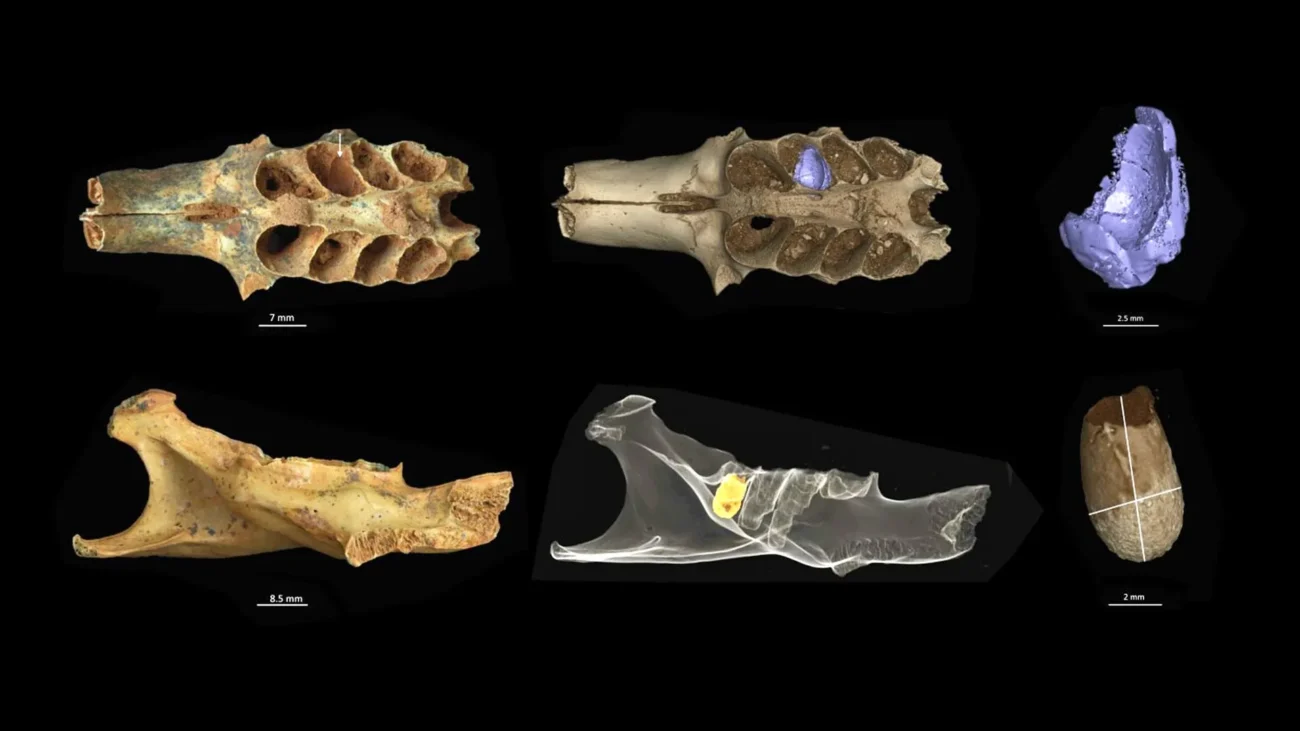
The bee’s discovery proved remarkably serendipitous. The hutia’s jawbone, where its teeth were once anchored in small sockets called alveoli, presented an ideal opportunity. Though the teeth themselves were long gone, these empty, naturally formed cavities offered a ready-made structure. The dimensions of these alveoli, discovered by the bee, perfectly approximated the size required for a bee nest.
This initial discovery by a single bee appears to have set a precedent. Over time, subsequent generations of bees, encountering the same fossilized remains, followed suit. They began to utilize these pre-existing hollow spaces within the ancient bones as secure and convenient nesting sites. This remarkable behavior, preserved by the cave’s stable environment, created a unique geological record, an ichnofossil assemblage that would lie undisturbed for millennia.
A Keen Eye for the Unusual: The Excavation and Initial Observations
The groundbreaking discovery was made by Lazaro Viñola Lopez, who was conducting doctoral research at the Florida Museum of Natural History. While excavating fossils in the Cueva de Mono, located in the southern Dominican Republic, Viñola Lopez encountered an extraordinary abundance of hutia remains, suggesting the cave was a long-term feeding site for giant barn owls.
However, Viñola Lopez’s meticulous approach to fossil excavation set his work apart. Instead of immediately removing all sediment from the fossilized jawbones, he took the time to examine them closely. This careful inspection led him to notice a peculiar anomaly: one of the alveoli within a hutia jaw exhibited a remarkably smooth inner surface, starkly contrasting with the typically rough texture of bone.
This observation triggered a memory from a previous excavation in Montana, where Viñola Lopez had encountered wasp cocoons interspersed with dinosaur fossils. His initial hypothesis was that he had found similar wasp nests within the hutia mandibles, a discovery he anticipated writing a short paper about.
The Case of Mistaken Identity: Wasps or Bees?
Viñola Lopez shared his initial findings with fellow doctoral student Mitchell Riegler. Riegler, initially occupied with other projects, expressed a degree of skepticism, viewing the idea as a niche undertaking. However, the project remained on Viñola Lopez’s mind.
The opportunity to revisit the hypothesis arose when Riegler accepted a challenge from a former advisor to write a scientific paper within a week. The two students engaged in a collaborative effort, a "game" of sorts, to draft a paper on the observed phenomenon.
Their initial research focused on identifying the structures as wasp nests. However, as they delved deeper into the study of ichnofossils – the traces of past biological activity – they began to notice inconsistencies. Typical wasp nests are constructed from chewed plant material and saliva, resulting in rough, uneven walls. The structures observed in the fossils, conversely, were exceptionally smooth.
Further investigation into the behavior of modern insects provided the crucial clue. Bees, particularly certain species of burrowing bees, are known to line their nests with a waxy secretion. This secretion creates a waterproof and polished interior, perfectly matching the smooth surfaces observed in the fossilized cavities. The realization dawned: they were not documenting wasp nests, but rather the ancient nesting sites of bees.
A Behavior of Rare Significance: The Implications of the Discovery
The correction from wasp nests to bee nests dramatically elevated the significance of the discovery. While burrowing bees are common, their documented nesting behaviors are diverse and often site-specific. The finding of bees utilizing pre-existing fossilized structures without any alteration is exceptionally rare. There is only one other known instance of burrowing bees nesting within a cave environment, and that involved a different type of interaction, not the occupation of natural cavities. A prior report described bees drilling into human bones, a more invasive action than simply inhabiting empty spaces.
Recognizing the profound implications of their findings, Viñola Lopez and Riegler expanded their research. They consulted with experts in contemporary bee biology and meticulously reviewed existing scientific literature. Viñola Lopez even returned to the Cueva de Mono to conduct further geological analysis of the cave’s strata, seeking to establish a more precise timeline for the nesting activity.
A Race Against Time: The Rescue Mission
Adding a layer of urgency to their research, the Cueva de Mono faced an imminent threat. Plans were underway to develop the land surrounding the cave, with proposals to convert it into a septic tank system. This development would have undoubtedly destroyed the invaluable fossil deposits. Understanding the scientific importance of the site, the researchers mobilized a "rescue mission" to recover as many fossils as possible before the destructive development could proceed. This rapid recovery effort ensured that a substantial portion of the cave’s paleontological record was preserved.
Beyond the Hutia Jaws: Diverse Fossil Hosts
The final comprehensive study, published in the Proceedings of the Royal Society B, detailed not only the bee nesting within hutia jaws but also revealed the remarkable adaptability of these insects across various fossil types. The bees did not limit their nesting to the alveoli of hutia mandibles.
In one astonishing instance, a bee nest was discovered nestled within the pulp cavity of a fossilized sloth tooth. The Caribbean was once home to several species of tree sloths, which largely disappeared following the arrival of humans. Another nest was found within a hutia vertebra, occupying the space that once housed the animal’s spinal cord.
Advanced imaging techniques, such as CT scans, provided further insights into the nesting behavior. These scans revealed that some cavities contained multiple layers of nests, stacked one inside another like Russian dolls. In a single hutia alveolus, researchers identified as many as six distinct bee nests, indicating a high degree of nest reuse and efficient utilization of available space.
Environmental Drivers of the Unusual Behavior
The researchers also proposed an ecological explanation for this unique nesting strategy. The region surrounding the Cueva de Mono is characterized by karst topography, a landscape formed from soluble rocks like limestone. Karst terrains are often sharp, fragmented, and possess minimal stable soil.
"The area we were collecting in is karst, so it’s made of sharp, edgy limestone, and it’s lost all of its natural soils," explained Riegler, recalling his own experience with the terrain. "I actually fell on it at one point, so I can tell you all about it."
In such environments, any soil that does accumulate on the surface is prone to being washed away or into cave systems. These deposited soils within caves can create localized pockets of suitable material for burrowing insects. It is theorized that these cave-dwelling soil deposits may have offered some of the most viable nesting conditions for burrowing bees in an otherwise challenging landscape. The ancient bones, therefore, provided not only structural support but also a stable substrate within a potentially unstable or resource-scarce environment for these insects.
A Legacy of Adaptation and Future Discoveries
The ongoing research into the fossils recovered from the Cueva de Mono promises further revelations about the cave’s complex history and the intricate relationships between its ancient inhabitants. The current findings represent a remarkable testament to the power of adaptation, demonstrating how life can find innovative solutions to environmental challenges. The cave, once a site of ancient predation, has been revealed as a sanctuary for a different form of life, a testament to the enduring cycles of nature and the unexpected ways in which the past continues to inform our understanding of the present. The meticulous work of paleontologists continues to unlock the secrets held within these ancient stone records, offering a glimpse into a world long gone but remarkably preserved.

