


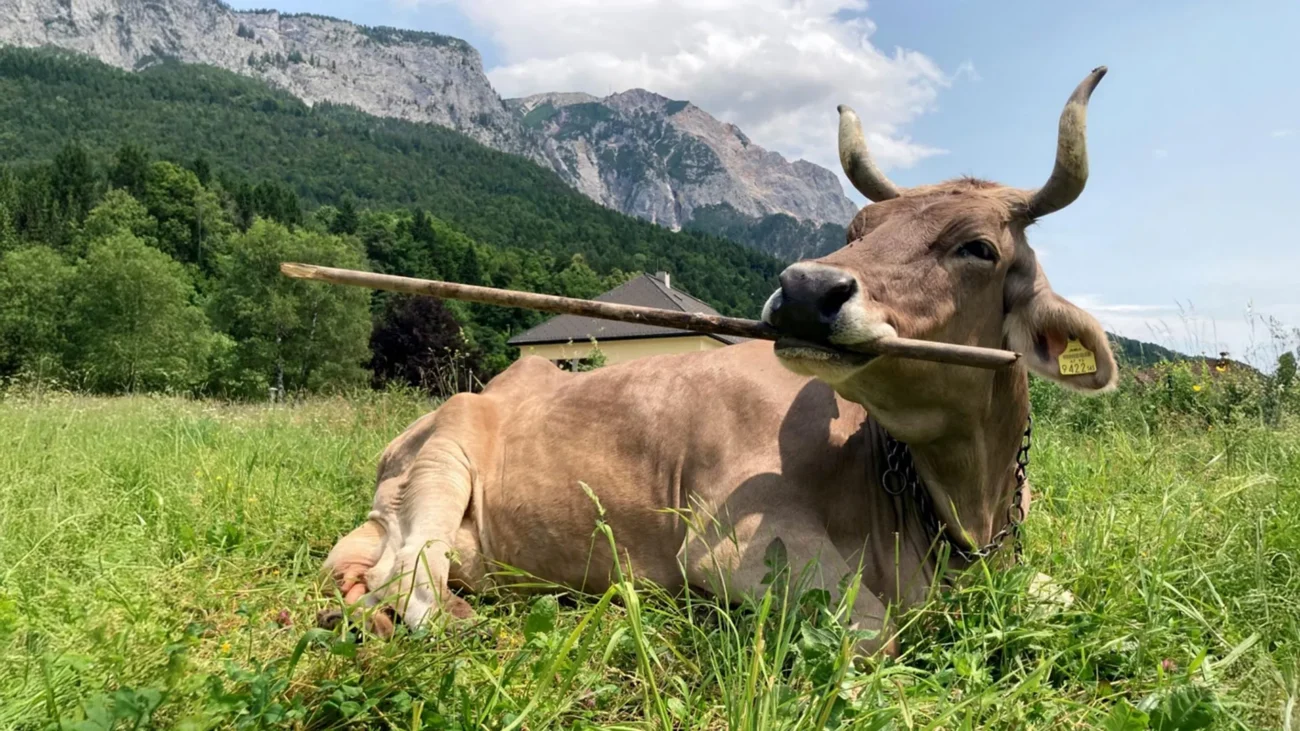
In a groundbreaking revelation that is challenging long-held assumptions about animal cognition, a domestic cow named Veronika has demonstrated a sophisticated level of tool use, a behavior previously thought to be exceptionally rare outside of primates. The findings, published in the esteemed scientific journal Current Biology, mark the first documented instance of purposeful tool utilization by a bovine, suggesting that cattle may possess cognitive capabilities far exceeding our current understanding. This discovery not only re-evaluates our perception of livestock intelligence but also prompts a broader reconsideration of how environmental factors and observational biases shape our understanding of animal capabilities.
From Cartoon Punchline to Scientific Marvel
The notion of a cow using tools was, until recently, the stuff of comedic absurdity, epitomized by Gary Larson’s iconic 1982 Far Side comic, "Cow Tools." The illustration depicted a cow proudly displaying a peculiar assortment of nonsensical objects, humorously playing on the widely accepted belief that cows lacked the intellectual capacity for such complex actions. The very premise of the comic relied on the perceived lack of manual dexterity and problem-solving skills in bovines. However, Veronika, a Swiss Brown cow residing as a companion animal, has become the unlikely protagonist in a real-life scientific narrative that directly confronts this long-standing stereotype.
Alice Auersperg, a cognitive biologist at the University of Veterinary Medicine, Vienna, and a lead researcher in the study, commented on the significance of the findings: "The findings highlight how assumptions about livestock intelligence may reflect gaps in observation rather than genuine cognitive limits. Veronika’s actions force us to question what we believe we know about these animals and the environments that foster their development."
The Genesis of Discovery: Veronika’s Unusual Habits
Veronika’s journey from an ordinary farm animal to a subject of scientific fascination began more than a decade ago with her owner, Witgar Wiegele. Wiegele, an organic farmer and baker, considers Veronika an integral part of his family, a far cry from the typical perception of cattle raised for agricultural purposes. It was Wiegele who first noticed Veronika engaging in a peculiar behavior: picking up sticks and using them to scratch her own body. This anomaly, initially observed as an unusual personal habit, eventually caught the attention of researchers when Wiegele recorded it on video and shared it with the scientific community.
"When I saw the footage, it was immediately clear that this was not accidental," Auersperg elaborated. "This was a meaningful example of tool use in a species that is rarely considered from a cognitive perspective. It presented an unparalleled opportunity to investigate the potential for complex behavior in cattle." The initial observations, though anecdotal, provided a compelling starting point for a more rigorous scientific inquiry.
Rigorous Testing: Unveiling Veronika’s Dexterity
To move beyond anecdotal evidence and establish the validity and nature of Veronika’s tool use, the research team designed a series of controlled experiments. The primary focus was on her interaction with a deck brush, an object chosen for its potential to be manipulated in various ways. The brush was strategically placed in different positions within Veronika’s enclosure, and her responses were meticulously documented.
The results of these structured tests were remarkably consistent and revealed a level of cognitive sophistication previously unassigned to cattle. Veronika did not interact with the brush randomly. Instead, she demonstrated a clear understanding of how to utilize its different parts to address specific scratching needs. Across numerous trials, her choices directly correlated with the areas of her body requiring attention.
Antonio Osuna-Mascaró, another key researcher on the team, stated emphatically: "We show that a cow can engage in genuinely flexible tool use. Veronika is not just using an object to scratch herself. She uses different parts of the same tool for different purposes, and she applies different techniques depending on the function of the tool and the body region." This observation moved the discussion beyond mere object manipulation to a more nuanced understanding of intentional and adaptive behavior.
Flexible and Multi-Purpose Tool Use: A Sophisticated Strategy
The detailed analysis of Veronika’s interactions with the deck brush unveiled distinct patterns indicative of advanced problem-solving. For larger, more robust areas of her body, such as her back, she consistently favored the bristled side of the brush, likely for more effective abrasion. Conversely, when targeting more sensitive regions on her lower body, she would switch to the smoother handle, demonstrating an awareness of different textures and their suitability for delicate areas.
Furthermore, Veronika exhibited control over her motor movements, adapting her technique to the task at hand. Scratching her upper body involved broader, more forceful motions, whereas movements directed at her lower extremities were characterized by slower, more precise actions. This fine-tuning of her physical engagement with the tool underscores a deliberate approach to achieving specific outcomes.
The scientific definition of tool use involves the employment of an external object to achieve a goal through physical interaction. Veronika’s actions not only meet this fundamental criterion but surpass it by demonstrating flexible and multi-purpose tool use. This level of behavior, where an individual utilizes different features of the same object for varied purposes, is exceptionally rare among non-human species. To date, it has been clearly documented in only a handful of species, most notably chimpanzees, making Veronika’s case even more extraordinary.
Overcoming Physical Limitations: Ingenuity in Action
Veronika’s tool use is classified as "egocentric tool use," meaning the tool is primarily used on her own body. While this form of tool use is generally considered less complex than using tools on external objects, it presents its own unique set of challenges, particularly for an animal lacking prehensile hands. Cows, by their very anatomy, must rely on their mouths to manipulate objects.
Despite this inherent physical limitation, Veronika displayed remarkable control and foresight. She appeared to anticipate the consequences of her actions, adjusting her grip and movements with evident deliberation to achieve the desired scratching effect. This suggests a cognitive process involving planning and an understanding of cause and effect, even without the benefit of opposable thumbs. The careful manipulation of the brush, the selection of specific areas, and the adaptation of her movements all point to a sophisticated understanding of her own anatomy and the properties of the tool.
Why This Behavior Might Be Rare: Environmental and Social Catalysts
The researchers posit that Veronika’s unique living conditions likely played a crucial role in fostering her remarkable cognitive abilities. Unlike the vast majority of cattle, who are raised in more utilitarian environments focused on production, Veronika has experienced a prolonged period of living in a complex and stimulating setting. Her daily interactions with humans, coupled with her access to a variety of objects she could explore and manipulate, created an environment ripe for innovation and learning.
This rich and varied environment provided the opportunities for exploration and experimentation that are often absent in more conventional livestock settings. The researchers explicitly noted in their findings: "[Veronika] did not fashion tools like the cow in Gary Larson’s cartoon, but she selected, adjusted, and used one with notable dexterity and flexibility. Perhaps the real absurdity lies not in imagining a tool-using cow, but in assuming such a thing could never exist." This statement directly challenges the anthropocentric biases that often underpin our interpretations of animal intelligence.
Rethinking Animal Intelligence: Broader Implications
Veronika’s discovery is more than just an isolated incident; it represents a significant expansion of the known repertoire of tool-using species. It strongly suggests that the capacity for complex cognitive behaviors like tool use may be more widespread in the animal kingdom than previously assumed, but perhaps simply has gone unnoticed due to a lack of targeted observation or conducive environments.
The implications of this research are far-reaching. It calls for a fundamental re-evaluation of how we perceive and interact with livestock. If cattle are capable of such sophisticated behaviors, it raises ethical questions about their welfare and the conditions under which they are raised. It also prompts a deeper investigation into the environmental and social factors that enable such behaviors to emerge.
The research team is actively pursuing these avenues, aiming to understand which specific conditions promote the development of complex cognitive skills in cattle. They are also extending an open invitation to the public and scientific community to report any similar observations of tool use in cattle. "Because we suspect this ability may be more widespread than currently documented," Osuna-Mascaró urged, "we invite readers who have observed cows or bulls using sticks or other handheld objects for purposeful actions to contact us." This collaborative approach aims to build a more comprehensive understanding of bovine cognition and potentially uncover further instances of this fascinating behavior.
The study’s findings are likely to spark further research into the cognitive abilities of domesticated animals, potentially leading to a paradigm shift in animal behavior studies and a more empathetic understanding of the intelligence present in species we often overlook. Veronika, the cow who once existed only in the realm of a cartoonist’s imagination, has now firmly established her place in the annals of scientific discovery, proving that the boundaries of animal intelligence are far more fluid and expansive than we ever dared to believe.

