


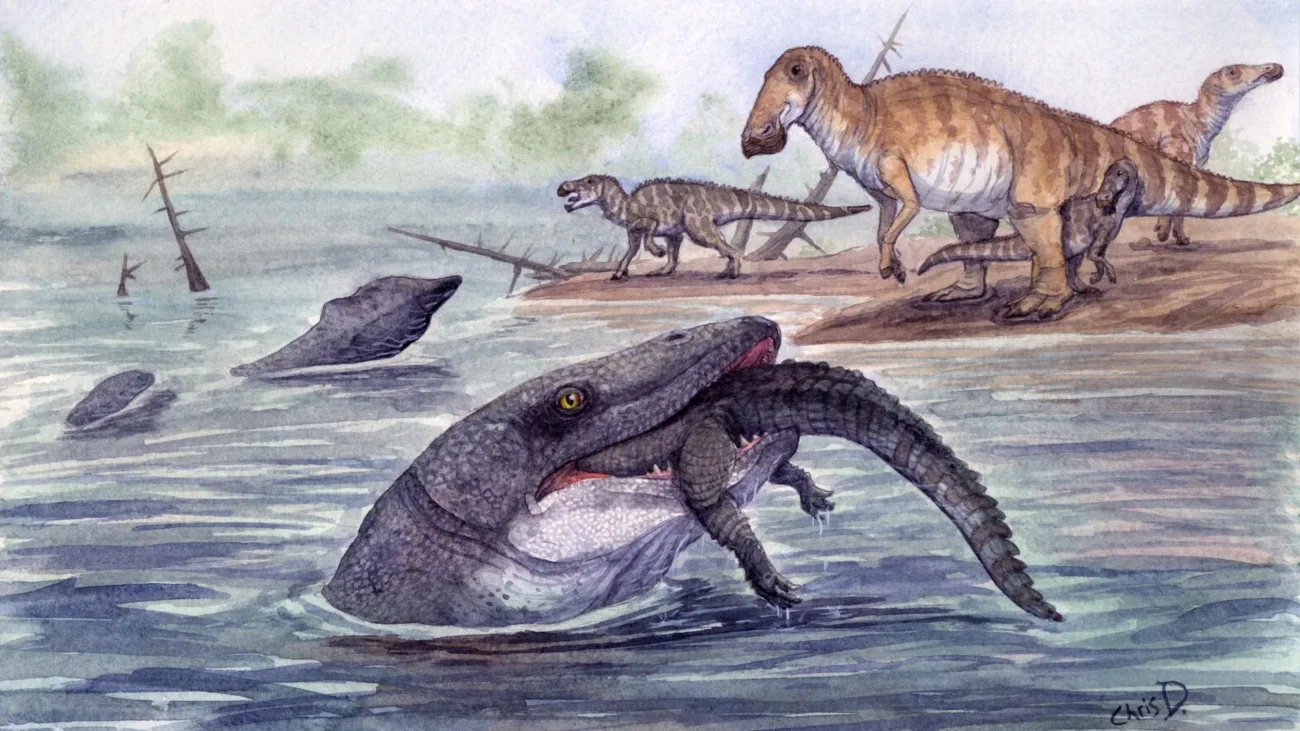
New evidence unearthed from the fossil-rich grounds of North Dakota suggests that mosasaurs, the colossal marine reptiles that once dominated ancient oceans, were not solely confined to saltwater environments. Researchers analyzing a mosasaur tooth, discovered in a river deposit dating back approximately 66 million years, have uncovered compelling signs that some of these formidable predators adapted to life in freshwater river systems during the twilight of the Cretaceous period. The tooth, likely belonging to an individual measuring up to 11 meters (approximately 36 feet) in length, indicates a significant shift in our understanding of these apex predators’ ecological range just before their extinction.
This groundbreaking discovery, led by an international team of scientists from Uppsala University in Sweden, in collaboration with institutions in the United States and the Netherlands, challenges the long-held perception of mosasaurs as exclusively marine behemoths. The findings, published in a recent scientific communication, paint a picture of remarkable adaptability in a changing world, hinting at a complex evolutionary trajectory for these creatures in their final million years.
The Unexpected Discovery in North Dakota
The mosasaur tooth in question was found in 2022 within a geological stratum known for its significant paleontological finds. This particular site yielded an extraordinary assemblage of fossils, including a tooth from the iconic tyrannosaur Tyrannosaurus rex and a jawbone from a crocodylian, a group of reptiles known for their amphibious nature. The region itself is already renowned for preserving fossils of terrestrial dinosaurs, most notably the duck-billed dinosaur Edmontosaurus. The presence of a marine reptile’s tooth within this mixed assemblage immediately sparked intrigue and a scientific puzzle: how did a creature believed to be a denizen of the open ocean end up preserved in a riverbed alongside terrestrial and freshwater species?
The unusual juxtaposition of these fossils—a giant marine reptile, a land-dwelling tyrant lizard, and a river-dwelling crocodile—underscored the anomaly. If mosasaurs were strictly oceanic, their remains would typically be found in marine sediments, not inland river deposits. This discovery necessitated a deeper investigation into the tooth’s origin and the environment in which it was deposited.
Unlocking Secrets Through Isotope Analysis
To unravel the mystery of the mosasaur’s presence in a river environment, the research team employed a sophisticated analytical technique: stable isotope analysis. This method examines the chemical composition of fossilized tooth enamel, providing insights into an animal’s diet and habitat. By focusing on isotopes of oxygen, strontium, and carbon, scientists could reconstruct the water sources the mosasaur encountered throughout its life.
The study, conducted at the Vrije Universiteit (VU) in Amsterdam, involved meticulously analyzing the mosasaur tooth alongside the T. rex tooth and the crocodylian jawbone, all of which are estimated to be from approximately the same temporal period, around 66 million years ago. This chronological overlap allowed for direct comparisons of their chemical signatures.
The results were striking. The mosasaur tooth enamel exhibited unusually high concentrations of the lighter oxygen isotope, oxygen-16 (16O). This isotopic signature is a strong indicator of freshwater environments, in contrast to the isotopic ratios typically found in marine settings. Similarly, the strontium isotope ratios within the tooth also pointed towards a freshwater habitat.
"Carbon isotopes in teeth generally reflect what the animal ate," explained Melanie During, one of the study’s corresponding authors. "Many mosasaurs have low 13C values because they dive deep. The mosasaur tooth found with the T. rex tooth, on the other hand, has a higher 13C value than all known mosasaurs, dinosaurs and crocodiles, suggesting that it did not dive deep and may sometimes have fed on drowned dinosaurs." This observation suggests a feeding strategy that differed from its purely marine counterparts, potentially exploiting resources available in a riverine ecosystem.
Further analysis of two additional mosasaur teeth, recovered from slightly older sites in North Dakota, revealed similar freshwater isotopic signatures. "These analyses show that mosasaurs lived in riverine environments in the final million years before going extinct," stated During, emphasizing the consistency of the findings across multiple specimens.
A World in Transition: The Shifting Seaway
The researchers propose that these freshwater adaptations were facilitated by significant environmental changes occurring at the time. The Western Interior Seaway, a vast inland sea that once divided the North American continent, was undergoing a gradual transformation. Increasing freshwater runoff from surrounding landmasses led to a dilution of the seaway’s salinity. Over time, what was once a predominantly saltwater environment transitioned into brackish and eventually largely freshwater conditions, particularly in its more northern and western reaches. This process is analogous to the modern-day Gulf of Bothnia, which exhibits varying salinity levels.
The scientists hypothesize that this influx of freshwater created a distinct stratification within the seaway, forming a "halocline." This phenomenon would have resulted in a layer of lighter, less saline freshwater floating above denser, saltier marine water. The isotope data gathered from the mosasaur teeth aligns with this proposed scenario.
To further validate their hypothesis, the team analyzed fossils of other marine animals from the same period and location. "For comparison with the mosasaur teeth, we also measured fossils from other marine animals and found a clear difference," noted Per Ahlberg, a co-author of the study. "All gill-breathing animals had isotope signatures linking them to brackish or salty water, while all lung-breathing animals lacked such signatures. This shows that mosasaurs, which needed to come to the surface to breathe, inhabited the upper freshwater layer and not the lower layer where the water was more saline." This crucial distinction highlights the mosasaurs’ reliance on the oxygen-rich upper layers, which were becoming increasingly freshwater-dominated.
Evolutionary Flexibility and Adaptation
The evidence suggests that mosasaurs were not merely passively subjected to environmental change but actively adapted to these new conditions. The ability of large predators to shift between habitats is a recurring theme in evolutionary history, demonstrating remarkable resilience and adaptability.
"Unlike the complex adaptation required to move from freshwater to marine habitats, the reverse adaptation is generally simpler," Dr. During commented, suggesting that the transition from saltwater to freshwater might have been a more straightforward evolutionary step for these creatures.
This adaptive capacity is mirrored in modern fauna. River dolphins, for instance, thrive exclusively in freshwater environments despite their marine ancestry. Similarly, the estuarine crocodile, often referred to as the saltwater crocodile, exhibits remarkable flexibility, traversing freely between rivers and the open ocean to hunt, showcasing a broad ecological niche.
A Bus-Sized Predator in an Unexpected Realm
Fossil evidence of mosasaurs is abundant in marine deposits across North America, Europe, and Africa, dating from approximately 98 to 66 million years ago. Their presence in North Dakota, particularly in a riverine context, is therefore exceptionally rare and significant. The size of the recovered tooth, estimated to belong to an animal up to 11 meters (36 feet) long, is comparable to the length of a modern bus. This estimation is further supported by earlier discoveries of mosasaur bones at nearby sites.
While the exact genus of the mosasaur cannot be definitively identified from a single tooth, its characteristics suggest it may have belonged to a prognathodontine mosasaur. This group, which includes genera like Prognathodon, is known for its massive skulls, powerful jaws, and robust teeth, adaptations indicative of opportunistic predation on large prey.
"The size means that the animal would rival the largest killer whales, making it an extraordinary predator to encounter in riverine environments not previously associated with such giant marine reptiles," stated Ahlberg. The presence of such a formidable predator in freshwater rivers would have had significant implications for the riverine ecosystems of the late Cretaceous.
Implications for Late Cretaceous Ecosystems
The discovery of freshwater-habituating mosasaurs fundamentally alters our perception of late Cretaceous ecosystems. It implies that these apex predators occupied a broader ecological niche than previously understood, potentially competing with or preying upon other large freshwater fauna, including juvenile crocodiles and large fish. The presence of a T. rex tooth in close proximity to the mosasaur tooth also raises intriguing questions about potential interactions between these two powerful predators, though direct evidence of predation remains elusive.
This adaptability might have provided some mosasaur populations with a buffer against the environmental pressures that ultimately led to their extinction. While the exact causes of the Cretaceous-Paleogene extinction event remain a subject of intense scientific study, likely involving a catastrophic asteroid impact and subsequent environmental upheaval, species with broader habitat ranges and diverse food sources may have possessed a greater chance of survival. The findings suggest that some mosasaur lineages were already evolving strategies that could have aided in navigating a changing world, even if ultimately unsuccessful against the scale of the K-Pg extinction.
A Collaborative Scientific Endeavor
The research behind this significant discovery represents a testament to international scientific collaboration. The study was a joint effort involving scientists from Uppsala University, Eastern West Virginia Community and Technical College in Moorefield, West Virginia, Vrije Universiteit Amsterdam, and the North Dakota Geological Survey. This multidisciplinary approach, combining paleontological fieldwork with advanced geochemical analysis, was crucial in piecing together this complex ecological puzzle.
The findings are also rooted in the doctoral research of Melanie During, who defended her thesis at Uppsala University in November 2024. Her extensive work on mosasaur paleobiology and paleoecology has been instrumental in shedding light on these ancient creatures.
This ongoing research continues to redefine our understanding of prehistoric life, revealing that the story of these ancient giants is far more complex and dynamic than previously imagined, with their final chapters unfolding not just in the vast oceans, but also in the vital river systems that shaped the ancient landscape. The North Dakota find serves as a potent reminder that the fossil record still holds many secrets, waiting to be unearthed and interpreted by dedicated scientific inquiry.

