


Thousands of years ago, on the Caribbean island of Hispaniola, a dramatic drama unfolded within the dark confines of a cave. A giant barn owl, a formidable predator, carried its latest catch – a hutia, a rodent endemic to the region – back to its lair. The meal, a necessity for survival, was swift and conclusive. The owl’s young were fed, and the unfortunate hutia was reduced to scattered remains. It was an event destined to be lost to time, a fleeting moment in the ancient ecosystem. However, the story did not end there. A minuscule architect, a burrowing bee, later sought refuge and a place to build its nest. Driven by instinct, it began to excavate into the clay-rich silt that had accumulated in the cave’s depths. Its journey inward was unexpectedly halted when it encountered the fossilized remains of the hutia. This seemingly insignificant encounter, however, would lead to a remarkable paleontological discovery, revealing an unprecedented behavior in the insect world and a unique window into the ancient past. The bee, unable to fly out of the cave once it had committed to nesting, became a permanent resident of the ancient predator’s dining hall, its presence preserving a story that would echo through millennia.
An Unexpected Sanctuary: Fossilized Remains as Ideal Nesting Sites
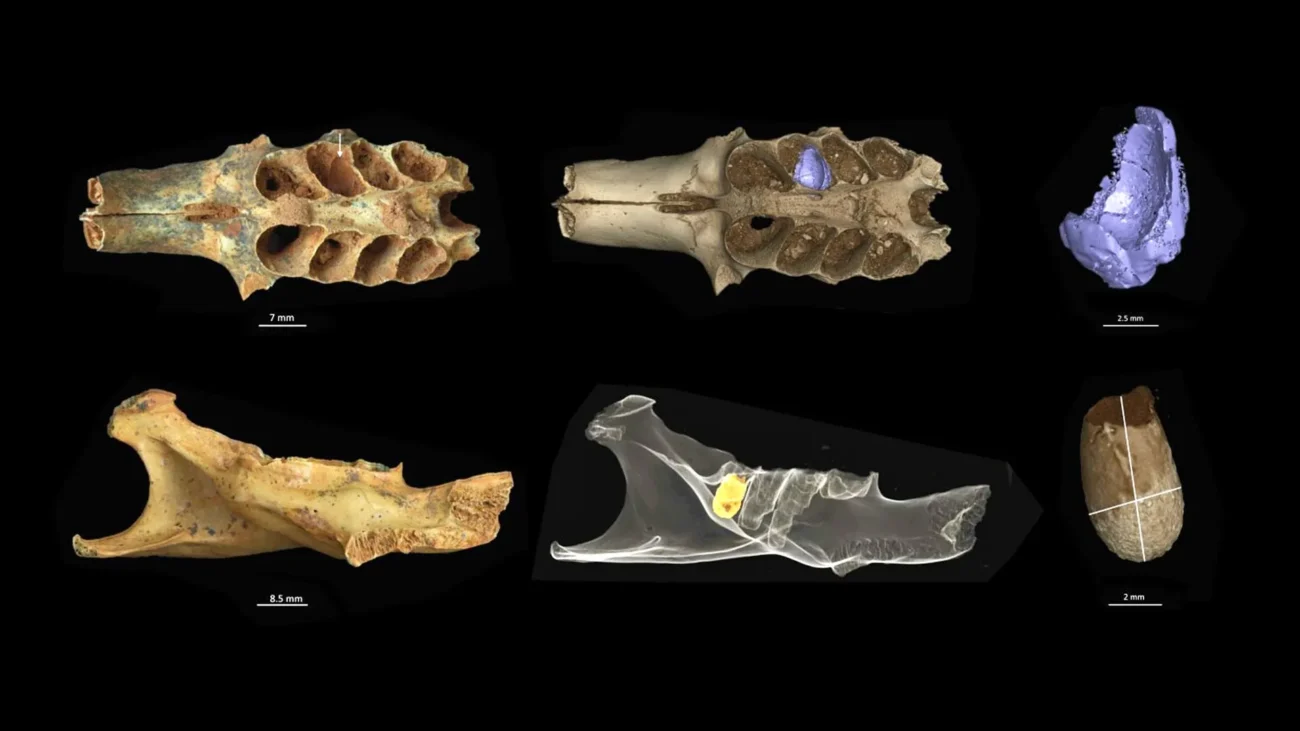
The bee’s discovery was serendipitous. As it dug into the silt, it stumbled upon the hutia’s jawbone. While the teeth were long gone, the small sockets in the jaw, known as alveoli, remained intact. These hollow spaces, perfectly sized and surprisingly smooth, presented an ideal opportunity for the bee. Instead of expending energy to construct a nest from scratch, the bee found a pre-made, secure cavity. It began to line these alveoli with a secretion, a waxy substance that would harden to create a waterproof and protective environment for its developing brood. This ingenious adaptation allowed the bee to bypass the challenges of finding suitable soil or constructing a complex burrow in the cave’s less hospitable terrain.
This initial act of nesting was not an isolated incident. Over time, it appears that this specific species of burrowing bee discovered the advantage of these fossilized cavities. The cave, having served as a long-term feeding site for generations of giant barn owls, contained a wealth of hutia remains. The bees, capitalizing on this resource, began to utilize these natural hollows within the fossilized bones as ready-made nesting sites. Each alveolus, a testament to the hutia’s life, was repurposed as a cradle for new life, a testament to nature’s ability to adapt and utilize available resources in the most unexpected ways.
The Paleontological Puzzle: Uncovering the Bee’s Secret Legacy
The remarkable nesting behavior remained hidden for thousands of years, preserved within the geological strata of the cave. It was only through the meticulous work of paleontologists that this ancient secret was brought to light. The discovery was not a sudden revelation but rather a consequence of careful observation and a willingness to question initial assumptions.
Lazaro Viñola Lopez, then a doctoral student at the Florida Museum of Natural History, was excavating fossils at the Cueva de Mono in the southern Dominican Republic. His focus was on a particular species of hutia, a species that was proving to be rare in other locations on the island. The Cueva de Mono, with its abundant hutia fossils, suggested it had been a significant feeding ground for giant barn owls over extended periods.
During the excavation process, Viñola Lopez encountered fossilized hutia mandibles. His initial instinct, and the standard practice in paleontology, was to meticulously clean out all sediment and debris from the alveoli. However, something about one particular cavity caught his attention. Its inner surface was unusually smooth, a stark contrast to the rough, porous texture typically associated with bone. This anomaly piqued his curiosity, setting him on a path of deeper investigation.
From Wasp Nests to Bee Hotels: A Correction of Scientific Identity
Viñola Lopez’s initial hypothesis was that the smooth-walled cavities were the remnants of wasp nests. He recalled a similar find in Montana in 2014, where wasp cocoons were discovered mixed with dinosaur fossils. He began to formulate the idea of publishing a short paper detailing this occurrence of wasp nests within ancient mandibles.
He shared his initial findings and hypothesis with his colleague, Mitchell Riegler, also a doctoral student at the museum. Riegler, initially occupied with other research, expressed some skepticism, viewing the potential paper as a "niche project." However, the idea was not entirely dismissed.
The project was rekindled when Riegler accepted a challenge from a former advisor to write a scientific paper within a week. This collaborative endeavor, described by Riegler as a "game back and forth," provided the impetus to revisit the mysterious smooth-walled cavities.
The team began to delve deeper into the nature of these structures. While initially leaning towards the wasp nest hypothesis, their research into ichnofossils – traces of past biological activity such as footprints, droppings, or nests – revealed discrepancies. The defining characteristic of wasp nests is their rough texture, formed from chewed plant material mixed with saliva. The structures found within the hutia fossils, however, were distinctly smooth. This led them to reconsider their identification.
Further research pointed towards bees. Many species of burrowing bees, when constructing their nests, coat the inner walls with a waxy secretion. This secretion, upon hardening, creates a waterproof and polished surface, precisely matching the observed texture of the fossilized cavities. The realization that they were not examining wasp nests but rather bee nests marked a significant shift in the scientific importance of their discovery.
An Unprecedented Behavior: Bees Utilizing Fossilized Structures
The correction from wasps to bees elevated the significance of the find. The use of pre-existing fossil structures by burrowing bees without any alteration was an unprecedented behavior. While there was one known instance of burrowing bees nesting inside a cave, and another report of bees drilling into human bones, this discovery represented the first documented case of bees directly occupying natural cavities within fossilized animal remains as nesting sites. This behavior was not merely opportunistic; it was a sophisticated adaptation to an environment with limited suitable nesting grounds.
Recognizing the unique nature of their findings, the researchers broadened their scope. They consulted with experts in modern bee behavior and meticulously reviewed existing scientific literature. Viñola Lopez returned to the Cueva de Mono to conduct a more thorough geological analysis of the cave’s layers, seeking to understand the environmental conditions that might have led to this behavior.
The team’s research was nearly compromised when plans emerged to develop the land surrounding the cave, with proposals to convert it into a septic tank. Fortunately, these plans were ultimately halted. However, the threat spurred the researchers into a "rescue mission" to recover as many fossils as possible before any potential damage could occur. This urgent effort proved successful, yielding a substantial collection of valuable specimens.
A Diverse Ecosystem of Nests: Beyond the Hutia Jaws
The final study, published in the prestigious journal Proceedings of the Royal Society B, provided a comprehensive account of the cave’s history and the extraordinary nesting habits of these bees. The discovery revealed that the bees’ preferred nesting sites were not confined to the hutia mandibles.
In one remarkable instance, a bee nest was found nestled within the pulp cavity of a sloth tooth. These giant sloths once roamed the Caribbean but eventually disappeared, likely due to human arrival. Another nest was identified inside a hutia vertebra, occupying the space where the spinal cord would have been. This demonstrated a remarkable versatility in the bees’ selection of nesting locations, utilizing a variety of fossilized bone structures.
Further investigation, employing CT scans, unveiled the intricate layering of these nests. Instead of excavating new tunnels, the bees exhibited a remarkable tendency to reuse existing cavities if they were unoccupied. In one striking example, a single alveolus contained six distinct nests, one nested inside another, reminiscent of the iconic Russian nesting dolls. This behavior suggests a strong instinct for resource conservation and efficient utilization of available nesting spaces.
Karst Landscapes and the Driving Force Behind Adaptation
The researchers proposed a compelling explanation for this unusual nesting behavior: the unique geological makeup of the surrounding landscape. The region where the Cueva de Mono is located is characterized by karst topography. This type of terrain is composed of sharp, jagged limestone formations, often lacking stable soil cover.
"The area we were collecting in is karst, so it’s made of sharp, edgy limestone, and it’s lost all of its natural soils," explained Riegler, drawing from personal experience of navigating the treacherous terrain. "I actually fell on it at one point, so I can tell you all about it."
In such environments, any soil that does accumulate on the surface is prone to being washed away, often finding its way into caves. These accumulated deposits within caves, though pockets of material, may have represented some of the only viable nesting conditions for burrowing bees in the region. The fossilized bone cavities, therefore, offered a stable and secure alternative to the precarious surface conditions, providing a safe haven for reproduction.
A Cave Full of Untold Stories: Ongoing Research and Future Discoveries
The research team continues to examine other fossils recovered from the Cueva de Mono, anticipating further revelations about the cave’s ancient inhabitants and their ecological interactions. The ongoing study promises to shed more light on the complex interplay between predators, prey, and the environment, and how life adapts to fill ecological niches in unexpected ways.
The discovery of these fossilized bee nests stands as a testament to the power of observation and the intricate tapestry of life that has unfolded on Earth over millennia. It highlights how even the remnants of past meals can be transformed into nurseries for future generations, showcasing nature’s remarkable capacity for adaptation and resilience. The Cueva de Mono, once a silent tomb for its ancient inhabitants, has revealed itself to be a vibrant archive, holding stories of survival, adaptation, and the enduring cycle of life.

