


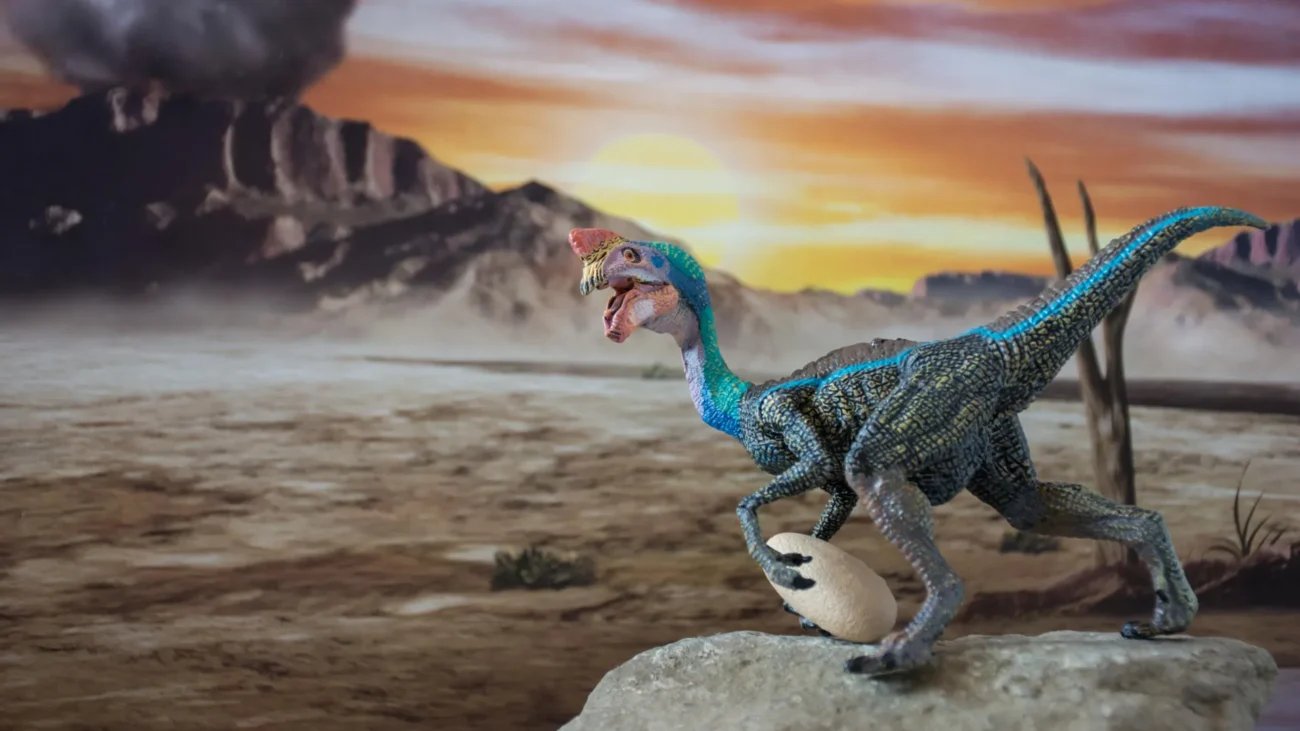
The age-old question of how oviraptors, the bird-like yet flightless dinosaurs that roamed the Earth millions of years ago, nurtured their young has taken a significant step toward resolution. A groundbreaking study published in the esteemed journal Frontiers in Ecology and Evolution sheds new light on the incubation strategies of these fascinating creatures, suggesting a sophisticated interplay between parental care and environmental conditions, a method distinct from both modern crocodiles and birds.
For decades, paleontologists have grappled with understanding the precise mechanisms behind oviraptor egg incubation. Unlike modern reptiles like crocodiles, which primarily rely on ambient heat from their surroundings to warm their buried eggs, or birds, which exhibit direct parental thermoregulation by sitting on their nests, the oviraptor’s approach remained elusive. This new research, spearheaded by a team of Taiwanese scientists, employed a multi-faceted approach, combining advanced heat transfer simulations with meticulously crafted physical experiments to reconstruct and analyze the incubation process of these ancient dinosaurs.
Reconstructing the Oviraptor Nest: A Blend of Science and Art
The study focused on Heyuannia huangi, an oviraptor species that thrived in what is now China during the Late Cretaceous period, approximately 70 to 66 million years ago. This dinosaur, estimated to be around 1.5 meters in length and weighing approximately 20 kilograms, exhibited a unique nesting behavior, constructing semi-open nests arranged in intricate, multi-ringed patterns.
To accurately simulate the oviraptor’s nesting environment, researchers embarked on an ambitious project to build a life-sized model of the dinosaur and a realistic replica of its nest. The oviraptor model’s torso was ingeniously constructed using a combination of polystyrene foam and a sturdy wooden frame, with layers of cotton, bubble paper, and fabric meticulously applied to mimic the soft tissues of the extinct animal. The eggs themselves were crafted from casting resin, designed to approximate the size, shape, and thermal properties of actual oviraptor eggs. This detailed reconstruction was crucial for accurately modeling heat transfer dynamics within the nest.
"Part of the difficulty lies in reconstructing oviraptor incubation realistically," explained Chun-Yu Su, the study’s first author, who was a high school student in Taichung, Taiwan, when the research was conducted. "For example, their eggs are unlike those of any living species, so we invented the resin eggs to approximate real oviraptor eggs as best as we could."
The experimental setup involved arranging these resin eggs in double rings, mirroring the arrangement observed in fossilized oviraptor nests. This precise replication was vital for understanding how heat would have distributed within the clutch and how the presence of an incubating adult might have influenced these temperatures.
Unraveling Heat Dynamics: The Crucial Role of Adult Position and Environment
The research team meticulously tested the impact of both the brooding adult’s presence and prevailing environmental conditions on egg temperatures and subsequent hatching outcomes. Their findings revealed a fascinating correlation between the relative position of the incubating oviraptor and the eggs, and the resulting hatching patterns.
"We show the difference in oviraptor hatching patterns was induced by the relative position of the incubating adult to the eggs," stated Dr. Tzu-Ruei Yang, the senior author and an associate curator of vertebrate paleontology at Taiwan’s National Museum of Natural Science. This observation is pivotal, suggesting that oviraptors did not simply sit on their eggs in a manner analogous to modern birds, but rather utilized their body heat in a more nuanced way, perhaps positioning themselves to maximize warmth transfer to specific parts of the clutch.
The experiments demonstrated that in colder environmental conditions, the presence of a brooding adult led to significant temperature variations within the nest. Specifically, the outer ring of eggs experienced temperature fluctuations of as much as 6 degrees Celsius. Such temperature differentials are known to induce asynchronous hatching, where eggs within the same clutch hatch at staggered intervals. This is a common strategy in some modern birds, allowing parents to manage resources more effectively.
Conversely, in warmer environments, these temperature variations within the nest were dramatically reduced, dropping to approximately 0.6 degrees Celsius. This suggests that in warmer climates, external heat sources, such as solar radiation, likely played a more dominant role in moderating egg temperatures and influencing hatching patterns.
"It’s unlikely that large dinosaurs sat atop their clutches," Dr. Yang explained. "Supposedly, they used the heat of the sun or soil to hatch their eggs, like turtles. Since oviraptor clutches are open to the air, heat from the sun likely mattered much more than heat from the soil." This inference points towards a more passive, yet effective, incubation strategy that leveraged the ambient environment.
Oviraptor Incubation Efficiency: A Different Strategy, Not a Lesser One
A key aspect of the study involved a comparative analysis of oviraptor incubation efficiency against that of modern birds. Most contemporary avian species rely on what is known as Thermoregulatory Contact Incubation (TCI). This method requires the adult bird to directly sit on its eggs, acting as the primary heat source and maintaining a consistent, optimal temperature across the entire clutch. For TCI to be effective, the adult must be able to make physical contact with all the eggs simultaneously.
The oviraptor’s ring-shaped egg arrangement presented a significant challenge to this direct contact method. The study concludes that oviraptors were likely unable to achieve the necessary full-clutch contact required for effective TCI. This inability, coupled with their body size and the open nature of their nests, strongly suggests they did not incubate their eggs in the same way as modern birds.
"Oviraptors may not have been able to conduct TCI as modern birds do," Su elaborated. Instead, the research posits that oviraptors functioned as "co-incubators," with their own body heat working in conjunction with environmental heat sources, such as solar radiation. This combined approach, while deemed less efficient than the TCI employed by most modern birds, was likely well-suited to their specific nesting style and ecological niche, which appears to have evolved from more deeply buried nests to the semi-open structures observed in Heyuannia huangi.
Dr. Yang emphasized that this difference in incubation strategy does not imply superiority or inferiority. "Modern birds aren’t ‘better’ at hatching eggs. Instead, birds living today and oviraptors have a very different way of incubation or, more specifically, brooding," he stated. "Nothing is better or worse. It just depends on the environment." This perspective highlights the adaptive nature of evolutionary strategies, where different methods can be equally successful within their respective contexts.
Implications for Dinosaur Parenting and Future Research
The findings of this study offer significant new insights into the complex world of dinosaur parenting, specifically shedding light on the nurturing behaviors of oviraptors. While the researchers acknowledge certain limitations, such as the fact that their experiments were conducted using reconstructed nests and under modern environmental conditions, which undoubtedly differ from those of the Late Cretaceous, their work provides a robust framework for future investigations.
The study’s authors also suggest that oviraptors likely experienced longer incubation periods compared to modern birds, a reasonable inference given their less direct and potentially less consistent heat source. This extended incubation could have had implications for parental investment and vulnerability during the nesting phase.
The innovative methodology employed by the Taiwanese team—the fusion of physical modeling and sophisticated simulations—opens exciting new avenues for studying dinosaur reproduction. By creating tangible, experimentally verifiable models, researchers can move beyond purely theoretical interpretations of fossil evidence and engage in more direct testing of hypotheses.
This research also holds a broader significance, particularly for aspiring scientists. Dr. Yang expressed his hope that the study serves as an inspiration, especially for students in Taiwan. "There are no dinosaur fossils in Taiwan, but that does not mean that we cannot do dinosaur studies," he remarked, underscoring the power of scientific ingenuity and dedication in overcoming geographical limitations. This sentiment highlights that the pursuit of knowledge about the prehistoric world is accessible to all, regardless of the immediate availability of fossil discoveries.
The study’s contribution to our understanding of oviraptor behavior is substantial. It moves beyond the simplistic dichotomy of reptile-like or bird-like incubation and presents a more nuanced picture of a dinosaur species that developed a unique strategy tailored to its environment and physiology. This sophisticated approach to egg incubation, combining parental presence with environmental influences, paints a richer portrait of the complex lives and parental dedication of these remarkable bird-like dinosaurs. The ongoing exploration of dinosaur reproduction continues to reveal the astonishing diversity of life that once inhabited our planet.

