


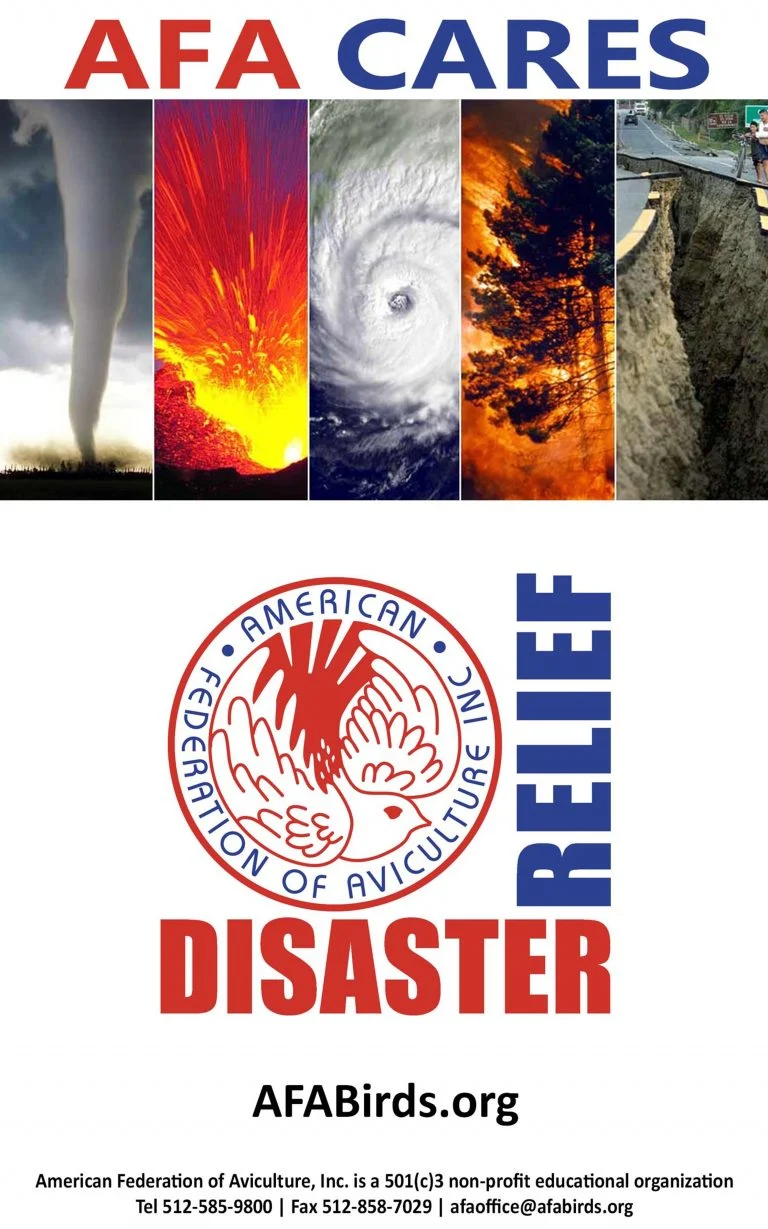
The American Federation of Aviculture (AFA) has formalized a national Disaster Relief Team, a specialized network of Regional Directors and localized volunteers strategically positioned across the United States to address the unique vulnerabilities of avian populations during catastrophic events. This organizational framework is designed to optimize response times by leveraging regional expertise and real-time weather monitoring, ensuring that bird owners and aviculturists receive immediate assistance when environmental hazards arise. By decentralizing its response capabilities, the AFA aims to provide a lifeline for both companion birds and large-scale avicultural collections that are often overlooked in general emergency management protocols.
The Strategic Framework of Avian Disaster Mitigation
Disaster preparedness in the context of aviculture requires a nuanced understanding of various environmental threats, ranging from the rapid onset of tornados and wildfires to the prolonged challenges of floods and ice storms. Mary Ellen LePage, a former Fire Chief for CalFire and a veteran in emergency services, emphasizes that the efficacy of a rescue operation is dictated by the quality of the "Pre-Event" planning phase. Unlike traditional pets, birds possess highly sensitive respiratory systems and specific metabolic needs that make them particularly susceptible to the secondary effects of disasters, such as smoke inhalation, heat stress, or sudden temperature drops during power outages.
The AFA’s disaster relief model operates on a tiered system. Regional Directors monitor localized meteorological data and coordinate with local bird clubs to establish a chain of command. This structure mirrors the federal Incident Command System (ICS), allowing for a seamless integration with governmental emergency responders when necessary. For the individual bird owner, the mandate is clear: the complexity of avian transport and care necessitates a level of preparation that far exceeds standard household emergency kits.
Comprehensive Preparedness: The Triple-Plan Doctrine
Effective disaster management for aviculturists is built upon the "Plan! Plan! Plan!" doctrine, which focuses on supply readiness, identification, and relocation logistics. The logistical burden of moving birds—especially in breeding facilities—can be astronomical. Experts suggest that carriers and cages should not only be pre-assembled but stored in accessible, high-velocity locations. In scenarios where space is a constraint, the utilization of overhead garage storage or proximity-based placement near permanent flights is recommended.
A critical, yet often overlooked, component of preparedness is the standardization of hardware. For large collections, keying all cage and flight locks to a single master key can save precious minutes during an evacuation. Furthermore, the assembly of a "capture kit" is essential. This kit should include specialized tools such as nets, towels, and heavy-duty gloves for handling non-tame or stressed birds. For those in wildfire-prone areas, specialized equipment such as wire cutters and chainsaws may be necessary to clear debris or breach damaged structures to reach trapped animals.
Identification and Documentation as a Legal Safeguard
In the chaos of a mass evacuation, the risk of avian displacement or loss of ownership proof is significant. The AFA recommends a dual-layer identification strategy involving both physical leg bands and subcutaneous microchips. However, physical identification is only effective if matched with redundant record-keeping. Aviculturists are urged to maintain digital and physical copies of bird records, including photographs, veterinary history, and proof of purchase or breeding. Storing these documents in a remote "cloud" server or a secondary physical location ensures that ownership can be verified even if the primary residence is destroyed.

Logistics of Evacuation and Sheltering in Place
The decision to evacuate is a complex calculation involving the speed of the approaching threat and the scale of the avian collection. For those with large parrots or extensive breeding stock, the transition from a permanent facility to a mobile one requires significant vehicular assets. Rental vehicles used for this purpose must be vetted for cargo-area ventilation, as the lack of airflow can be fatal for birds in transit.
A key strategic element is the pre-identification of "Safe Zones." This involves establishing reciprocal agreements with other aviculturists, barns, or commercial warehouses located outside of high-risk corridors. Because emergency services often restrict road access during disasters, the AFA advises that evacuations must occur well before mandatory orders are issued to avoid gridlock and fuel shortages.
For those who choose or are forced to shelter in place, self-sufficiency is the priority. This requires a robust infrastructure including:
- Independent Power Generation: To maintain climate control and lighting.
- Water and Food Reserves: A minimum of two weeks of supplies, rotated regularly to prevent spoilage.
- Geospatial Awareness: Maintaining exact GPS coordinates is vital for rescuers, as landmarks and street signs are frequently obliterated in hurricanes or tornados.
Field Operations and the Incident Command System (ICS)
When private efforts fail, the AFA Disaster Relief Team transitions into field operations. These operations are conducted under the oversight of the Occupational Safety and Health Administration (OSHA) and the Incident Command System (ICS). The ICS is a standardized approach to the command, control, and coordination of emergency response, providing a common hierarchy within which responders from multiple agencies can be effective.
Rescue volunteers must operate with professional legitimacy. The AFA provides magnetic signage, identification cards, and official apparel to its volunteers to facilitate passage through police checkpoints. However, the ultimate authority in any disaster zone is the Incident Commander (IC). Access to restricted areas is not guaranteed and must be negotiated through the IC or their designated representative, emphasizing the need for rescuers to be trained in official protocols.
Technical Rescuer Guidelines and Biosecurity
Rescuers entering a disaster zone face high-stress environments where bird identification and safety are paramount. The AFA provides several mandates for field agents:
- Prioritization: Only birds in immediate life-threatening situations should be removed to minimize unnecessary stress.
- Pair Integrity: Maintaining the identity of breeding pairs is essential for the long-term viability of the birds’ genetic lines. Rescuers are instructed to use permanent markers to annotate crates with the bird’s original location and perceived pairings.
- Improvised Housing: In the absence of standard carriers, rescuers are trained to utilize ventilated plastic storage bins, cardboard boxes, or even paper bags for smaller species.
- Biosecurity: Moving birds from different environments into a centralized rescue hub creates a significant risk of disease transmission. Rescuers must coordinate with the AFA to identify quarantine-capable housing.
Data Analysis: The Rising Frequency of Avian Emergencies
The necessity for a structured avian relief program is underscored by recent climate data. According to the National Oceanic and Atmospheric Administration (NOAA), the United States has seen a marked increase in "billion-dollar disasters." In the last decade, the frequency of high-intensity wildfires and Category 4 or 5 hurricanes has placed unprecedented pressure on animal welfare organizations.
Unlike dogs and cats, for which the 2006 PETS (Pets Evacuation and Transportation Standards) Act provides some federal framework, exotic birds often fall into a regulatory grey area. This gap in federal protection makes the AFA’s role critical. Data suggests that pet birds are present in approximately 5.7 million American households. When factoring in professional aviaries and conservation centers, the number of birds at risk during a national-level disaster reaches into the tens of millions.
Institutional Response and Community Impact
The American Federation of Aviculture serves as the primary liaison between the avicultural community and emergency services. Through its central office (reachable at 512-585-9800 or [email protected]), the organization facilitates the movement of food, medical supplies, and volunteer labor to affected areas.
The broader impact of these efforts extends beyond animal welfare. The preservation of rare avian species during disasters is a matter of biological conservation. Many aviculturists hold the "insurance populations" of species that are nearly extinct in the wild. The loss of a single major aviary due to a lack of disaster planning can represent the loss of decades of genetic diversity.
Conclusion: A Call for Proactive Stewardship
The recurring theme in the AFA’s disaster relief philosophy is that the survival of birds in a crisis is directly proportional to the foresight of their caretakers. While the AFA Disaster Relief Team provides a formidable safety net, the primary responsibility remains with the owner to develop a written, posted, and practiced evacuation plan.
As environmental volatility increases, the integration of professional firefighting experience—exemplified by contributors like Mary Ellen LePage—with specialized avicultural knowledge becomes the gold standard for animal emergency management. The AFA continues to solicit experienced bird handlers to join its volunteer ranks, ensuring that when the next disaster strikes, the avian community is not merely reactive, but resilient. Through rigorous planning, standardized identification, and a deep understanding of emergency command structures, the AFA aims to ensure that no bird is left behind in the wake of a storm.

