


The landscape of animal ownership in the United States is undergoing a period of rapid legislative transformation, prompting organizations like the American Federation of Aviculture (AFA) to intensify their oversight of local, state, and federal legal developments. At its core, legislation is defined as the proposing of laws, but in the contemporary political climate, this process has become a complex arena where the interests of bird owners, breeders, and exhibitors often clash with well-funded lobbying efforts. The primary vehicle for these changes is the "Bill," a formal proposal that outlines intended legal frameworks, enforcement mechanisms, and societal impacts. While these documents often include summaries intended to clarify their purpose, legal experts warn that such summaries can be reductive or even misleading, obscuring the long-term consequences for the avicultural community.
Most modern bills do not emerge in a vacuum; they are frequently the product of specific advocacy groups. Animal rights and animal welfare organizations, particularly those with dedicated lobbying arms, draft legislation and present it to sympathetic representatives for introduction into the legislative system. While "animal welfare" focuses on the humane treatment and well-being of animals, "animal rights" often moves toward an abolitionist philosophy that seeks to end the human-animal bond entirely, including the keeping of pets. Because these agendas often diverge from the practical realities and needs of the general public, the AFA emphasizes that vigilant monitoring is the only way to ensure that the rights of bird keepers are not inadvertently or intentionally stripped away.
The Structural Hierarchy of Avian Law: Bills, Ordinances, and Regulations
Understanding the impact of legislation requires a clear distinction between the various levels of legal authority. A "Bill" is a proposed law at the state or federal level that must pass through legislative bodies, such as a State General Assembly or the U.S. Congress, before being signed into law. At the local level, these are referred to as "ordinances." Local ordinances, while often appearing benign, represent some of the most immediate threats to bird owners.
A common example of "creeping legislation" involves numerical limits on pets. An ordinance might initially be proposed to limit the number of dogs or cats in a single household to six, a measure that many residents might view as a reasonable way to prevent hoarding or noise nuisances. However, if that ordinance is later amended to include "all animals" or specifically lists birds, a hobbyist breeder with six pairs of canaries suddenly finds themselves in violation of the law. Because ordinances are civil rather than criminal matters, violations typically result in fines rather than arrests. However, failure to comply can lead to court appearances, escalating financial penalties, and judicial orders that may force the removal of birds from the home.
Beyond bills and ordinances lie "regulations," which are the specific rules written by government agencies to implement and enforce laws. Unlike bills, regulations can often be changed without a direct vote from elected officials, provided a specific administrative process is followed. A prime example is the U.S. Fish and Wildlife Service (USFWS) adding a bird species to the Endangered Species Act (ESA). While the act itself is federal law, the list of species and the specific restrictions on their movement or sale are regulatory decisions that can shift based on departmental findings.
A Chronology of Avian Legislative Shifts
The history of avian legislation in the United States is marked by several key milestones that have shaped the current environment. To understand the present urgency, one must look at the timeline of federal and state oversight:
- The Wild Bird Conservation Act of 1992 (WBCA): This landmark federal legislation was enacted to protect exotic bird species from over-exploitation in the international trade. It effectively halted the mass importation of wild-caught birds into the U.S., forcing the avicultural community to transition toward sustainable, domestic captive-breeding programs.
- The Expansion of the Animal Welfare Act (AWA): For decades, birds were largely excluded from the oversight of the U.S. Department of Agriculture (USDA) under the AWA. However, following years of litigation from animal rights groups, the USDA finalized new standards in 2023. These regulations now require many breeders and exhibitors of birds to obtain federal licenses, maintain specific facility standards, and undergo regular inspections.
- The Rise of Retail Pet Sale Bans (2010s–Present): Numerous states, including California, New York, and Illinois, have passed laws prohibiting pet stores from selling dogs, cats, and sometimes rabbits. While these laws often exempt birds initially, there is a growing trend of "amendment expansion," where birds are added to the list of prohibited species in subsequent legislative sessions.
- The Proliferation of "Invasive Species" Lists: State agencies, such as those in Florida and Hawaii, have increasingly used administrative rulemaking to ban the possession of certain parrot species, citing concerns over potential feral populations. These lists often expand rapidly with little notice to the public.
Data and Economic Context of the Avian Industry
The necessity of legislative monitoring is further highlighted by the scale of the avian community. According to the American Pet Products Association (APPA), approximately 5 to 6 million households in the United States own birds. The economic footprint of this sector is significant, encompassing the sale of specialized diets, veterinary care, cage manufacturing, and the professional breeding of both companion and conservation-priority species.
Despite this large footprint, the avicultural community is often fragmented. Unlike the dog or cat industries, which have massive corporate backing, bird owners are frequently independent hobbyists or small-scale professional breeders. This fragmentation makes them vulnerable to "blanket legislation"—laws designed for one purpose that catch birds in their wide net. For instance, a "circus ban" intended to stop the use of elephants or lions may contain language prohibiting "all public displays of non-domesticated animals," which could effectively criminalize a local bird club’s educational outreach at a county fair.
The Strategic Role of the AFA Legislative Committee
The AFA Legislative Committee serves as a frontline defense, working in tandem with other animal-interest organizations such as the Pet Advocacy Network (formerly PIJAC). Their primary function is to read through the thousands of bills introduced each year to identify "trigger words" or vague language that could be used against bird keepers.
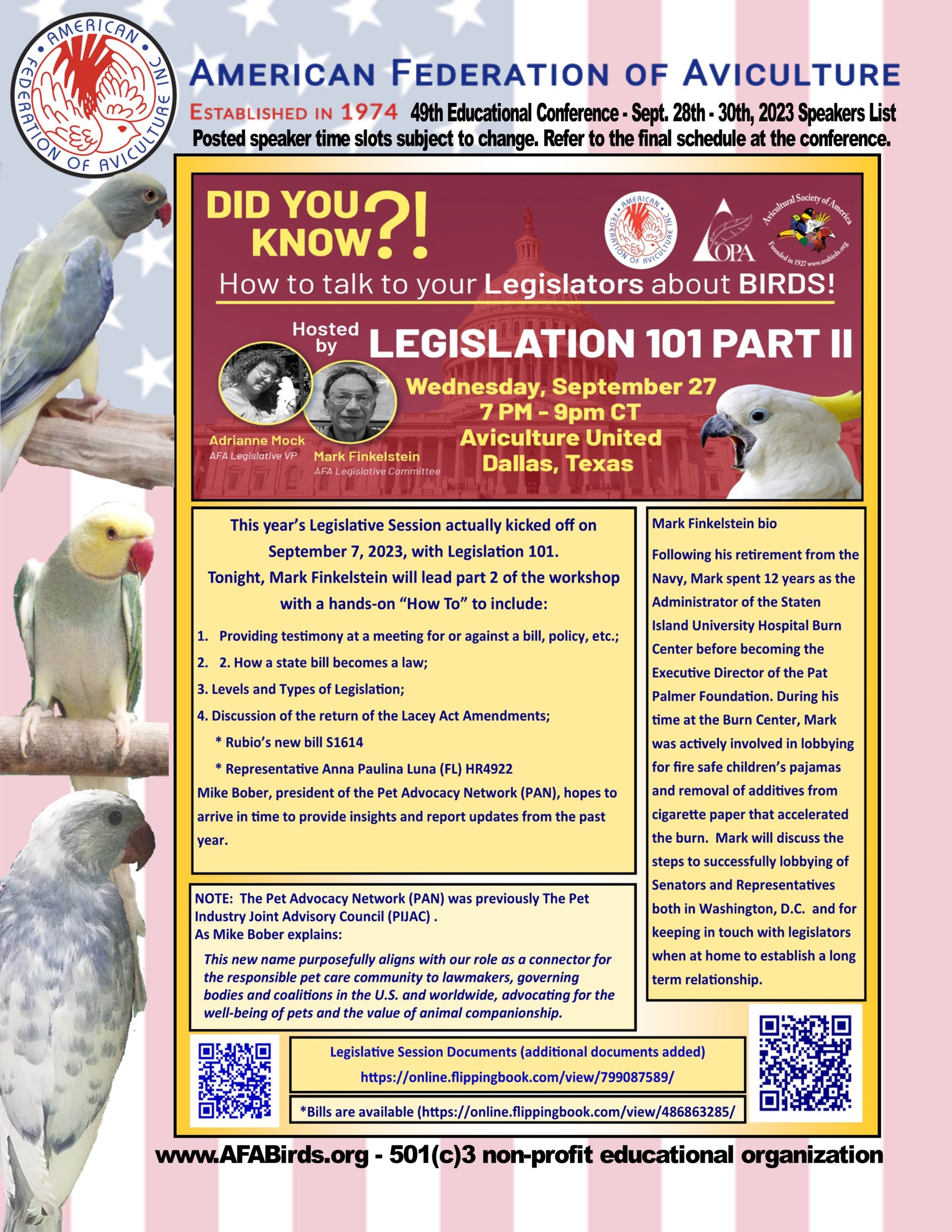
One of the committee’s most critical functions is educational outreach. Through programs like "Legislation 101," the AFA trains bird owners on how to engage with their local and state representatives. The goal is to move the community from a reactive stance to a proactive one. When a bill is introduced that threatens the keeping of birds, the committee mobilizes "calls to action," encouraging members to provide factual testimony, share data on avian care, and explain the negative impacts of the proposed law to lawmakers who may not realize that their bill affects the bird-owning constituents in their district.
Official responses from the AFA often emphasize that while "humane treatment" is a goal shared by all, the specific wording of a bill is what determines its impact. A bill that "insinuates" it is targeting animal cruelty may, in its final regulatory form, mandate cage sizes or environmental controls that are biologically inappropriate for certain species or financially impossible for small breeders to maintain.
Broader Implications and the Future of Aviculture
The long-term implications of unchecked legislation are profound. If the current trend of restrictive laws continues, the "private sector" of aviculture—the hobbyists and breeders who maintain the genetic diversity of species not found in zoos—could be eliminated. Legal analysts point out that as laws are passed in one state, they serve as a blueprint for others. This "copycat legislation" means that a victory for an anti-pet lobbying group in a major metropolitan area can quickly translate into a statewide or even national standard.
Furthermore, the loss of the right to keep and breed birds has conservation consequences. Many species, such as the Spix’s Macaw or the Bali Myna, have relied on the expertise of private aviculturists for their survival. If legislation makes it impossible for individuals to keep these birds, the "safety net" provided by private collections vanishes, leaving species more vulnerable to extinction in the event of habitat loss or disease in the wild.
In conclusion, the monitoring of legislation is not merely a bureaucratic exercise but a fundamental necessity for the survival of the avian community. By staying informed through resources like the AFA’s "Current Legislative Issues" portal and participating in training courses, bird owners can ensure that they remain a part of the conversation. The goal of the AFA is to ensure that birds remain a vibrant part of human lives, protected by laws that are fair, scientifically sound, and reflective of the deep bond between humans and their feathered companions. Vigilance today is the only way to prevent the elimination of bird keeping tomorrow.

