


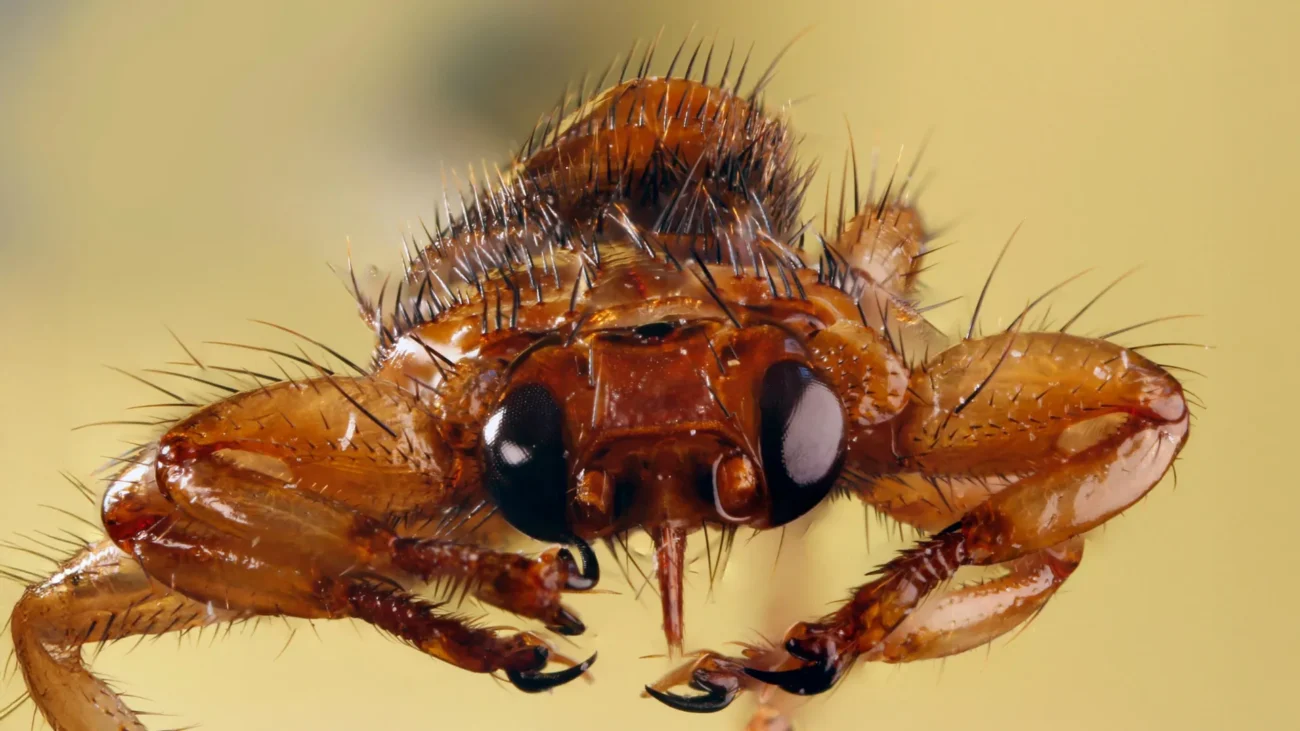
A peculiar adaptation in the life cycle of deer keds, a blood-feeding fly, has been illuminated by new research, revealing a remarkable shift in sensory perception. These ubiquitous ectoparasites, found across Europe, Asia, Africa, and the Americas, undergo a dramatic transformation upon finding a suitable host, most commonly deer, but also occasionally humans and other mammals. Once they successfully land, these flies permanently shed their wings and dedicate the remainder of their existence to navigating the dense fur of their hosts and sustaining themselves on blood. This profound behavioral and physiological change is now understood to be intricately linked with a significant reduction in their visual capabilities, a strategic evolutionary trade-off that prioritizes energy conservation for parasitic survival over the demands of active hunting.
The groundbreaking findings stem from a collaborative effort between scientists at Aberystwyth University in the United Kingdom and the University of Florence in Italy. Their investigation delves into the intricate mechanisms by which deer keds reallocate their biological resources, suggesting that after establishing themselves on a host, these flies significantly diminish their investment in vision. This redirection of energy is then channeled towards functions more critical for their permanent parasitic lifestyle, such as digestion and reproduction. The study, published in the prestigious Journal of Experimental Biology, offers a compelling glimpse into the evolutionary pressures that shape sensory systems in response to drastic changes in an organism’s ecological niche.
The Dual Life of the Deer Ked: From Aerial Hunter to Grounded Parasite
Deer keds (family Hippoboscidae) present a unique case study in evolutionary biology due to their distinct life stages. As winged adults, they actively employ both flight and vision to locate potential hosts from a distance. This aerial phase is crucial for their survival and reproduction, enabling them to disperse and find new blood sources. Their visual acuity during this period is comparable to that of other host-seeking insects, such as tsetse flies, which are renowned for their visually-driven hunting strategies in African savannas. The ability to spot a moving animal from afar requires sophisticated visual processing and a significant metabolic expenditure dedicated to maintaining optimal visual function.
However, this phase is transient. The moment a deer ked successfully lands on a host, its biology undergoes a radical metamorphosis. The wings, once vital tools for survival, are systematically shed. This is not a temporary loss but a permanent detachment, signaling the transition to a completely different mode of existence. The wingless ked then embarks on a life spent entirely within the thick pelage of its host. Here, the challenges are entirely different: navigating a complex, three-dimensional environment, avoiding the host’s grooming behaviors, and consistently accessing blood meals. In this confined, dark, and tactile world, the need for acute vision diminishes dramatically.
Dr. Roger Santer, a leading researcher in the Department of Life Sciences at Aberystwyth University and the principal investigator of the study, elaborated on the evolutionary logic behind this shift. "Vision plays a vital role in animal behavior, but it is also energetically expensive," Dr. Santer explained. "Evolution favors sensory systems that are efficiently matched to an animal’s way of life. Some blood-feeding flies rely heavily on vision, while others live permanently on hosts and have little need for it. Deer keds are especially interesting because they switch between these two lifestyles." This inherent duality makes them an ideal model organism for understanding how sensory systems adapt to divergent ecological pressures within a single species.
Unraveling the Genetic Basis of Sensory Adaptation
To comprehend the physiological underpinnings of this dramatic transition, the research team meticulously examined deer keds at various stages of their life cycle. They collected and analyzed both winged adults actively engaged in host-seeking behavior and wingless adults that had been retrieved from deer hosts, signifying their established parasitic existence. The core of their investigation focused on the genetic machinery responsible for visual sensitivity, specifically a class of genes known as opsins.
Opsins are photoreceptor proteins that play a fundamental role in light detection and signal transduction in the visual system. The activity levels of these genes are a direct indicator of the fly’s capacity for vision. By comparing the expression patterns of opsin genes in winged versus wingless deer keds, the scientists were able to quantify the changes in their visual systems following the abandonment of flight.
The results of this genetic analysis were striking. Dr. Santer revealed, "We found that a flying deer ked’s visual system is much like that of a tsetse fly, which famously hunt out mammal hosts in Africa. However, after a deer ked loses its wings and becomes an ectoparasite, activity of its opsin genes reduces to around half the previous level." This quantitative reduction is a critical finding. It indicates that deer keds do not become completely blind after settling on a host; rather, their visual sensitivity is significantly attenuated. This suggests a finely tuned evolutionary response, where vision is not entirely discarded but rather downscaled to a level that is sufficient for their new environment, thereby conserving precious metabolic resources.
"We think the fly might be sacrificing sight to conserve energy for functions such as digestion and reproduction," Dr. Santer hypothesized, providing a clear rationale for this evolutionary trade-off. The energy saved by reducing the metabolic demands of maintaining a highly sensitive visual system can be reinvested in other vital physiological processes. For a permanent parasite, efficient digestion of blood and successful reproduction are paramount for the continuation of the species. Therefore, a reduction in visual processing power is a logical adaptation to optimize energy allocation.
Chronology of Adaptation: A Life Cycle in Flux
The life cycle of a deer ked can be broadly divided into two distinct phases, each characterized by different sensory requirements and physiological adaptations:
-
Phase 1: The Winged Hunter (Pre-Host)
- Behavior: Actively flies, searches for hosts, utilizes both flight and vision for detection.
- Sensory Focus: High visual sensitivity, comparable to other visually-oriented hunting insects.
- Physiological State: Energetically demanding, focused on host location and dispersal.
- Genetic Activity: High expression of opsin genes related to visual acuity.
-
Phase 2: The Wingless Parasite (Post-Host)
- Behavior: Permanently wingless, resides within host fur, navigates by touch and possibly reduced vision.
- Sensory Focus: Reduced visual sensitivity, increased reliance on tactile and olfactory cues within the host environment.
- Physiological State: Shifts energy allocation towards digestion, reproduction, and maintenance within the host.
- Genetic Activity: Significantly reduced expression of opsin genes.
The study’s methodology involved sampling from these two distinct populations of deer keds. Winged individuals were likely collected from environments where they actively hunt, perhaps near known deer habitats or in open areas. Wingless individuals were obtained from their natural habitat – the fur of deer – after they had completed their transition. This comparative approach allowed researchers to directly observe the effects of the lifestyle change on gene expression.
Supporting Data and Broader Implications
The quantitative reduction in opsin gene activity to "around half the previous level" provides robust evidence for the study’s conclusions. While specific gene names were not detailed in the provided excerpt, the general class of opsins encompasses a variety of light-sensitive proteins, each tuned to different wavelengths of light and contributing to various aspects of vision, from motion detection to color perception. A halving of activity across these genes suggests a broad dampening of visual processing capabilities.
The implications of this research extend beyond the specific biology of deer keds. It offers a powerful model for understanding sensory adaptation in parasites across the animal kingdom. Many parasitic organisms, from insects to helminths, evolve specialized sensory systems that are tailored to their specific host environments. This study highlights that such adaptations are not static but can involve significant shifts in sensory perception, driven by changes in an organism’s ecological niche.
Furthermore, a deeper understanding of how biting flies, including deer keds, utilize their senses could have practical applications in public health and animal welfare. Deer keds can transmit diseases to their hosts, and their presence can cause significant discomfort and economic loss in livestock management. By understanding how these flies locate and orient themselves, scientists may be able to develop more effective strategies for monitoring their populations and mitigating their impact. This could involve novel attractants, repellents, or control methods that target their sensory systems.
Future Directions and Expert Commentary
While the current study provides a significant leap in understanding deer ked adaptation, further research could explore several avenues. Investigating the specific behavioral consequences of reduced vision in wingless keds would be valuable. For instance, do they rely more heavily on tactile cues for navigation within fur? Are there specific olfactory signals from the host that become more important? Additionally, examining the mechanisms of wing shedding itself, a remarkable feat of biological engineering, could reveal further insights into parasitic adaptation.
The scientific community’s reaction to such findings is typically one of keen interest and anticipation for further developments. While no direct quotes from external experts were provided in the source material, researchers in the fields of entomology, evolutionary biology, and parasitology would likely view these findings as a significant contribution. They underscore the principle of "use it or lose it" in evolutionary biology, demonstrating how energetically costly traits can be downregulated or eliminated when they are no longer essential for survival and reproduction in a new environment. The study serves as a testament to the intricate and often surprising ways in which life adapts to its surroundings, showcasing the power of natural selection to fine-tune even the most fundamental biological processes.

