


Fifty years after Donald Griffin’s groundbreaking proposition in 1976 that nonhuman animals possess consciousness and varying degrees of self-awareness, the scientific community continues to grapple with the profound implications of animal minds. What was once considered a revolutionary, even controversial, idea has steadily gained traction, culminating in a recent declaration signed by hundreds of scientists affirming "strong scientific support" for consciousness in mammals, birds, and potentially all vertebrates (Andrews et al., 2024). At the forefront of this evolving understanding is the meticulous work of researchers like Dr. Irene Pepperberg, whose decades-long studies with Grey Parrots offer compelling insights into avian cognitive capacities that hint at complex internal experiences. Her recent commentary in Pepperberg (2026) synthesizes the current state of this intricate debate, highlighting the challenges and progress in demonstrating nonhuman consciousness.
The Genesis of a Revolution: Donald Griffin’s Legacy
Before Griffin’s seminal 1976 book, The Question of Animal Awareness, the prevailing scientific consensus largely relegated nonhuman animals to the realm of instinctual beings. Influenced by behaviorism, many researchers viewed animals primarily as creatures that responded to stimuli based on classical and operant conditioning – actions rewarded or punished (Pepperberg, 1999). This perspective denied animals complex mental states, self-awareness, or indeed, any form of consciousness beyond basic sensory perception. Griffin’s work, however, dared to challenge this entrenched view. An ethologist, he observed intricate animal behaviors in their natural habitats, which seemed to defy purely mechanistic explanations. He posited that many complex animal behaviors, particularly those involving communication, tool use, and intricate social interactions, were best explained by assuming some level of conscious thought and subjective experience. His ideas were met with skepticism and resistance, as they ventured into territory previously reserved exclusively for humans, but they irrevocably opened the door for a new era of cognitive ethology, sparking a scientific inquiry that continues to deepen our understanding of the animal kingdom.
Defining the Undefinable: Sentience, Self-Awareness, and Consciousness
The core challenge in assessing nonhuman consciousness lies in its very definition and the methodology for its evaluation. Scientists often differentiate between various levels of internal experience. Sentience, defined as the ability to experience emotions and sensations like pleasure, pain, fear, or comfort, is increasingly accepted as widespread across the animal kingdom. While a necessary component, the article notes that sentience alone might not be sufficient to argue for human-like consciousness. The difficulty in evaluating subjective emotions and sensations, even in humans (Plutchik, 2001), is compounded when attempting to do so in species that cannot verbally articulate their internal states.
Higher-order consciousness, often associated with self-awareness, involves not only monitoring sensory inputs and mental states but also possessing executive control over decision-making and voluntary action. Crucially, it includes the awareness of one’s own thoughts – being aware that one is aware. This "meta-awareness" is particularly elusive to examine in nonhumans, as even species capable of referential communication lack the symbolic labels necessary to report such introspective experiences to human observers. The absence of a shared linguistic framework presents a formidable barrier to direct inquiry into animal subjective experiences.
Metrics and Methodologies: The Quest for Evidence
In the absence of direct verbal reports, researchers have developed various indirect metrics and behavioral tasks to infer consciousness. However, many early attempts to quantify consciousness were often "too strongly biased toward human capacities" (Pepperberg, 2026), failing to account for the unique cognitive architectures and sensory worlds of different species (Birch et al., 2020; Bayne et al., 2024). To address this, Pepperberg and Lynn (2000) proposed a framework suggesting that levels of consciousness exist, and these levels might correlate with quantifiable cognitive abilities within a given species. They argued that such cognitive processing likely arose from homologous or convergent brain evolution, shared perceptual structures, and similar learning mechanisms.
A significant hurdle remains the identification of "neural correlates of consciousness" (NCC) – specific patterns of brain activity linked to conscious experience. Even in human neuroscience, the search for a definitive NCC is ongoing and complex (Cognitive Consortium, 2025). Extrapolating this search to nonhumans, whose brain structures and functions can differ significantly from primates, adds layers of complexity. While comparative neuroanatomy has revealed striking similarities in the neural pathways and structures associated with higher cognition in birds and mammals, particularly in areas like the pallium (analogous to the mammalian cortex), definitively linking these to subjective experience remains a challenge.
The advent of highly advanced Artificial Intelligence (AI) systems further complicates the debate. Modern AI can perform incredibly complex cognitive processing, solving problems, generating creative content, and even simulating conversations with remarkable sophistication. If mere processing power were the sole criterion, AI systems might be considered conscious. However, as Block (2025) discusses, most scientists agree that current AI lacks genuine self-awareness or subjective experience, highlighting that cognitive processing alone does not equate to consciousness. This distinction reinforces the argument that consciousness involves more than just computation; it requires an internal, subjective "what it feels like" aspect.
Grey Parrots: A Window into the Avian Mind
Within this complex landscape, Grey Parrots (Psittacus erithacus) have emerged as particularly compelling subjects for investigating nonhuman consciousness. Renowned for their remarkable vocal learning abilities and cognitive prowess, these birds have demonstrated capacities that challenge traditional views of animal intelligence. Dr. Pepperberg’s work, building on her extensive research with Alex the parrot, has consistently pushed the boundaries of what is believed to be possible for avian cognition.
One of the most powerful behavioral metrics used to infer self-awareness and higher-order cognitive processing is delayed gratification. This task requires an individual to forgo an immediate, less desirable reward in anticipation of a larger or more appealing reward if they wait. Success in delayed gratification tasks demands a suite of sophisticated cognitive abilities:
- Recognition and Understanding: The subject must recognize the value of both immediate and future rewards.
- Impulse Suppression: They must actively suppress immediate impulses, needs, and desires.
- Conflict Resolution: They must understand the potential conflict between instant gratification and a long-term goal.
- Working Memory: The long-term goal must be actively maintained in memory during the delay period.
- Strategic Engagement: The subject must devise and execute a strategy that actively engages their thoughts to achieve the desired future outcome.
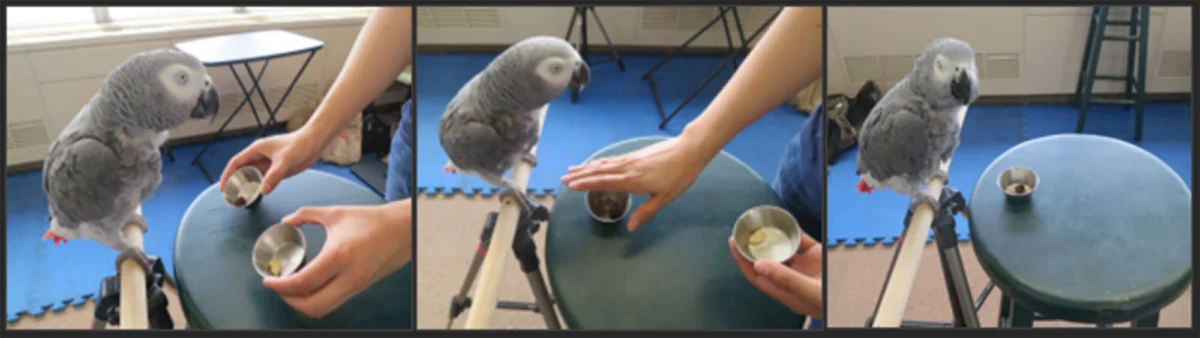
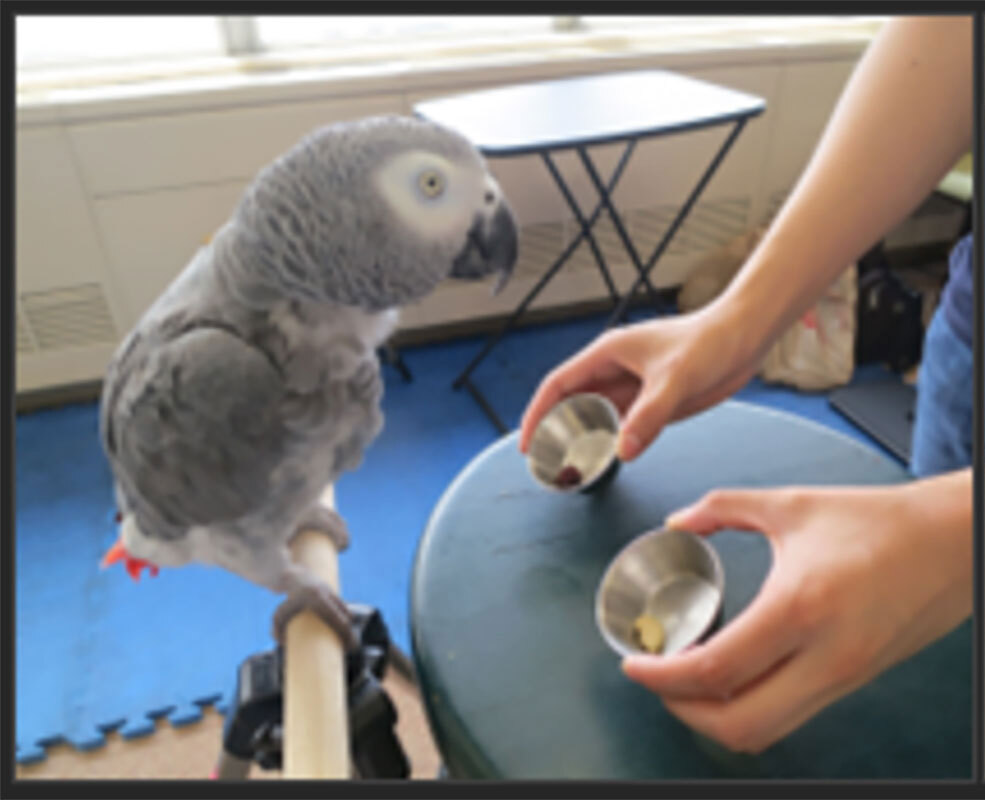
Grey Parrots have repeatedly demonstrated remarkable success in delayed gratification tasks. Studies by Koepke et al. (2015), Pepperberg & Rosenberger (2022), and Pepperberg & Hartsfield (2023) have shown Grey Parrots, including individuals like Griffin, willingly waiting for extended periods to receive a better reward, even when a less appealing but still desired treat is present. For instance, in typical experiments, the parrot is shown two sets of rewards. One is then removed, and the remaining, less appealing reward is briefly covered while the bird is told to "wait." The parrot must then sit with the accessible, but less desirable, reward during the delay, consciously resisting the urge to consume it, knowing a superior reward is contingent on their patience. While these studies provide powerful indicative evidence of self-control and future planning, Dr. Pepperberg acknowledges that, like all behavioral tests, delayed gratification tasks are not without potential confounds, urging continued scrutiny of the observed behaviors. Nevertheless, the consistent performance of Grey Parrots in these complex scenarios strongly suggests sophisticated cognitive processing akin to what is observed in humans demonstrating self-awareness.
Beyond Proof: Ethical Implications and the "Do No Harm" Principle
While behavioral evidence from tasks like delayed gratification offers compelling insights, it does not constitute definitive proof of avian consciousness in the same way one might prove a chemical reaction. The subjective nature of consciousness makes such absolute proof difficult even in humans. However, the scientific community is increasingly recognizing that the ethical implications of this research extend beyond the demand for irrefutable proof.
The "New York Declaration on Animal Consciousness," published in April 2024 (Andrews et al., 2024), represents a significant shift in the scientific discourse. Signed by numerous leading neuroscientists, cognitive scientists, and philosophers, it asserts that the weight of scientific evidence strongly supports the existence of conscious experience in a wide range of nonhuman animals. The declaration explicitly invokes the principle of "Do No Harm," advocating that even "material that is merely indicative of consciousness should be considered integral to the design of protocols on welfare, humane treatment, and conservation."
Dr. Pepperberg echoes this sentiment, arguing that when considering how best to coexist with nonhumans, the exceptionally high levels of certainty typically demanded for scientific "proof" of consciousness should be lowered. Given the profound implications for animal welfare, humane treatment in laboratories and agriculture, and conservation efforts, prudence dictates that strong indicative evidence should be sufficient to inform policy and ethical guidelines. To wait for absolute, incontrovertible proof before extending ethical considerations risks causing unnecessary harm to sentient beings. This proactive ethical stance encourages a precautionary principle, where the possibility of animal consciousness, supported by robust scientific indicators, drives our moral obligations.
The Road Ahead: Future Research and Societal Shifts
The quest to fully understand nonhuman consciousness is an ongoing, multidisciplinary endeavor, weaving together neuroscience, ethology, philosophy, and psychology. Future research will undoubtedly refine our metrics, develop new experimental paradigms, and leverage advanced technologies like neuroimaging to probe deeper into the internal worlds of animals. Comparative studies across diverse species, from invertebrates to mammals, will continue to reveal the evolutionary pathways and varied forms that consciousness might take.
The implications of this research are far-reaching, extending beyond academia into societal norms, legal frameworks, and environmental policies. A broader acceptance of animal consciousness, even based on indicative evidence, could fundamentally alter human-animal relationships, influencing everything from the way we raise livestock to the legal rights afforded to animals, and the urgency with which we approach conservation. Recognizing the rich inner lives of species like Grey Parrots not only enriches our scientific understanding but also prompts a critical re-evaluation of our responsibilities towards the diverse forms of life that share our planet. The dialogue initiated by Griffin decades ago, and meticulously advanced by researchers like Pepperberg, ensures that the question of animal awareness will remain a central, compelling, and ethically vital area of inquiry for generations to come.

