


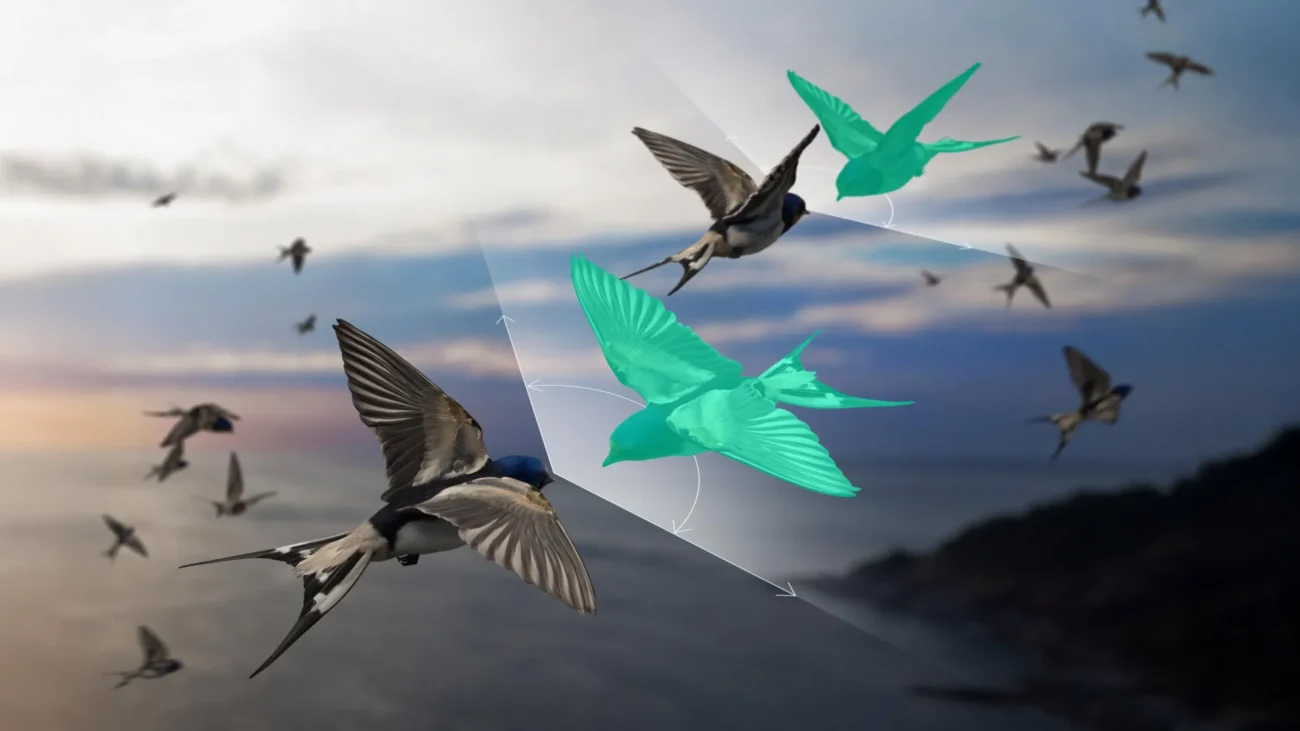
Birds, with their aerial ballet across the skies, have long captivated human observation. Their synchronized movements in vast flocks, a breathtaking spectacle of nature, reveal a fascinating aspect of collective behavior. While individual birds possess an expansive field of vision, their attention within a flock is remarkably selective. They primarily focus on their immediate neighbors—those beside and in front of them—rather than those trailing behind. This seemingly simple observation, however, has profound implications, appearing to defy one of the most fundamental principles in physics: Newton’s Third Law of Motion.
For over three centuries, Newton’s Third Law, famously encapsulated as "for every action, there is an equal and opposite reaction," has been a cornerstone of classical physics, explaining phenomena from the propulsion of rockets to the simple act of walking. When a runner pushes off the ground, the ground exerts an equal and opposite force back, propelling them forward. This principle governs the mechanics of countless everyday occurrences: the way a car accelerates, a rower propels a boat, or a deflating balloon rockets through the air. The law dictates a fundamental symmetry in interactions, where forces always occur in pairs, acting on different objects, and being equal in magnitude and opposite in direction.
"Whatever we normally teach our students in theoretical mechanics, it ultimately rests on the action-reaction principle," states Professor Marin Bukov, a leading researcher in the field and group leader for the Würzburg-Dresden Cluster of Excellence ctd.qmat. This principle’s ubiquity in theoretical frameworks underscores its foundational importance.
However, the synchronized yet asymmetric attentiveness of bird flocks is not an isolated anomaly. Similar patterns of behavior are observed in other complex systems, including the swirling movements of bacterial swarms, the ebb and flow of human crowds, and even the intricate collective organization of cells within living tissues. In these diverse scenarios, individual components of the system tend to react to only a portion of their surrounding environment, rather than to the totality of influences. This directional responsiveness leads to interactions that are not balanced in the traditional Newtonian sense, where action and reaction are precisely mirrored.
Physicists have termed these phenomena "non-reciprocal interactions," a stark contrast to the "reciprocal interactions" that form the basis of traditional physics. Because established theories were designed for reciprocal systems, scientists have long faced significant challenges in accurately simulating and understanding these non-reciprocal systems. The ability to model these behaviors with precision is crucial for advancing our comprehension of a wide array of fields, from the intricate dynamics of biological processes and the emergent patterns of crowd psychology to the complex collective motion of animal aggregations.
A Breakthrough in Modeling Non-Reciprocal Systems
Addressing this longstanding scientific quandary, a team of physicists in Dresden, spearheaded by Professor Roderich Moessner, has developed a groundbreaking theoretical framework. Professor Moessner, a Principal Investigator at the ctd.qmat Cluster of Excellence and director of the Max Planck Institute for the Physics of Complex Systems in Dresden, has been instrumental in guiding this research.
"The research team has developed and proven a theory that makes much of what we teach our students applicable to non-reciprocal systems as well," explains Professor Bukov. "These systems, where Newton’s third law does not apply, can now finally be described exactly and simulated precisely—even using established methods. This is exactly the kind of tool that has been missing in recent years."
The core of their innovative solution lies in an extension of the traditional action-reaction paradigm. Their novel approach enables the study of non-reciprocal systems using many of the same sophisticated analytical tools already employed for their reciprocal counterparts. The key to this transformation is the ingenious introduction of additional, artificial variables into the mathematical models.
Traditionally, physicists describe natural systems using variables that represent tangible properties of the entities involved—such as a bird’s precise position and velocity, a fish’s location within its school, or a car’s placement within a traffic flow. These variables are rooted in the physical reality of the system.
"The trick behind the new theory is that it constructs a partner for each component of the system—a fictitious partner that doesn’t exist in nature," elaborates Dr. Ricard Alert, a biophysicist and colleague of Professor Bukov. "The original non-reciprocal interactions are replaced by reciprocal interactions with these auxiliary degrees of freedom."
The Fictitious Avian Companion: A Practical Illustration
To grasp the practical application of this theoretical advancement, consider the example of the flock of birds. When simulating their complex movements, researchers can now treat the "flock of birds" as a reciprocal system, even though its inherent interactions are non-reciprocal. The elegance of the solution lies in artificially introducing a "fictitious bird" for every real bird in the flock. This imaginary companion is positioned and oriented in precisely the opposite direction of the real bird it represents.
These imaginary partners are not literal representations of birds; they are purely mathematical constructs. Their purpose is to serve as computational tools, enabling the transformation of inherently one-way, non-reciprocal interactions into a form that can be readily analyzed by existing, well-established methodologies in physics. By creating these auxiliary degrees of freedom, the system effectively becomes reciprocal from a mathematical perspective, allowing for precise simulation and analysis.
Expanding the Horizons of Physics Research
While the concept of using auxiliary degrees of freedom is not entirely new in physics, its application to systems exhibiting non-reciprocal interactions marks a significant departure. This innovative approach allows scientists to leverage the robust and extensively developed framework of many-body physics, a field dedicated to understanding systems composed of numerous interacting particles. Simultaneously, it promises to yield far more accurate simulations of complex, real-world systems.
Beyond computational advancements, this breakthrough offers a deeper, more fundamental understanding of the underlying physics governing these seemingly anomalous behaviors. Such conceptual clarity often serves as fertile ground for future scientific discoveries and technological innovations.
"In Würzburg and Dresden, we study quantum matter whose particles interact under certain conditions in ways that give rise to new phenomena such as magnetism or lossless current transport," notes Professor Moessner. "The exciting question now is whether these exceptions to Newton’s law lead to entirely new forms of collective quantum behavior. We still know very little about this—and that is precisely what makes this so fascinating."
The implications of this research extend beyond the immediate application to biological systems and crowd dynamics. The fundamental nature of the problem—reconciling observed behaviors with established physical laws—suggests potential applications in diverse areas of physics. For instance, in the realm of quantum mechanics, certain quantum systems exhibit non-reciprocal interactions that have been difficult to model accurately. This new theoretical framework could unlock new avenues for understanding phenomena like topological phases of matter, exotic magnetic states, and the behavior of superconductors.
The research team’s seminal findings were recently published in the prestigious journal Nature Physics, a testament to the significance and rigor of their work. This publication is expected to generate considerable interest within the scientific community, potentially sparking a surge of new research endeavors aimed at exploring the implications of non-reciprocal interactions across various scientific disciplines.
Historical Context and the Enduring Power of Newtonian Mechanics
The development of Newton’s Laws of Motion in the late 17th century marked a pivotal moment in scientific history, providing a unified and predictive framework for understanding the physical world. The Third Law, in particular, emphasized the inherent balance and symmetry in physical interactions, a concept that has since been deeply ingrained in scientific thought.
For centuries, physicists have operated under the assumption that for every push, there is an equal and opposite pull. This principle has been successfully applied to a vast array of phenomena, from the celestial mechanics of planetary orbits to the everyday mechanics of machines. Textbooks and curricula have been built around this fundamental understanding, shaping generations of physicists.
The emergence of systems that appear to violate this law presents a fascinating challenge. It is not that Newton’s laws are "wrong," but rather that they describe a specific class of interactions—reciprocal ones. The Dresden research group’s work does not invalidate Newton’s Third Law but rather expands the scope of physics to encompass phenomena previously outside its direct predictive power.
The identification of non-reciprocal interactions in seemingly disparate systems like bird flocks, bacterial swarms, and cellular tissues suggests a deeper, underlying principle at play in nature. This principle, previously difficult to articulate mathematically, now has a formal theoretical basis.
Implications for Biological and Social Sciences
The impact of this research on biological and social sciences could be profound. In biology, understanding how cells interact within tissues, how pathogens coordinate their spread, or how entire ecosystems function relies heavily on accurate modeling of collective behaviors. The ability to simulate non-reciprocal interactions could lead to breakthroughs in developmental biology, disease modeling, and the study of ecological dynamics.
For instance, in studying cancer, understanding how tumor cells migrate and interact with their environment is critical for developing effective treatments. Similarly, in epidemiology, predicting the spread of infectious diseases often involves modeling the collective movement and interaction patterns of populations.
In social sciences, the study of crowd dynamics, traffic flow, and even the spread of information or opinions online can be enhanced by this new theoretical lens. While the "fictitious partners" might seem abstract, they provide a robust mathematical bridge to understanding how real-world, complex systems behave when individuals do not respond symmetrically to their surroundings. This could lead to improved urban planning, more effective disaster response strategies, and a deeper understanding of social phenomena.
The Road Ahead: Quantum Realms and Unforeseen Discoveries
Professor Moessner’s mention of quantum matter hints at the ambitious scope of this research. The study of quantum systems often reveals behaviors that defy classical intuition. If non-reciprocal interactions can lead to novel collective quantum phenomena, this could open entirely new avenues in condensed matter physics and quantum computing.
The challenges in quantum physics often stem from the extreme sensitivity of quantum systems and the complex interplay of their constituent particles. The ability to accurately model systems where interactions are not symmetrical could prove invaluable in understanding emergent quantum properties, such as novel forms of entanglement or exotic states of matter.
The publication of this research in Nature Physics is a significant event, marking the culmination of years of theoretical work and rigorous mathematical proof. It serves as an invitation to the broader scientific community to explore the implications and applications of this novel approach to understanding the complex dynamics of the natural world. The work done in Dresden and Würzburg represents not just a solution to a long-standing physics problem, but a fundamental advancement in our capacity to describe and predict the behavior of collective systems, both animate and inanimate. The implications are far-reaching, promising to reshape our understanding of everything from the smallest bacterial colonies to the grandest cosmic structures.

