


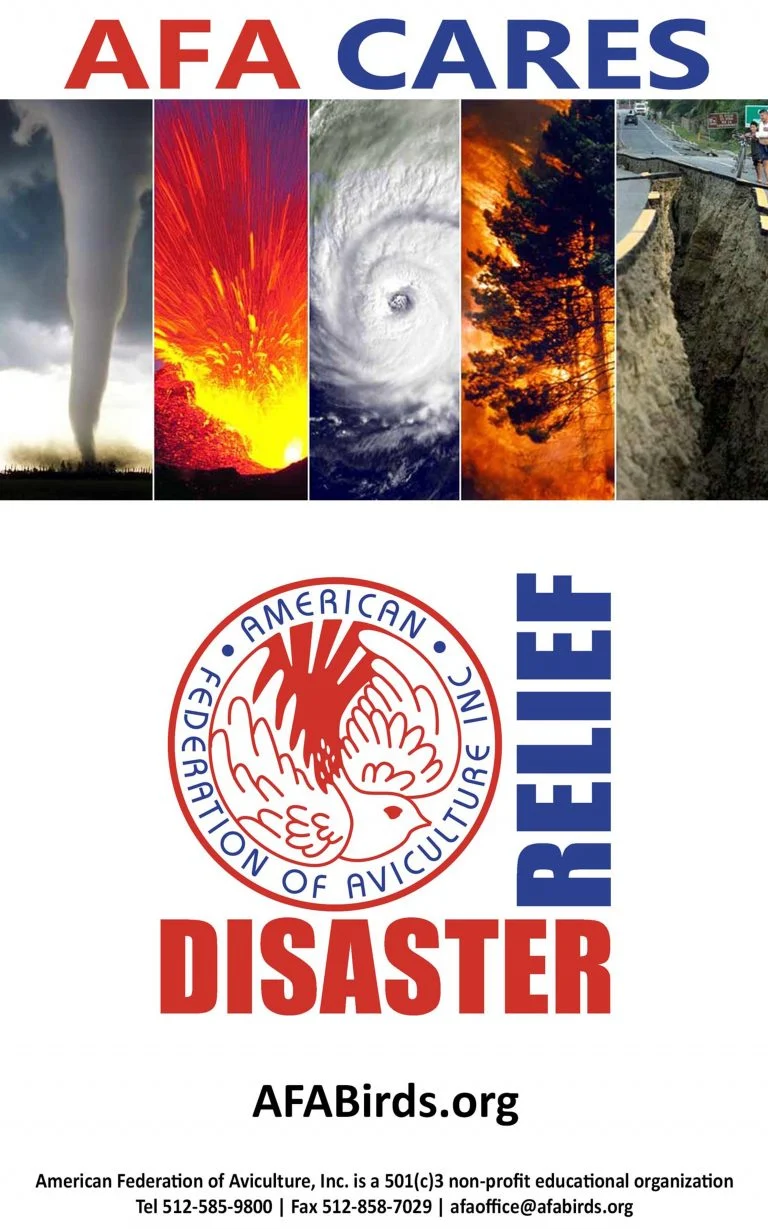
The American Federation of Aviculture (AFA) has formalized a sophisticated Disaster Relief Team designed to address the unique and often overlooked needs of avian populations during large-scale emergencies. Comprised of Regional Directors and specialized volunteers strategically positioned across the United States, the team provides a rapid-response infrastructure that monitors localized weather patterns and geological threats. This decentralized model ensures that as environmental crises arise, local volunteers—who are intimately familiar with the geography and specific avian needs of their districts—can be activated immediately to assist bird owners and professional aviculturists.
The necessity of such a specialized network is underscored by the vulnerability of exotic and domestic birds during natural disasters. Unlike mammals, birds possess highly specialized respiratory systems that make them acutely susceptible to smoke, airborne particulates, and chemical fumes, which are common byproducts of wildfires and industrial accidents. The AFA’s mission extends beyond mere rescue; it encompasses a rigorous educational framework designed to prepare owners for the logistical complexities of transporting sensitive species under duress.
The Strategic Importance of Pre-Disaster Planning
In the field of emergency management, the "golden hour" of response is often determined by the quality of preparation undertaken months or years in advance. Mary Ellen LePage, a former Fire Chief for CalFire and a veteran aviculturist, emphasizes that the diversity of potential disasters—ranging from the straight-line winds of the Midwest to the seismic shifts of the West Coast—requires a modular approach to safety.
Planning begins with the physical infrastructure of transport. Experts recommend that bird owners maintain a dedicated fleet of pre-assembled or collapsible carriers. These units must be more than simple transport boxes; they should be fully equipped with perches of appropriate diameters and secured water dishes. For large-scale aviaries, the AFA suggests storing these carriers in accessible locations, such as garages or hanging from ceilings, to ensure they are not buried under debris when a crisis strikes. Furthermore, the standardization of security is a critical but often overlooked detail. By keying all locks on flights and transport cages the same, owners can avoid the catastrophic loss of time associated with fumbling for specific keys during a rapid evacuation.
Identification and Documentation as a Recovery Tool
A primary challenge in post-disaster recovery is the reunification of owners with their animals. In the chaos of a hurricane or earthquake, birds may escape damaged aviaries or be separated during the rescue process. The AFA advocates for a multi-layered identification strategy. While traditional leg bands remain a staple of the industry, the integration of microchipping provides a permanent, tamper-proof method of identification that is increasingly recognized by veterinary clinics and shelters nationwide.
Beyond physical identification, the maintenance of duplicate records is essential. Digital backups of ownership papers, health certificates, and dietary requirements should be stored in cloud-based systems or at off-site locations. This ensures that even if a primary residence is lost, the owner can prove legal title and provide critical medical history to temporary caregivers. Identifying secondary and tertiary relocation sites—such as barns, vacant commercial spaces, or out-of-state avian facilities—must be completed long before an evacuation order is issued.

The Logistics of Evacuation and On-Site Sheltering
The decision to evacuate is a complex calculation involving the projected path of the disaster, the number of birds involved, and the available transport capacity. For major breeders, the logistics of moving hundreds of birds require significant vehicular resources. The AFA notes that if rental trucks are utilized, they must feature climate control or adequate ventilation in the cargo area, as heat exhaustion can be as lethal as the disaster itself.
Timing is the most critical factor in avian evacuation. Because police and emergency services often implement road closures and "no-entry" zones as a disaster nears, bird owners must initiate their departure well ahead of official mandates. Waiting until a storm is imminent often leads to gridlock, where the lack of access to fuel, water, and food can turn a transport vehicle into a trap.
In scenarios where evacuation is not feasible, on-site sheltering requires its own rigorous set of protocols. This includes the maintenance of redundant power systems, such as industrial generators, to ensure that climate-controlled environments remain stable. Stockpiles of food and water must be rotated regularly to prevent spoilage. Additionally, owners are encouraged to record their exact GPS coordinates; in the event that street signs and landmarks are destroyed by wind or water, these coordinates are the only reliable way for rescuers to locate a facility.
Integration with the Incident Command System (ICS)
Professional avian rescue is not an isolated activity but must function within the broader framework of national emergency response. In the United States, large-scale disaster zones are managed under the Occupational Safety and Health Administration (OSHA) Incident Command System (ICS). This hierarchical structure ensures that all government and non-government entities report to a single Incident Commander.
For AFA disaster relief volunteers, navigating these zones requires professional credentials. To facilitate this, the AFA provides magnetic vehicle signs, specialized t-shirts, and identification cards that designate individuals as legitimate relief workers. When stopped by law enforcement at a perimeter, these volunteers are trained to request communication with the Incident Commander or their representative to secure authorized entry. This professionalized approach reduces the risk of well-intentioned rescuers being turned away or inadvertently interfering with primary life-saving operations.
Tactical Rescue Operations for Avian Species
The physical act of rescuing birds in a disaster zone requires specialized tools and expertise. Rescuers often find themselves in environments where structural integrity is compromised. A standard rescue kit, as recommended by the AFA and seasoned fire officials, includes wire cutters, heavy-duty nets, towels, and, in some cases, chainsaws to clear fallen trees or debris blocking access to aviaries.
Identifying the birds during a high-stress rescue is paramount for future reunification. Rescuers are instructed to use permanent markers to annotate crates with the bird’s original location and any identifying features. In cases where specific carriers are unavailable, the AFA provides guidance on using improvised containers—such as plastic storage bins with drilled ventilation holes or even heavy-duty paper bags for smaller species—to move birds out of immediate danger.
The ethical framework of avian rescue emphasizes that only birds whose lives are under immediate threat should be removed. This principle respects the property rights of the owners while prioritizing the welfare of the animals. Once birds are moved to a secure location, the AFA leverages its national network to find temporary housing, often utilizing local bird clubs and member facilities that have not been affected by the disaster.
Broader Implications and the Future of Avicultural Resilience
The impact of disasters on the avicultural community extends far beyond the immediate loss of life. Significant events can disrupt decades of genetic lineages and conservation efforts. Many aviculturists maintain "insurance populations" of endangered species; the loss of a single major breeding facility can have global implications for the survival of certain parrot or passerine species.
Analysis of recent disaster trends suggests that the frequency and intensity of extreme weather events are increasing, making the role of the AFA Disaster Relief Team more vital than ever. The organization’s focus on regional preparedness reflects a shift toward a more resilient, community-based model of animal welfare. By empowering local directors to act as conduits for information and resources, the AFA ensures that the specialized knowledge required to care for exotic birds is available precisely where and when it is needed.
The AFA continues to solicit volunteers and donations for its disaster relief fund to maintain stockpiles of emergency supplies and to provide training for rescuers. This proactive stance serves as a blueprint for other specialized animal welfare organizations, demonstrating that through meticulous planning, professional coordination, and a dedicated volunteer network, the devastating impact of natural disasters on the avian community can be significantly mitigated.
For those in immediate need of assistance or for those wishing to join the relief efforts, the American Federation of Aviculture maintains a 24-hour contact protocol through its main business office at 512-585-9800 or via email at [email protected]. Through collective action and rigorous adherence to safety protocols, the avicultural community continues to build a future where both birds and their keepers are better protected against the unpredictable forces of nature.

