


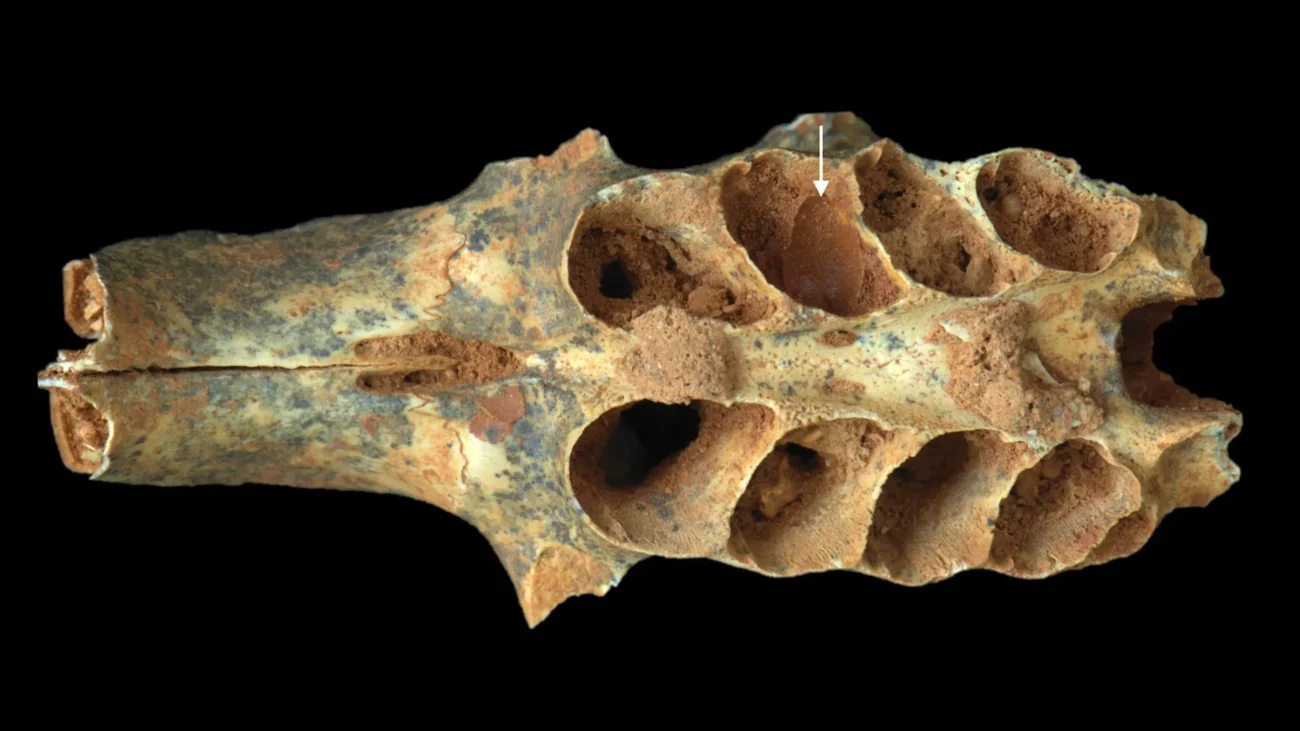
Approximately 20,000 years ago, a Dominican Republic cave, a sanctuary for generations of owls, became an unwitting incubator for a novel nesting strategy. The persistent regurgitation of owl pellets, comprised of indigestible prey remains, inadvertently created a unique resource for ancient bees. A groundbreaking study, recently published in the prestigious journal Royal Society Open Science, reveals that these industrious insects ingeniously utilized the empty tooth sockets within fossilized animal jaws as miniature nurseries for their developing offspring. This remarkable discovery represents the first documented instance of bees employing animal bones as nesting sites, unveiling an unexpected and previously unknown facet of ancient insect behavior.
A Fossil Treasure Trove: The Secrets of Hispaniola’s Caves
The Caribbean island of Hispaniola, shared by Haiti and the Dominican Republic, is renowned for its extensive network of limestone caves, estimated to number in the thousands. These geological formations, sculpted by millennia of water erosion, often harbor rich deposits of paleontological significance. Dr. Lazaro Viñola López, a postdoctoral researcher at the Field Museum in Chicago and the lead author of the study, describes the landscape as peppered with sinkholes, stating, "In some areas, you’ll find a different sinkhole every 100 meters."
The specific cave investigated in this research had previously been identified by Juan Almonte Milán, a distinguished curator of paleobiology at the Dominican Republic’s Museo Nacional de Historia Natural, as an exceptionally rich fossil deposit. Dr. Viñola López and his research team, including colleagues from the University of Florida and the Florida Museum of Natural History, first explored this site during his doctoral research. The initial descent into the cave is described as a dramatic introduction to its hidden world. "The initial descent into the cave isn’t too deep — we would tie a rope to the side and then rappel down," Dr. Viñola López recounts. "If you go in at night, you see the eyes of the tarantulas that live inside. But once you walk down a ten-meter-long tunnel underground, you start finding the fossils."
The cave’s geological structure played a crucial role in preserving its ancient contents. Multiple fossil layers are discernible, separated by carbonate deposits that formed during ancient periods of high rainfall. The overwhelming majority of the excavated remains belonged to various rodent species, but the researchers were astonished by the diversity of other fauna unearthed. The fossil record within this single cave included remains from sloths, a wide array of birds, reptiles, and numerous other animals, collectively representing over 50 distinct species. This remarkable preservation allows scientists to piece together a vivid picture of the cave’s ecosystem and its inhabitants over extended periods.
Unraveling the Owl’s Role: A Predatory Past
The fossil assemblage within the cave strongly suggests it served as a long-term roosting and nesting site for owls. "We think that this was a cave where owls lived for many generations, maybe for hundreds or thousands of years," explains Dr. Viñola López. "The owls would go out and hunt, and then come back to the cave and throw up pellets. We find fossils of the animals that they ate, fossils from the owls themselves, and even some turtles and crocodiles who might have fallen into the cave." These owl pellets, a concentrated mass of undigested material such as bones, fur, and feathers, are invaluable to paleontologists as they provide direct evidence of the predator’s diet and the surrounding environment. The sheer volume and variety of bones recovered, particularly the small, often fragmented skeletal remains, point to consistent owl activity over vast stretches of time.
The presence of a diverse range of prey species, from small mammals to larger vertebrates like sloths, indicates that these ancient owls were formidable hunters with a broad foraging range. The inclusion of non-prey items, such as the accidental inclusion of turtles and crocodiles that may have perished after falling into the cave’s depths, further enriches the paleoecological narrative. This intricate interplay of predator and prey, preserved within the cave’s stable environment, laid the groundwork for an even more surprising discovery.
An Unexpected Revelation: Nests Within Sockets
While meticulously studying the mammal bones deposited by the owls, Dr. Viñola López made an observation that would redefine our understanding of ancient bee behavior. During the process of cleaning the fossilized jaws, he noticed peculiar smooth deposits within several empty tooth sockets. These formations differed significantly from naturally accumulated sediment.
"It was a smooth surface, and almost concave. That’s not how sediment normally fills in, and I kept seeing it in multiple specimens. I was like, ‘Okay, there’s something weird here,’" he recalls. The unusual texture and shape immediately triggered a memory from an earlier fossil excavation in Montana during his undergraduate studies. There, he had been shown fossilized wasp cocoons – small, hardened chambers constructed by wasps to house their developing larvae. The resemblance between these ancient wasp nests and the deposits he was observing in the fossilized jaws was striking.
This initial observation, born from careful examination and prior experience, sparked a new line of inquiry. The possibility that these were not merely geological formations but evidence of ancient biological activity began to take shape, setting the stage for advanced analytical techniques to confirm the hypothesis.
Decoding the Tiny Architects: CT Scans Reveal Ancient Bee Nests
To confirm his suspicions, Dr. Viñola López and his research team employed advanced imaging technology. The fossils were subjected to computed tomography (CT) scanning, a non-destructive method that generates detailed three-dimensional images of the internal structures. This technique allowed researchers to examine the compacted material within the tooth sockets without causing any damage to the delicate fossils or the sediment itself.
The CT scans provided irrefutable evidence. The internal structures of the deposits within the tooth sockets closely matched the morphology of mud nests constructed by modern solitary bee species. More remarkably, some of these ancient nests even preserved microscopic grains of pollen. This ancient pollen, meticulously collected and stored by the mother bees, served as a vital food source for their developing larvae. This finding provided a direct link to the bees’ provisioning behavior, a hallmark of their reproductive strategy.
The researchers theorize that these ancient bees, likely solitary species, mixed readily available dirt with their saliva to construct these minuscule nests. Each nest was remarkably small, measuring less than the diameter of a pencil eraser. The choice of empty tooth sockets within larger animal bones as nesting sites may have offered a significant advantage: enhanced protection from potential predators, such as rival wasps or other arthropods, that would have found it more challenging to access eggs and larvae hidden within these bony cavities. This ingenious adaptation highlights the resourceful nature of these ancient insects in a challenging environment.
A New Classification: Honoring a Pioneer
While the CT scans definitively identified the structures as nests, the absence of fossilized bees themselves presented a challenge in determining the exact species responsible. Dr. Viñola López explains that the cave’s warm and humid conditions, while excellent for preserving bones, are not conducive to the fossilization of delicate insect bodies.
Despite the lack of preserved insects, the distinct structural characteristics of the nests were sufficient for scientific classification. The fossil nests have been formally named Osnidum almontei. This scientific designation serves a dual purpose: it acknowledges the unique nature of these fossilized nests and honors Juan Almonte Milán, the paleontologist whose foresight in identifying the cave’s potential was instrumental to this discovery. His decades of dedicated research in the region have established him as one of Hispaniola’s foremost paleontologists.
The question of the bees’ species remains open. "Since we didn’t find any of the bees’ bodies, it’s possible that they belonged to a species that’s still alive today — there’s very little known about the ecology of many of the bees on these islands," Dr. Viñola López notes. Alternatively, given that many of the larger animals whose bones were found in the cave are now extinct, it is also plausible that the bees that utilized these unique nesting sites represent a species that has since vanished. Further research into the extant bee populations of Hispaniola may shed light on this intriguing possibility.
The Broader Implications: Rethinking Paleoecology
This discovery marks a significant milestone in paleoecological research, providing the first concrete evidence of bees nesting within animal bones. Dr. Viñola López suggests that a confluence of environmental factors likely facilitated this unusual behavior. The geological landscape of Hispaniola, characterized by its limestone bedrock, offers limited natural soil for underground burrowing bees, making traditional nesting sites scarce. Simultaneously, the consistent deposition of owl pellets over millennia provided an abundant and readily available supply of suitable nesting cavities within the abandoned tooth sockets. This symbiotic relationship, albeit unintentional on the part of the owls, demonstrates a remarkable ecological adaptation.
The findings underscore the importance of meticulously examining even the smallest details within fossil assemblages. "This discovery shows how weird bees can be — they can surprise you. But it also shows that when you’re looking at fossils, you have to be very careful," Dr. Viñola López emphasizes. He recounts that without his prior experience with fossilized wasp nests, he might have inadvertently discarded the sediment within the tooth sockets during routine fossil preparation.
This revelation carries profound implications for the field of paleontology. It highlights the critical role of trace fossils – indirect evidence of past life, such as nests, footprints, or burrows – in reconstructing ancient ecosystems. "Even if you’re looking primarily for fossils of larger, vertebrate animals, you should keep an eye out for trace fossils that can tell you about invertebrates like insects," he advises. "Knowing about insects can tell you a lot about a whole ecosystem, so you have to pay attention to that part of the story." The study of these ancient bee nests not only expands our knowledge of insect behavior but also provides a unique lens through which to view the intricate relationships and environmental pressures that shaped prehistoric life on Hispaniola. Future research may uncover further instances of such unconventional nesting strategies, enriching our understanding of the planet’s long and diverse evolutionary history.

