


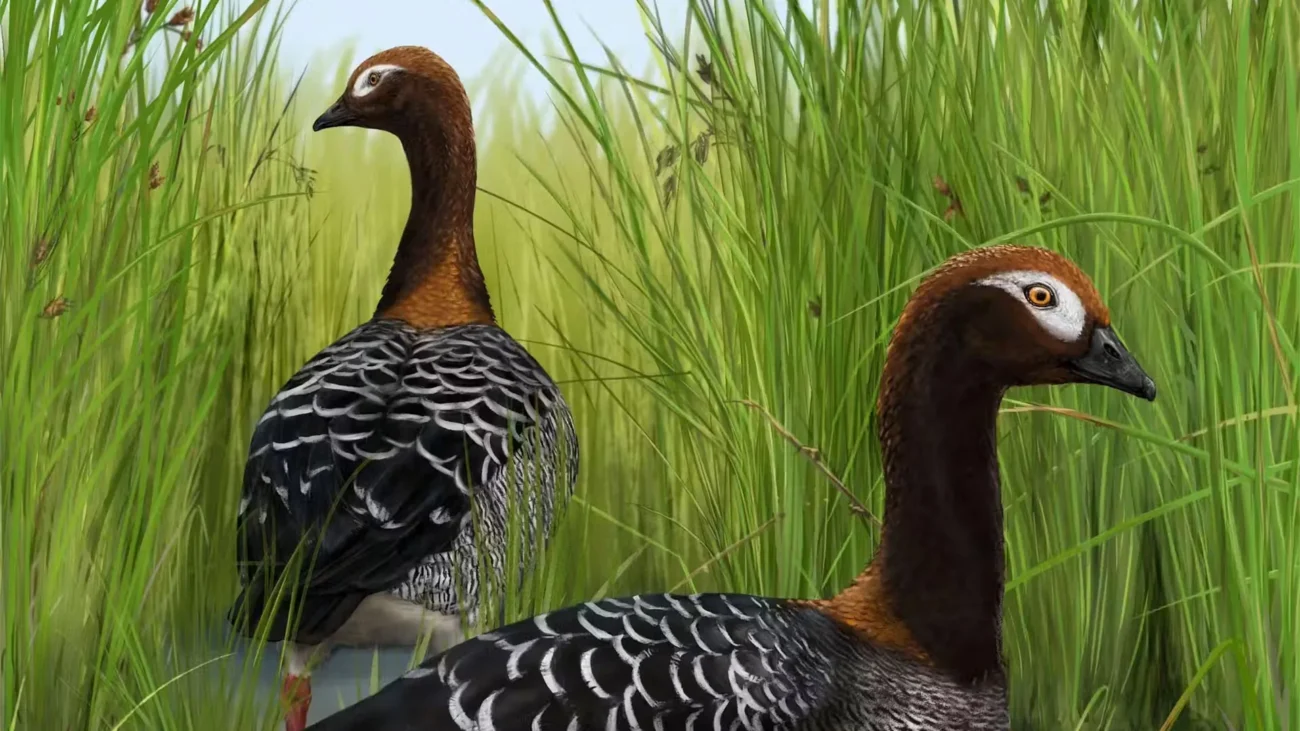
Recent paleontological excavations within the ancient, fossil-rich lake deposits of Central Otago have yielded a remarkable discovery that is fundamentally reshaping scientific understanding regarding the evolution of New Zealand’s avian wildlife. An international research collaborative, featuring prominent academic and institutional representation from the University of Otago (tÄ“kou Whakaihu Waka), the Museum of New Zealand Te Papa Tongarewa, and the University of Cambridge in the United Kingdom, has officially identified a previously unknown species of prehistoric waterfowl. This rare fossil goose, unearthed from the globally significant St Bathans fossil deposits, provides compelling new evidence that the origin and developmental history of Aotearoa’s unique bird populations were significantly more dynamic, fluid, and complex than previously theorized.
The findings, which were recently published in the peer-reviewed scientific journal Historical Biology, center on an intensive, multi-year reassessment of fossilized bones recovered from a prehistoric freshwater system that existed millions of years ago. By combining cutting-edge paleogenetic analytical techniques with rigorous morphological comparisons against both extinct and modern avian skeletons, the research team has solved a longstanding evolutionary puzzle while simultaneously dismantling several entrenched dogmas in New Zealand biogeography.
A New Species Hidden in Plain Sight: The Story of Meterchen luti
Associate Professor Nic Rawlence, Director of the Otago Palaeogenetics Laboratory and a co-author of the groundbreaking study, noted that while various waterfowl fossils are relatively common within the St Bathans deposits, remains definitively attributable to geese have historically been scarce. To gain a clearer understanding of the ecological makeup of ancient Zealandia, the research team undertook a comprehensive re-examination of every single fossil bone from the site that had ever been tentatively classified as belonging to the goose lineage.
The scientists cross-referenced these ancient specimens with a vast, global collection of modern and extinct bird skeletons, carefully analyzing bone density, structural dimensions, and anatomical markers. The painstaking analytical process yielded an unexpected breakthrough: the collection contained a distinctly unique, undescribed species roughly equivalent in size to a modern small goose.
The newly classified taxon has been formally designated as Meterchen luti. The etymology of the binomial nomenclature bridges whimsy and rigorous scientific convention, drawing direct inspiration from the classic nursery rhyme character "Old Mother Goose." This naming convention poetically reflects the imagery of an ancient waterfowl emerging directly from the sediment of a prehistoric fossil deposit. The generic epithet, Meterchen, translates from Ancient Greek as "mother goose," while the specific epithet, luti, is derived from the Latin word meaning "of the mud."
Crucially, morphological and genetic analyses revealed that Meterchen luti occupies a distinct branch on the evolutionary tree. It shares no close familial relationship with the recently extinct, giant flightless New Zealand geese belonging to the Cnemiornis genus, nor is it closely related to their modern Australian counterpart, the Cape Barren goose. Instead, Meterchen luti represents an independent lineage that arrived in the region during a much earlier chapter of Zealandia’s geological history.
The St Bathans Fossil Deposits: A Window Into Ancient Zealandia
To fully appreciate the significance of the Meterchen luti discovery, it is essential to examine the geological and paleontological context of the St Bathans Fauna. Located in Central Otago, these fossiliferous deposits represent the remnants of an expansive Miocene-epoch lake—known to paleo-scientists as Lake Manuherikia—that existed approximately 16 to 19 million years ago.
During this period, Zealandia had separated from the supercontinent of Gondwana and was largely submerged or composed of low-lying islands, creating an isolated laboratory of evolution. The St Bathans deposits are internationally renowned because they offer an exceptionally rare, highly detailed snapshot of terrestrial life in the Southern Hemisphere during the Miocene, a critical epoch when modern ecological communities were beginning to take shape.
Over decades of meticulous field excavation, paleontologists working at St Bathans have unearthed an astonishing diversity of fossilized flora and fauna. These finds include early bats, primitive land mammals, crocodilians, tuatara relatives, and a vast array of unique avian species such as early moa ancestors, primitive rails, and specialized waterfowl. The discovery of Meterchen luti adds yet another vital puzzle piece to this prehistoric ecosystem, demonstrating that the biological communities of ancient New Zealand were rich, diverse, and constantly subjected to waves of colonization and extinction.
Challenging Long-Held Scientific Paradigms
For decades, the prevailing consensus among many New Zealand paleontologists and biogeographers favored a relatively static model of avian evolution. Under this older theoretical framework, it was widely assumed that a large proportion of New Zealand’s endemic bird lineages—including foundational species like moa, kiwi, and various waterfowl—had maintained a continuous, uninterrupted presence on the landmass ever since the breakup of Gondwana roughly 80 million years ago.
With specific regard to the fossil geese of New Zealand, an established hypothesis argued that the ancient waterfowl discovered at St Bathans represented the direct, linear ancestors of the giant flightless Cnemiornis geese that later roamed the landscape. Proponents of this view maintained that the lineage had maintained a continuous local history spanning at least 14 million years.
However, this neat, linear narrative began to encounter friction when advanced genetic testing and paleogenetic analyses were introduced to the field. DNA extracted from subfossil remains increasingly pointed to a different conclusion: the genetic divergence between the giant flightless Cnemiornis geese and Australian waterfowl suggested that the ancestors of Cnemiornis did not evolve from the ancient St Bathans lineage. Instead, genetic data indicated that Cnemiornis ancestors arrived across the Tasman Sea from Australia relatively recently—approximately seven million years ago.
Faced with this apparent contradiction, traditionalists frequently discounted the genetic evidence, attempting to force the physical fossils to fit the older, long-residency model. The new study led by Alan Tennyson of the Museum of New Zealand Te Papa Tongarewa, alongside Associate Professor Rawlence and international colleagues, directly addresses and resolves this scientific friction.
Through a rigorous, multi-disciplinary reassessment that integrated both fossil morphology and modern DNA sequencing, the research team definitively supports the later-arrival theory, completely upending the traditional linear lineage model.
The Chronology of Colonization: A Dynamic Island History
The publication of this study provides a significantly more nuanced chronology of how Aotearoa was populated by avian species over millions of years. According to the research findings, New Zealand’s bird history is characterized not by a single, static colonization event followed by isolated evolution, but rather by a continuous, highly dynamic wave of arrivals, adaptations, and subsequent extinctions.
The chronological timeline of avian presence in the region can be understood through several distinct phases:
-
Deep History and Ancient Arrivals (16 to 19+ Million Years Ago): During the Miocene epoch, ancestral lineages such as the St Bathans goose (Meterchen luti) successfully colonized the landmass of Zealandia. These early arrivals established populations in the expansive freshwater habitats of Lake Manuherikia. However, despite their early establishment, this specific lineage ultimately proved vulnerable to environmental shifts, eventually disappearing completely from the fossil record without leaving any surviving modern or subfossil descendants.
-
Mid-Cenozoic Turnover and Trans-Tasman Dispersal (Approximately 7 Million Years Ago): As geological forces reshaped Zealandia, altering climate patterns, sea levels, and topography, new waves of avian colonizers traversed the vast ocean expanses from Australia and other neighboring regions. Genetic evidence indicates that the evolutionary ancestors of the iconic giant flightless Cnemiornis geese arrived during this window, representing a distinct colonization event entirely separate from the earlier St Bathans inhabitants.
-
Recent Geological History (4 to 5 Million Years Ago to Present): In a revelation that continues to surprise many casual observers, the ancestors of some of New Zealand’s most iconic and familiar large bird species actually arrived in the country surprisingly recently in geological terms. Lead author Alan Tennyson highlights that major avian taxa—including the takahē, Forbes’ harrier, and the apex avian predator, the colossal Haast’s eagle—made their way to Aotearoa only four to five million years ago.
This staggered, multi-wave chronology demonstrates that Zealandia was far more accessible to transoceanic dispersal than previously believed, functioning as a dynamic ecological melting pot rather than an isolated evolutionary backwater.
The Role of Modern Science: Combining DNA and Morphology
The breakthrough regarding Meterchen luti was made possible only by the convergence of traditional paleontology and advanced molecular biology. Associate Professor Rawlence emphasizes that contemporary researchers must utilize every available scientific tool to accurately reconstruct the past.
"Using all the tools in the toolbox, including DNA and fossils, we can reconstruct how the dynamic geological, climatic and human history of Zealandia has shaped the evolution of Aotearoa fauna in ever more detail," Rawlence stated.
While traditional fossil analysis provides critical information regarding the physical size, shape, and biomechanical capabilities of an extinct organism, it has inherent limitations when attempting to reconstruct ancestral relationships over millions of years. Bone morphology can sometimes be misleading due to convergent evolution, where unrelated species develop similar physical traits in response to similar environmental pressures—such as the tendency for island-dwelling birds to become flightless and increase in body size.
By extracting ancient DNA fragments (where preservation allows) and running sophisticated phylogenetic models alongside comprehensive morphological databases, researchers can cut through superficial resemblances. This dual approach allows scientists to construct family trees that reflect true genetic lineage, resolving longstanding debates that could never be settled through bone measurements alone.
Rapid Evolutionary Transformation: The Enigma of Cnemiornis
The study of Meterchen luti and its evolutionary context also sheds light on one of the most fascinating phenomena in island biology: the rapid rate at which morphological changes can occur in isolated ecosystems.
When discussing the giant flightless Cnemiornis geese, Rawlence points out that their relatively recent emergence serves as a striking textbook example of rapid island evolution. Free from mammalian land predators and often exploiting open, resource-rich niches, certain bird lineages can undergo drastic physical transformations over evolutionary short timeframes.
Cnemiornis geese ultimately evolved to stand approximately one meter tall and reached astonishing weights of up to 18 kilograms. These dimensions made them the largest geese anywhere in the world. The rapid transition from standard-sized flying waterfowl ancestors to massive, ground-bound megafauna underscores how swiftly island environments can sculpt the physical characteristics of colonizing species.
However, this same specialized adaptation that allowed them to dominate the landscape also rendered them exceptionally vulnerable. Following human arrival in New Zealand and the subsequent introduction of mammalian predators, alongside anthropogenic habitat modification and hunting, these once-mighty island giants were driven to extinction within a relatively brief historical window.
Broader Implications for Conservation and Biodiversity
Beyond academic debate, the reassessment of the St Bathans goose carries profound implications for modern conservation biology, evolutionary theory, and the public understanding of New Zealand’s natural heritage.
For conservationists working to protect Aotearoa’s remaining endemic species, understanding the true history of colonization and extinction provides a vital baseline. Recognizing that New Zealand’s ecosystems have experienced continuous waves of immigration and extinction over millions of years helps scientists contextualize contemporary biodiversity challenges. It reinforces the understanding that island ecosystems are inherently fragile, highly sensitive to environmental disruption, and capable of rapid, dramatic biological shifts.
Furthermore, the discovery of Meterchen luti emphasizes the immense scientific value of New Zealand’s fossil heritage. Sites like the St Bathans deposits in Central Otago are not merely local curiosities; they are globally significant archives that hold the keys to understanding southern hemisphere biogeography and the fundamental laws of avian evolution. As paleotologists continue to refine their analytical techniques and unearth new material from these ancient lakebeds, it is virtually certain that additional hidden chapters of New Zealand’s prehistoric past will come to light.
In sum, the unassuming fossil goose unearthed from the ancient mud of Central Otago has delivered a powerful academic message. By challenging comfortable assumptions and replacing them with a complex, data-driven narrative of multi-wave colonization and rapid evolutionary adaptation, Meterchen luti has permanently enriched our comprehension of how the breathtaking biodiversity of Aotearoa came to be.

