


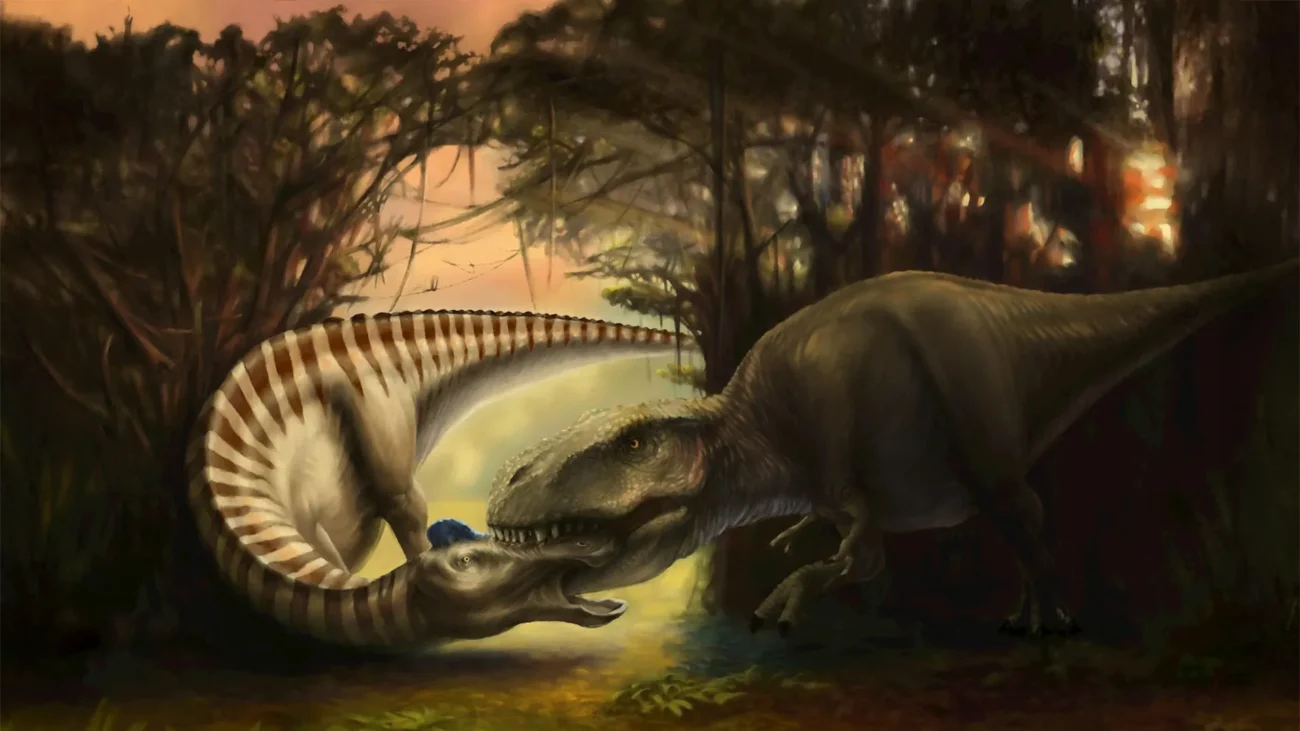
Paleontologists have long debated the exact mechanics of how Tyrannosaurus rex and its closest relatives interacted with their prey, oscillating between theories of active apex predation and opportunistic scavenging. Now, a remarkable fossil housed within the extensive collections of the Museum of the Rockies at Montana State University is offering researchers an unprecedented, high-resolution glimpse into the terminal moments of a Cretaceous herbivore. The specimen in question—a nearly complete skull of the duck-billed dinosaur Edmontosaurus featuring a broken Tyrannosaurus tooth firmly and inextricably wedged into its facial bones—serves as the centerpiece of a newly published scientific investigation.
Led by Taia Wyenberg-Henzler, a doctoral student at the University of Alberta, alongside John Scannella, the Curator of Paleontology at the Museum of the Rockies, the collaborative research effort was recently published in the peer-reviewed scientific journal PeerJ. By combining classical comparative osteology with modern medical imaging technologies, the research team has unlocked a forensic timeline of a deadly encounter that transpired approximately 66 million years ago during the twilight of the Mesozoic Era.
Main Facts of the Discovery
The fossilized Edmontosaurus skull at the heart of this study was originally unearthed in 2005 from the sprawling badlands of the Hell Creek Formation in eastern Montana. The excavation site, situated on public lands managed by the United States Department of the Interior’s Bureau of Land Management (BLM), yielded numerous scientifically significant remains over the decades, but this specific specimen immediately captured the attention of field crews due to an anomalous morphological feature on its facial structure.
Upon closer examination in the preparation laboratories of the Museum of the Rockies—located in Bozeman, Montana—curators identified the crown of a theropod tooth deeply embedded within the nasal bones of the duck-billed dinosaur. While isolated shed Tyrannosaurus teeth and isolated bones bearing rough scoring or punctures are relatively common occurrences in Hell Creek fossil deposits, a tooth physically broken off and locked inside the healed or unhealed bone of a prey item is exceptionally rare.
This rare preservation provides researchers with a dual identification: not only does it definitively mark the species of the recipient of the bite, but it also physically anchors the biological signature of the aggressor directly to the victim. Currently preserved and exhibited for the public within the museum’s Hall of Horns and Teeth, the skull has transformed from a static display piece into a dynamic crime scene waiting to be deciphered.
Chronology and Geological Context: The Hell Creek Ecosystem
To fully understand the implications of the discovery, researchers must place the fossil within its precise geological and temporal framework. The Hell Creek Formation is a famous sequence of continental sedimentary rocks dating from the very end of the Cretaceous period, spanning approximately 68 to 66 million years ago. This geologic window captures the final chapters of the non-avian dinosaur lineage immediately preceding the catastrophic Cretaceous-Paleogene (K-Pg) mass extinction event, which was precipitated by an asteroid impact off the coast of the modern Yucatán Peninsula.
During this interval, the landscape of eastern Montana bore little resemblance to its current semi-arid terrain. Instead, the region was characterized by broad, low-lying coastal floodplains, meandering river systems, expansive subtropical forests, and swampy wetlands bordering a receding inland sea known as the Western Interior Seaway.
Within this humid and productive ecosystem, Tyrannosaurus reigned supreme as the apex terrestrial predator, routinely reaching lengths exceeding 40 feet and body weights surpassing nine metric tons. Sharing this dynamic habitat was a diverse assemblage of megafauna, including armored herbivores like Ankylosaurus, horned ceratopsians such as Triceratops horridus, and large hadrosaurs like Edmontosaurus annectens. These duck-billed dinosaurs formed a staple component of the local vertebrate fauna, serving as abundant primary consumers and, consequently, primary targets for large carnivorous theropods.
Methodological Approach: From Field Discovery to Clinical CT Scans
The rigorous investigative process undertaken by Wyenberg-Henzler and Scannella mirrors modern forensic science. To definitively attribute the embedded tooth to Tyrannosaurus rather than contemporary predators such as the smaller dromaeosaurid Dakotaraptor or the tyrannosauroid Nanotyrannus, the research team engaged in a meticulous comparative anatomy analysis. Every known meat-eating dinosaur species documented within the Hell Creek Formation had its dental morphology cataloged and compared against the dimensions, serration density, and cross-sectional shape of the embedded fragment. The structural match pointed unequivocally to Tyrannosaurus.
To investigate the internal mechanics of the bite without damaging the priceless fossil, the researchers transported the delicate Edmontosaurus skull to Advanced Medical Imaging at Bozeman Health Deaconess Hospital. There, medical-grade Computed Tomography (CT) scans were performed, generating high-resolution three-dimensional digital reconstructions of the skull’s internal architecture.
The scans revealed the precise trajectory of the bite, illustrating how the tyrannosaur’s tooth penetrated the dense cortical bone of the snout, experienced immense torsional stress, and ultimately snapped off beneath the gumline during the struggle. Crucially, the CT analysis confirmed the absolute absence of bone remodeling or healing responses around the embedded foreign object.
Scientific Analysis and Official Perspectives
The lack of osteological healing around the wound site provides critical behavioral insights into the interaction between the predator and its prey. According to Dr. John Scannella, the absence of healing indicates one of two distinct scenarios: either the Edmontosaurus was already deceased and being scavenged when the tyrannosaur inadvertently bit into the skull, or the trauma inflicted by the bite was severe enough to cause immediate mortality, halting any biological healing processes.
"A fossil like this is extra exciting because it captures a behavior: a tyrannosaur biting into this duckbill’s face," Scannella noted during discussions surrounding the publication of the study. "The skull shows no signs of healing around the tyrannosaur tooth, so it may have already been dead when it was bitten, or it may be dead because it was bitten."
Expanding upon this analysis, lead author Taia Wyenberg-Henzler emphasized that the anatomical placement of the wound leans heavily toward active predation. The spatial orientation and depth of the tooth embedded within the nasal region of the Edmontosaurus strongly imply a direct, face-to-face confrontation.
"Looking at the way the tooth is embedded in the nose of the Edmontosaurus suggests that it met its attacker face-to-face, something that usually happens to an animal that was killed by a predator," Wyenberg-Henzler explained. "The amount of force necessary for a tooth to have become broken off in bone also points to the use of deadly force. For me, this paints a terrifying picture of the last moments of this Edmontosaurus."
Biomechanical models of Tyrannosaurus bite force suggest that the animal possessed one of the most powerful jaws in the history of vertebrate evolution, capable of exerting tens of thousands of newtons of force—enough to crush bone and shear through tough connective tissue. The physical snapping of a massive, robust premaxillary or maxillary tooth during an impact against the snout of a duckbill underscores the extreme physical stresses involved in these prehistoric predatory interactions.
Broader Impact and Implications for Paleontology
The debate concerning whether Tyrannosaurus rex functioned primarily as an active apex predator or an opportunistic scavenger has persisted within paleontological literature for decades, initially sparked by provocative arguments put forward by researchers like Jack Horner in the late 20th century. While subsequent discoveries of healed tyrannosaur bite marks on living prey—such as Edmontosaurus tail vertebrae with bone regrowth around embedded teeth—demonstrated that T. rex actively hunted living animals, direct physical evidence capturing the kinetic violence of an attack remains exceptionally scarce.
This newly studied specimen from the Museum of the Rockies significantly strengthens the consensus supporting active predation. By bridging the gap between isolated theoretical models and tangible physical evidence, the fossil contributes valuable empirical data to ongoing studies of predator-prey dynamics, ecological niche partitioning, and behavioral ecology during the late Cretaceous period.
Furthermore, the study highlights the vital importance of continued institutional collaboration between academic researchers, regional museums, and federal land management agencies such as the Bureau of Land Management. Specimens recovered from public lands, when curated and studied within rigorous scientific frameworks like those maintained at Montana State University, continue to yield profound insights into the complex history of life on Earth. As analytical techniques in paleontology continue to evolve—incorporating advanced imaging, isotopic analysis, and digital biomechanical simulations—fossils like the Hell Creek Edmontosaurus skull ensure that ancient ecosystems will continue to reveal their long-hidden secrets to modern science.

