


The drumming of a woodpecker is an iconic sound of nature, a percussive rhythm that often sets these birds apart from their avian counterparts. With heads capable of striking surfaces up to 20 times per second, reaching speeds exceeding 15 miles per hour, woodpeckers possess a remarkable adaptation that fuels their foraging and communication. For enthusiasts in Minnesota, the opportunity to observe and photograph these fascinating creatures is abundant, thanks to the presence of eight distinct woodpecker species within the state. This guide delves into the characteristics, habitats, and behaviors of each of these remarkable birds, offering insights for both seasoned birdwatchers and newcomers to the field.
The Diverse World of Minnesota Woodpeckers
Minnesota’s varied landscapes, from dense northern forests to sprawling deciduous woodlands and even urban backyards, provide crucial habitats for a rich array of woodpecker species. These birds play vital ecological roles, from controlling insect populations to creating cavities used by other wildlife. Understanding their unique adaptations and ecological niches is key to appreciating their presence and ensuring their continued thriving.
1. The Ubiquitous Downy Woodpecker (Dryobates pubescens)
The Downy Woodpecker, the smallest of its kind found in Minnesota, is also one of the most common and widespread throughout North America. These diminutive birds, weighing less than an ounce, are often mistaken for their larger relatives, the Hairy Woodpecker. Their small stature, however, is a significant advantage, allowing them to forage in tight spaces inaccessible to larger birds, such as the delicate branches of shrubs and the smaller twigs of trees.
Physical Characteristics: Downy Woodpeckers exhibit a striking black and white plumage. Their backs are predominantly black, contrasted by white streaks on their wings and a distinctive black and white checkered pattern on their crowns. A vibrant red patch adorns the back of the male’s head, a key identifying feature. The rest of their body is largely white.

Habitat and Foraging: These adaptable birds are found wherever trees are present, making them a frequent visitor to suburban backyards, especially those equipped with bird feeders. Their primary diet consists of small insects, particularly ants, which they meticulously seek out by probing bark crevices. Their preference for foraging on bark makes them a common sight clinging vertically to tree trunks.
Social Behavior and Vocalizations: Downy Woodpeckers often associate with mixed flocks of smaller birds, such as chickadees, for added protection against predators. Their vocalizations are characterized by a series of quick, cheerful chirps, often followed by light, short drumming sequences. Unlike some of their larger cousins, their small size means their drumming is generally not overly loud or disruptive.
2. The Resembling Hairy Woodpecker (Dryobates villosus)
The Hairy Woodpecker shares a striking resemblance to the Downy Woodpecker, leading to frequent confusion among observers. However, the Hairy Woodpecker is notably larger, approximately 40% bigger and nearly three times the weight of its smaller counterpart. Like the Downy Woodpecker, Hairy Woodpeckers are year-round residents in Minnesota.
Physical Characteristics: The color patterns of the Hairy and Downy Woodpeckers are remarkably similar, including the male’s characteristic red patch on the back of the head. However, key distinctions exist. Hairy Woodpeckers possess a longer, more robust bill compared to the Downy. Their backs tend to appear straighter, giving them a more upright posture, reminiscent of a soldier standing at attention.
Habitat and Foraging: Their larger size influences their habitat preference; Hairy Woodpeckers favor larger, mature trees and are thus less commonly encountered in heavily urbanized areas or small parks. They are more likely to be found in extensive forests and woodlands. Their foraging behavior involves searching for insects within the bark of trees, similar to the Downy Woodpecker.
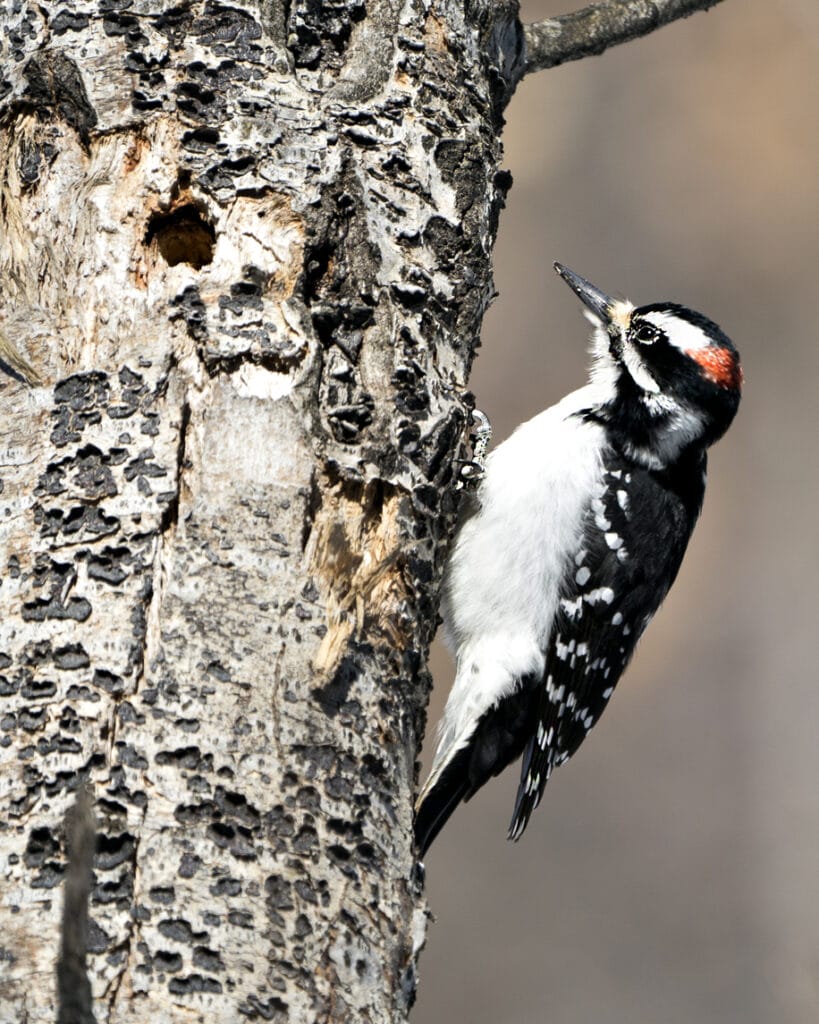
Vocalizations and Identification Challenges: Their calls and drumming patterns are also quite similar to those of the Downy Woodpecker, though generally louder and more forceful due to their size. Differentiating between the two can be challenging, especially from a distance, and requires careful observation of bill length, overall size, and subtle posture differences. With practice, however, birdwatchers can become adept at distinguishing these two closely related species.
3. The Elusive Black-backed Woodpecker (Picoides arcticus)
The Black-backed Woodpecker, while similar in size to the Hairy Woodpecker, is considerably less common in the United States, with its primary range extending across Canada. In Minnesota, these birds can be found year-round, particularly in the northern regions bordering Canada, where they favor cooler climates.
Physical Characteristics: True to its name, the Black-backed Woodpecker is predominantly black, adorned with white patches on its wings and often a white belly. A distinctive black crown is accompanied by two white lines near the bill, creating a mustache-like appearance. A key differentiator between sexes is a yellow patch on the forehead of the male, which is present in juveniles of both genders but disappears in adult females.
Habitat and Foraging: These woodpeckers exhibit a unique preference for forests that have experienced recent fires. Their dark plumage provides excellent camouflage against the charred bark of burned trees, aiding them in both hunting and predator evasion. Their diet largely consists of wood-boring beetles, which they locate by drilling test holes into the bark. Once a beetle tunnel is found, they employ their long, specialized tongues to extract their prey.
Vocalizations: Black-backed Woodpeckers are known for their remarkably quiet calls, typically consisting of a single, quick chirp followed by a brief pause before another chirp. This subdued vocalization contrasts with the more raucous drumming of many other woodpecker species.

4. The Sap-Drinking Yellow-bellied Sapsucker (Sphyrapicus varius)
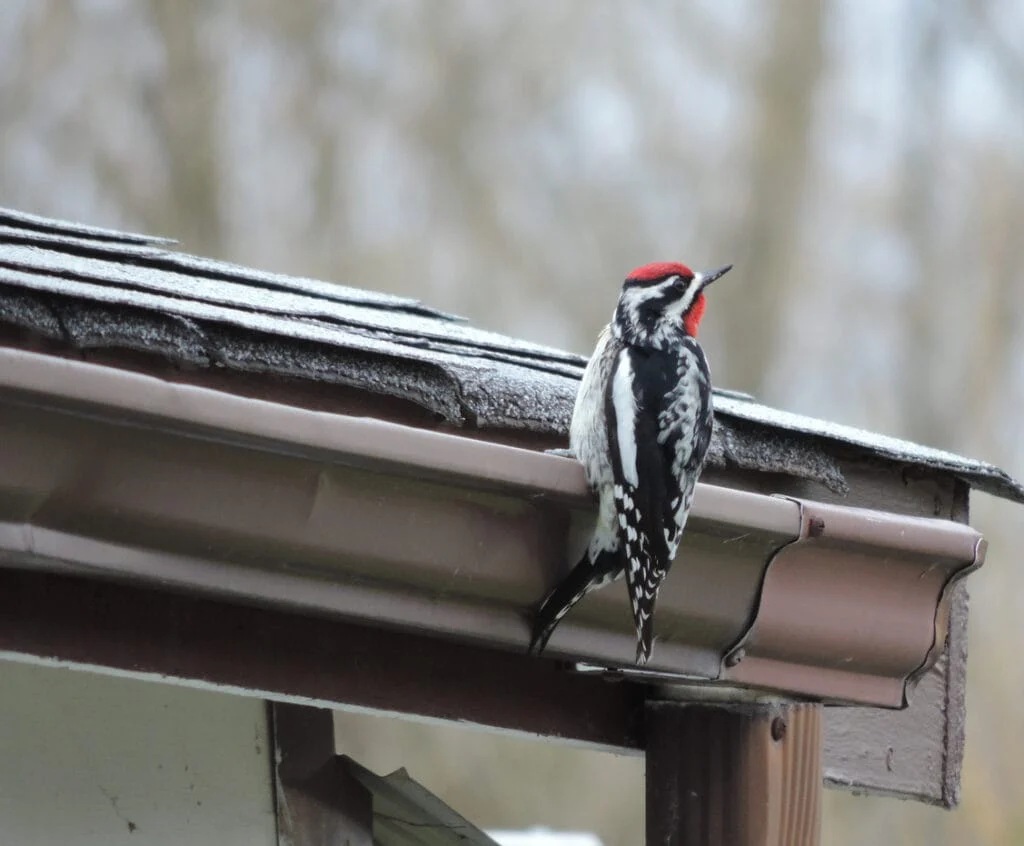
The Yellow-bellied Sapsucker is a beautifully marked woodpecker, roughly the size of an American Robin. These birds breed in the northern reaches of Minnesota and migrate to the southern parts of the state during the colder months, meaning they can be observed for a significant portion of the year within Minnesota.
Physical Characteristics: Their plumage is a striking combination of black and white, though the pattern is not rigidly defined. Both males and females sport a red forehead, but only the males possess a red throat. The bird’s namesake feature is a small yellow patch on its chest.
Unique Feeding Behavior: The "sapsucker" in their name refers to their distinctive feeding habit. They excavate rows of small, precise holes, known as "sap wells," in the bark of trees. From these wells, they drink the tree sap, which forms the primary component of their diet. While they also consume insects and fruits, sap is their preferred sustenance. This behavior has an interesting ripple effect in the ecosystem, as other creatures, such as Ruby-throated Hummingbirds, often take advantage of the sapsucker-drilled wells to access the sweet liquid.
Vocalizations: Yellow-bellied Sapsuckers have a unique call described as "pew pew pew," often repeated without a discernible pattern until the bird decides to cease. This distinctive vocalization is a key identifier for this species.
5. The Ground-Foraging Northern Flicker (Colaptes auratus)
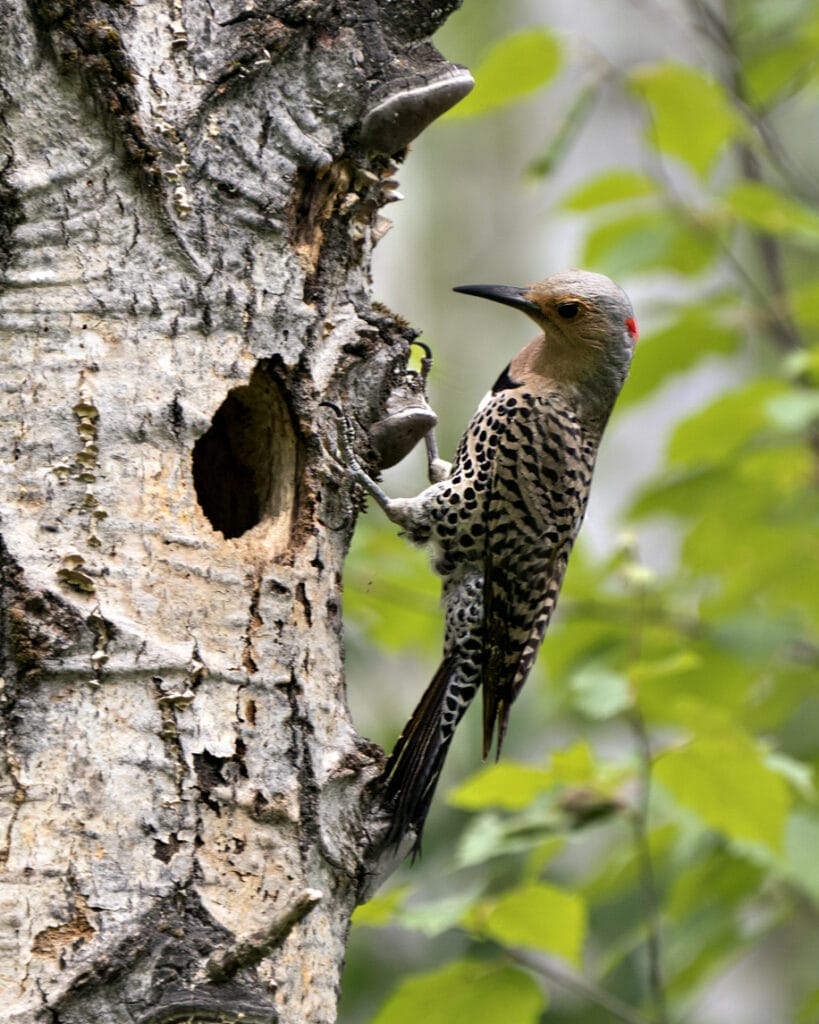
The Northern Flicker is a relatively large woodpecker, slightly smaller than a crow, and is a common sight in Minnesota throughout the year. They inhabit a variety of environments, including woodlands, parks, and backyards.

Physical Characteristics: Northern Flickers possess an attractive plumage characterized by gray feathers speckled with black dots. They have a distinct red patch on the nape of their neck and a prominent black crescent on their chest. Males are further distinguished by a black cheek patch, while females have a red cheek patch.
Unconventional Foraging: Unlike most woodpeckers that primarily forage on tree trunks and branches, Northern Flickers are notable ground foragers. A significant portion of their diet is acquired by searching for insects, such as ants and beetle larvae, on the ground. This behavior often leads to them being inadvertently startled by humans walking through their foraging areas.
Mating Drumming: Northern Flickers are among the fastest drummers in the woodpecker world, particularly during the mating season. To attract a mate, they engage in intense drumming, sometimes on resonant surfaces like metal objects. This competition for mates can result in exceptionally loud and rapid drumming, a phenomenon that can even occur in urban settings if metal structures are available.
6. The Visually Striking Red-headed Woodpecker (Melanerpes erythrocephalus)
The Red-headed Woodpecker is one of Minnesota’s most easily identifiable species, primarily due to its striking all-red head. This vibrant coloration, combined with a distinctive black, white, and blue "checkered" pattern on its body, has earned it the nickname "flying checkerboard."
Physical Characteristics: The brilliant red crown is its most prominent feature. The rest of its plumage displays a bold pattern of black, white, and blue, creating a visually arresting appearance in flight. Juvenile Red-headed Woodpeckers lack the red crown and blue feathers, instead exhibiting dark brown plumage that gradually transforms as they mature.

Habitat and Diet: Red-headed Woodpeckers are typically seen in Minnesota during the breeding season, from spring through summer. However, in the southeastern part of the state, they can be observed year-round. They are omnivores, feeding on a varied diet that includes fruits, seeds, insects, and even the eggs of other birds. They are often observed foraging on tree bark, much like other woodpecker species.
Vocalizations: Their call is loud and harsh, capable of surprising the unprepared listener. This initial sharp sound is often followed by a series of softer chirps.
7. The Rare American Three-toed Woodpecker (Picoides dorsalis)
The American Three-toed Woodpecker is a rare sight in Minnesota and across the United States. Its presence in the state is primarily limited to the northeastern regions, making it a special encounter for any birdwatcher.
Unique Anatomy: The defining characteristic of this species, from which it derives its name, is its reduced number of toes. While most woodpeckers possess four toes (two facing forward and two backward, known as zygodactyl feet), the American Three-toed Woodpecker has only three. This anatomical difference allows them to lean back slightly more on vertical surfaces, potentially contributing to the force of their drumming.
Habitat and Diet: These woodpeckers are adapted to drilling into tree bark in search of their primary food source: beetles and ants. Their unique foot structure may aid them in their tenacious pursuit of these insect prey.
Vocalizations: Their call is typically a single, loud chirp. However, juveniles are considerably more vocal, emitting a continuous stream of chirps until they are fed, a behavior common among young birds seeking parental attention.
8. The Majestic Pileated Woodpecker (Dryocopus pileatus)
The Pileated Woodpecker is the largest woodpecker species found in Minnesota, easily rivaling the size of a crow. These impressive birds can be found year-round in the state, favoring woodlands, forests, and backyards that offer suitable foraging and nesting opportunities.
Physical Characteristics: Pileated Woodpeckers are predominantly black, distinguished by white stripes along their neck and crown. Their most striking feature is a prominent, often flamboyant, crest atop their head. Male Pileated Woodpeckers can be identified by a red patch on their cheeks.
Ecological Significance and Conservation: While not considered rare, their numbers have faced challenges. Historical deforestation in the 19th century led to a decline in their populations. However, as forests have regenerated, their numbers have stabilized, though they remain less common than some of the smaller woodpecker species.
Vocalizations: Their calls are loud and distinctive, often described as a series of "wak wak wak wak" sounds. The speed and intensity of these calls can indicate the bird’s level of defensiveness, with faster and louder vocalizations signaling greater agitation.

Coexisting with Minnesota’s Woodpeckers
Woodpeckers in Minnesota have demonstrated remarkable adaptability in coexisting with human populations. However, it is crucial to remember that these are wild animals. While providing food and water sources like bird feeders and baths can be beneficial, it is imperative to avoid attempting to capture or domesticate them. Their wild nature and ecological roles are best appreciated from a respectful distance, allowing them to continue their vital work in the state’s diverse ecosystems.
Frequently Asked Questions About Minnesota’s Woodpeckers
What is the most common woodpecker in Minnesota?
The Downy Woodpecker and the Northern Flicker are generally considered the most commonly observed woodpecker species in Minnesota, owing to their adaptability to various habitats, including urban and suburban environments.
Where can I find more information about local woodpecker sightings in Minnesota?
For up-to-date information on woodpecker sightings in Minnesota, resources like eBird are invaluable. This platform allows users to search for recent sightings, track specific species, and explore what birds have been observed in particular geographic areas. This data is compiled from birdwatchers worldwide and provides a dynamic snapshot of avian distribution and activity.

