


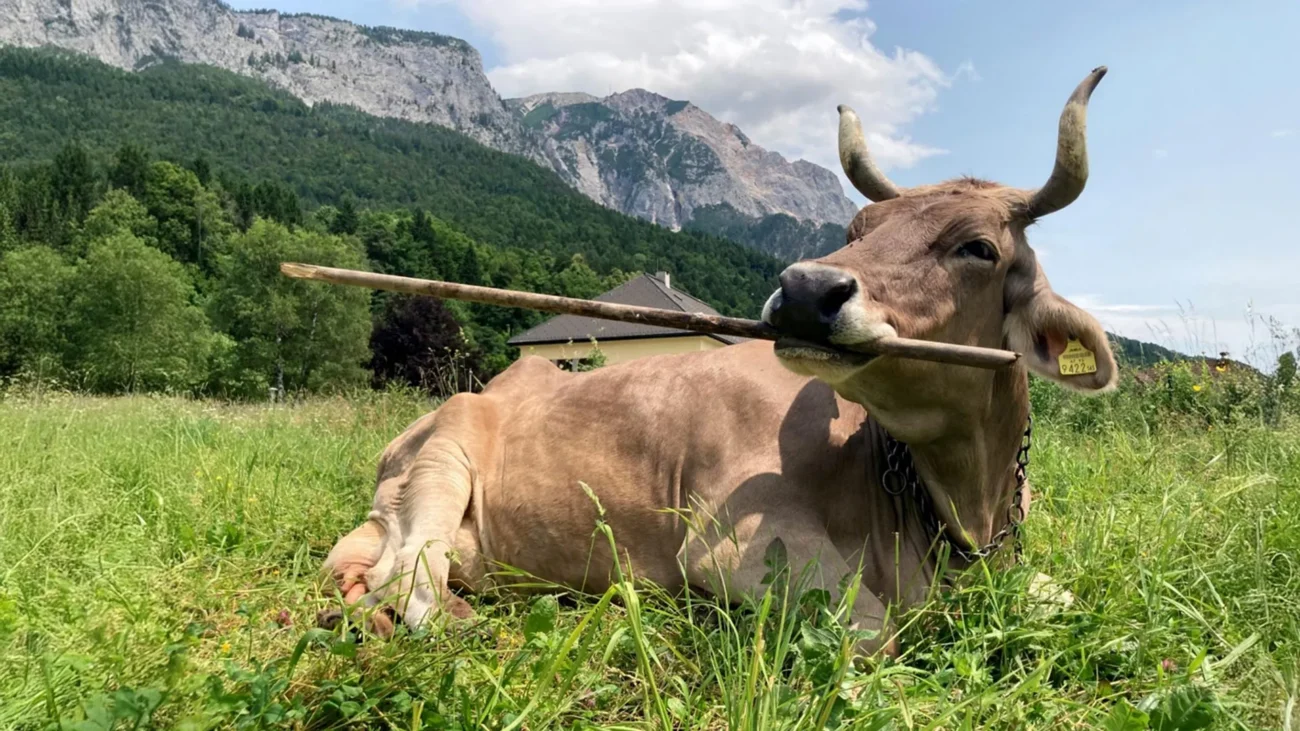
In 1982, cartoonist Gary Larson’s iconic Far Side comic, "Cow Tools," humorously depicted a cow proudly presenting a collection of bizarre, utterly useless objects, playing on the long-held assumption that bovines are incapable of creating or wielding tools. This widely accepted notion, ingrained in popular culture and perhaps even scientific perception, is now facing a significant challenge thanks to a remarkable cow named Veronika. A groundbreaking study, recently published in the esteemed journal Current Biology, details the first documented instance of tool use in a pet cow, strongly suggesting that cattle possess a far greater cognitive capacity than previously understood.
Alice Auersperg, a cognitive biologist at the University of Veterinary Medicine in Vienna and a lead researcher on the study, commented on the broader implications of these findings. "The findings highlight how assumptions about livestock intelligence may reflect gaps in observation rather than genuine cognitive limits," she stated, emphasizing that what we perceive as a species’ limitations might simply be a reflection of our own limited understanding and observation.
The Unlikely Innovator: Meet Veronika
Veronika is not your typical farm animal. She is a Swiss Brown cow who lives as a cherished companion animal, rather than being raised for agricultural purposes. Her owner, Witgar Wiegele, an organic farmer and baker, considers Veronika an integral member of his family. This unique living situation, characterized by a close human-animal bond and an enriched environment, appears to have played a crucial role in fostering Veronika’s extraordinary abilities.
Wiegele first noticed Veronika’s unusual behavior over a decade ago. He observed her picking up sticks and using them to scratch parts of her body. Initially, this might have been dismissed as a quirky habit, but Wiegele’s keen observation and the eventual recording of this behavior on video brought it to the attention of scientific researchers. Upon reviewing the footage, Auersperg was immediately struck by the intentionality of Veronika’s actions. "When I saw the footage, it was immediately clear that this was not accidental," Auersperg recalled. "This was a meaningful example of tool use in a species that is rarely considered from a cognitive perspective." This observation marked the beginning of a scientific journey to understand the extent of Veronika’s cognitive capabilities.
Rigorous Investigation: Testing the Boundaries of Bovine Cognition
To move beyond anecdotal observation and rigorously assess Veronika’s tool-using abilities, the research team designed a series of controlled experiments. These tests were meticulously structured to eliminate any possibility of random behavior and to confirm the flexible and purposeful nature of Veronika’s actions.
The core of the experimental setup involved placing a deck brush, an object with distinct features, in various positions within Veronika’s enclosure. Researchers then observed her interactions with the brush across numerous trials. The results were compelling. Veronika consistently demonstrated a discerning approach to using the brush, selecting specific parts of the tool depending on where she intended to scratch. This was not a haphazard application of the object; her choices directly correlated with the needs of different anatomical regions of her body.
Antonio Osuna-Mascaró, another key researcher on the study, elaborated on the significance of these findings. "We show that a cow can engage in genuinely flexible tool use," he stated. "Veronika is not just using an object to scratch herself. She uses different parts of the same tool for different purposes, and she applies different techniques depending on the function of the tool and the body region." This observation moves beyond a simple understanding of tool use to a more complex appreciation of adaptable and strategic application.
Flexible and Multi-Purpose Tool Use: A Sophisticated Skill
The detailed analysis of Veronika’s behavior revealed intricate patterns that underscored the sophistication of her tool use. For larger, more robust areas of her body, such as her back, Veronika consistently opted for the bristled side of the deck brush, presumably for a more effective scratch. In contrast, when targeting more sensitive regions on her lower body, she adeptly switched to using the smoother handle of the brush. This deliberate choice of tool feature based on the body part being addressed is a significant indicator of cognitive flexibility.
Furthermore, Veronika exhibited a nuanced control over her movements. The researchers observed that when scratching her upper body, her motions were broader and more forceful, reflecting the needs of those areas. Conversely, when applying the brush to her lower body, her movements became slower and more precise, indicating a fine-tuned understanding of force and pressure.
The scientific definition of tool use involves the employment of an external object to achieve a goal through physical interaction. Veronika’s actions not only meet this fundamental definition but also surpass it. Her behavior qualifies as flexible, multi-purpose tool use—a rare cognitive ability where an individual can utilize different features of the same object for varied outcomes. This level of cognitive sophistication has been clearly documented in only a handful of non-human species, most notably chimpanzees, making Veronika’s case exceptionally noteworthy.
Overcoming Anatomical Constraints: Ingenuity in Action
Veronika’s tool use is categorized as egocentric tool use, meaning the tool is employed to directly affect her own body. While this form of tool use is generally considered less complex than using tools on external objects, it still presents significant challenges, particularly for an animal lacking manual dexterity. Cows, unlike primates, do not possess hands. Veronika must therefore manipulate tools using her mouth.
Despite this anatomical limitation, Veronika demonstrated remarkable control and apparent foresight. She appeared to anticipate the results of her actions, meticulously adjusting her grip and movements to achieve the desired outcome. This suggests a sophisticated internal model of how the tool interacts with her body and a capacity for fine motor control, even when using her mouth as the primary manipulator. This level of adaptive manipulation, especially given the constraints, further elevates the significance of her discovered abilities.
The Environmental Catalyst: Why This Behavior May Be Rare
The researchers posit that Veronika’s unique living conditions likely contributed significantly to the development and expression of her tool-using behavior. Unlike the vast majority of cattle, who are raised in environments primarily focused on food production and often experience limited cognitive stimulation, Veronika has lived a long life in a rich and complex environment. Her daily life includes extensive interaction with humans and access to a variety of objects that she can explore and manipulate.
These enriched conditions likely provided the crucial opportunities for exploration, experimentation, and innovation that are uncommon for most cattle. The researchers’ concluding remarks in their study directly address this point: "[Veronika] did not fashion tools like the cow in Gary Larson’s cartoon, but she selected, adjusted, and used one with notable dexterity and flexibility," they wrote. "Perhaps the real absurdity lies not in imagining a tool-using cow, but in assuming such a thing could never exist." This statement serves as a powerful indictment of our tendency to underestimate the cognitive potential of species we often view through a purely utilitarian lens.
Rethinking Animal Intelligence: Broader Implications and Future Directions
The discovery of Veronika’s tool-using capabilities represents a pivotal moment in our understanding of animal intelligence. It is the first scientifically confirmed case of tool use in cattle, thereby expanding the known repertoire of species exhibiting this sophisticated cognitive skill. More importantly, it raises a critical question: how many other instances of advanced cognitive abilities in livestock and other species have gone unnoticed due to a lack of targeted observation and research?
The research team is now focused on understanding the specific environmental and social conditions that foster the development of such behaviors. Their work underscores the importance of enriched environments and positive human-animal interactions in unlocking cognitive potential. They are also actively encouraging the broader scientific community and the public to report any similar observations.
"Because we suspect this ability may be more widespread than currently documented," Osuna-Mascaró conveyed, "we invite readers who have observed cows or bulls using sticks or other handheld objects for purposeful actions to contact us." This open call for citizen science highlights the collaborative nature of modern research and the potential for widespread discoveries when we are open to looking beyond our preconceived notions.
The implications of this research extend far beyond the realm of bovine cognition. It challenges anthropocentric views of intelligence and encourages a more nuanced and respectful appreciation of the diverse cognitive landscapes of the animal kingdom. As we continue to uncover such remarkable abilities, the lines between species, once thought to be clearly defined by cognitive capacity, begin to blur, prompting a profound re-evaluation of our place within the broader tapestry of life on Earth. The "Cow Tools" of Gary Larson’s imagination may have been a caricature, but Veronika’s reality is a testament to the extraordinary and often overlooked ingenuity present in the natural world.

