


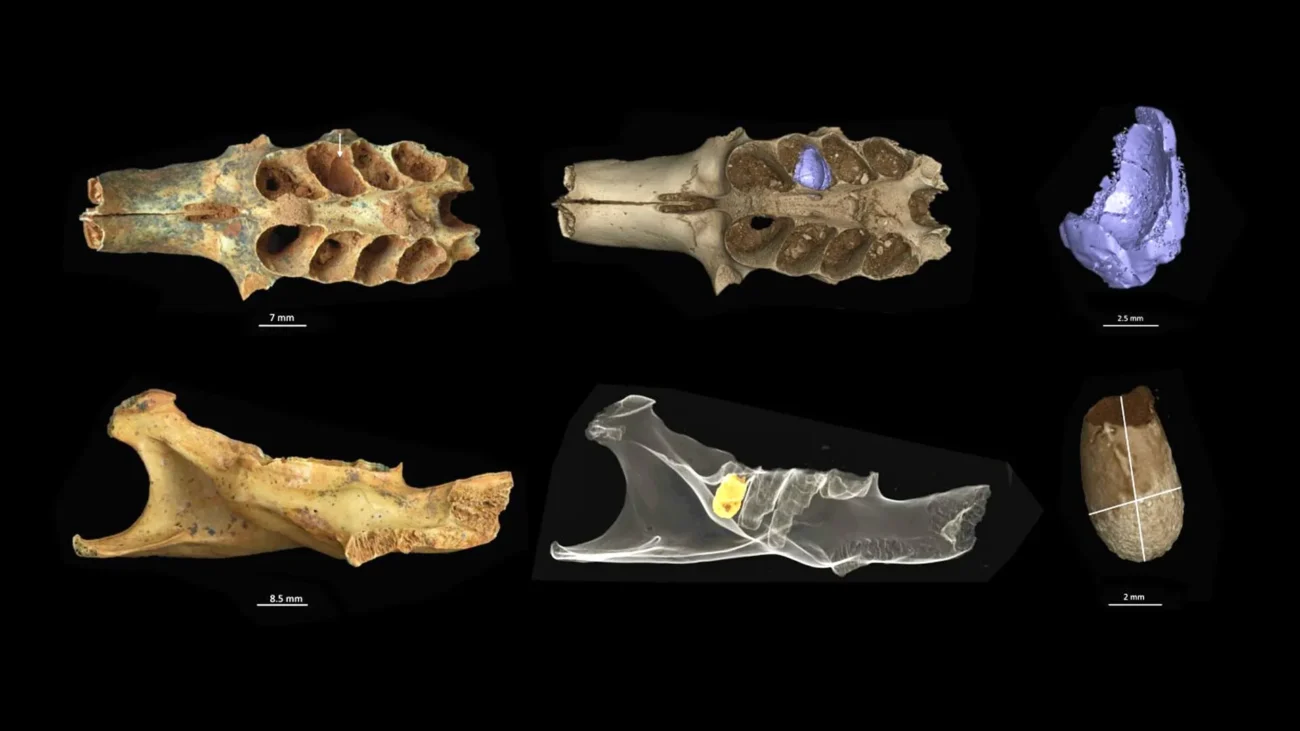
Thousands of years ago, deep within a cave on the Caribbean island of Hispaniola, a dramatic scene unfolded. A giant barn owl, a formidable predator, delivered its prey – a rodent known as a hutia – to its lair. The intended purpose was sustenance for the owl’s young. The meal was swift, and when the owl departed, it left behind the skeletal remains of the unfortunate hutia. It was within these scattered bones, preserved in the cave’s mineral-rich environment, that an entirely unexpected chapter of life’s resilience began to write itself, a chapter that paleontologists have only recently deciphered. The story, as revealed by meticulous scientific investigation, involves a burrowing bee seeking shelter and a remarkable adaptation that repurposed the remnants of ancient life into a vibrant nursery.
The initial riddle, posed by the ancient cave’s inhabitants and their fate, highlights the stark realities of predator-prey relationships. A giant barn owl, a hutia, and a burrowing bee entered the cave. Only two emerged. The riddle’s answer—the one that cannot fly—points to the hutia, consumed by the owl. However, the true narrative lies not in the hutia’s demise, but in the unexpected subsequent use of its remains. This ancient event, likely occurring over millennia, has provided scientists with an unprecedented glimpse into the intricate ecological interactions and evolutionary adaptations that can occur in seemingly desolate environments.
The Cave as a Fossilization Chamber
The geological setting of Hispaniola, characterized by its karst topography—a landscape of soluble rocks like limestone, often riddled with caves and sinkholes—played a crucial role in preserving these ancient events. The fine, clay-rich silt that accumulated in the darker recesses of the cave provided an ideal medium for fossilization. This silt, washed down from the surface and trapped within the cave’s sheltered confines, gradually enveloped the hutia’s remains, slowly transforming them into stone over thousands of years.
The Cueva de Mono, located in the southern Dominican Republic, proved to be an exceptionally rich repository of these ancient stories. This particular cave likely served as a long-term feeding site for generations of giant barn owls. Their repeated activity, bringing prey back to the same secure location, created a concentrated collection of animal remains, perfect for subsequent fossilization. The sheer volume of hutia fossils discovered here, all appearing to belong to the same species, underscores the consistent predation patterns over a significant period.
An Unconventional Nursery Discovered
The unraveling of this ancient narrative began with a keen observation during a fossil excavation. Lazaro Viñola Lopez, then a doctoral student at the Florida Museum of Natural History, was meticulously studying the hutia fossils. His initial focus was on understanding the species’ presence and distribution on the island, as this particular hutia was rarely found elsewhere. While examining the hutia jaws, he noticed something unusual. Instead of the rough, porous texture typical of bone, one cavity possessed an unnervingly smooth inner surface.
This observation sparked a memory for Viñola Lopez. He recalled a similar discovery in Montana in 2014, where wasp cocoons were found embedded within dinosaur fossils. He initially hypothesized that the smooth cavities in the hutia jaws were also evidence of wasp nests. This seemed like a plausible explanation, a niche project that could lead to a brief scientific report. He shared his preliminary findings with fellow doctoral student Mitchell Riegler. Riegler, initially occupied with other research, was not immediately enthusiastic about pursuing what he perceived as a minor investigation.
The Shift from Wasps to Bees: A Scientific Revelation
The project remained on the back burner until Riegler accepted a challenge from a former advisor to write a scientific paper within a week. This friendly competition spurred him and Viñola Lopez to re-examine the intriguing fossil specimens. Their initial assumption of wasp nests began to falter as they delved deeper into the scientific literature, particularly research on ichnofossils—traces of past biological activity.
The key distinction emerged upon closer examination of nest structures. Wasp nests are typically constructed from chewed plant material mixed with saliva, resulting in rough, irregular walls. The smooth, polished interiors observed in the hutia jaw cavities did not align with this characteristic. However, research on modern bees provided a compelling alternative. Many species of burrowing bees are known to coat their nests with a waxy secretion. This secretion not only provides waterproofing but also creates a remarkably smooth and durable inner lining. This crucial detail shifted the researchers’ focus from wasps to bees.
This correction elevated the significance of their discovery dramatically. The use of fossilized structures as nesting sites by bees was virtually unprecedented. While there is one known instance of burrowing bees nesting within a cave, and another report of bees drilling into human bones, the phenomenon of bees utilizing pre-existing natural cavities within fossilized animal remains without excavation or alteration was entirely novel.
A Race Against Time to Preserve the Evidence
The newfound importance of their discovery prompted Viñola Lopez and Riegler to expand their research. They consulted with experts in modern bee behavior and conducted extensive literature reviews. Viñola Lopez even returned to the Cueva de Mono to examine the cave’s geological strata more closely, seeking further context for the bee’s ancient behavior.
Their efforts to document this unique ecological interaction were nearly thwarted by an unexpected threat. Plans emerged to develop the land surrounding the cave, with proposals to convert it into a septic tank system. Such a development would have irrevocably damaged the cave’s delicate ecosystem and destroyed invaluable fossil evidence. Recognizing the impending danger, the research team launched what they described as a "rescue mission" to recover as many fossils as possible before the proposed construction could commence. Their urgent efforts proved successful, yielding a significant collection of specimens that allowed for a more comprehensive study.
Expanding the Scope: Beyond Hutia Jaws
The comprehensive study that followed revealed that the bees’ unconventional nesting habits were not limited to the hutia jaws. The researchers discovered bee nests embedded within other fossilized remains found in the cave. In one instance, a nest was meticulously constructed within the pulp cavity of a sloth tooth. Tree sloths, once native to the Caribbean, had long since disappeared from the region, likely due to the arrival of humans. Another nest was found within a hutia vertebra, occupying the space where the spinal cord once resided.
Through the use of advanced imaging techniques, such as CT scans, the researchers were able to peer inside these fossilized nests. The scans revealed a remarkable level of organization and reuse. Some cavities contained multiple, concentric layers of nests, indicating that certain bee species had a propensity for reusing existing, empty cavities. In a particularly striking example, six distinct bee nests were found stacked one inside another within a single hutia tooth socket, resembling a set of Russian nesting dolls. This layered construction suggests a long history of successful nesting within these fossilized structures.
Environmental Pressures Driving Novel Adaptations
The research team proposed a compelling environmental explanation for this unusual behavior. The surrounding landscape of Hispaniola is predominantly karst, characterized by sharp, rugged limestone terrain that offers little stable soil for burrowing insects. Mitchell Riegler vividly described the challenging terrain, recounting a personal experience of falling on the sharp limestone.
In such an environment, any soil that does accumulate on the surface is prone to being washed away, often finding its way into caves. These subterranean deposits, accumulated over time, may have represented some of the few viable nesting sites for burrowing bees in the region. The cave, therefore, became a refuge, offering a stable and protected environment with the necessary material for reproduction, even if that material was derived from the fossilized remains of ancient prey.
Implications for Understanding Life’s Adaptability
The discovery, published in the prestigious journal Proceedings of the Royal Society B, offers profound insights into the adaptability of life and the intricate ecological relationships that can develop over vast stretches of time. It highlights how even the most unlikely circumstances can foster novel evolutionary strategies. The cave, once a site of predation and decay, was transformed into a dynamic nursery, demonstrating nature’s remarkable ability to repurpose resources.
This research underscores the importance of seemingly minor paleontological finds. The initial dismissal of the smooth cavities as a "niche project" nearly led to the overlooking of a significant scientific revelation. The careful observation and persistent investigation by Viñola Lopez and Riegler exemplify the scientific process, where initial hypotheses are rigorously tested and refined.
The broader implications of this finding extend to our understanding of past ecosystems and the potential for discovering similar adaptations in other fossil-rich environments. It suggests that the study of ichnofossils, the traces of past biological activity, can reveal a wealth of information beyond the direct remains of organisms. These "trace fossils" can offer unique perspectives on behavior, environmental conditions, and the complex interplay of life.
Future Research and Unanswered Questions
The Cueva de Mono continues to hold secrets. The researchers are actively engaged in studying other fossils recovered from the site, anticipating further discoveries that will shed more light on the cave’s ancient history and the diverse life forms that inhabited it. The ongoing work promises to expand our knowledge of Caribbean paleontology and the extraordinary ways in which life finds a way to persist and thrive, even in the face of seemingly insurmountable environmental challenges. The story of the giant barn owl, the hutia, and the burrowing bee is a testament to nature’s enduring ingenuity and the enduring power of scientific curiosity to unearth the hidden narratives of our planet’s past.

