


The landscape of animal ownership in the United States is currently undergoing a period of profound legislative transformation, driven by a complex interplay between advocacy groups, regulatory agencies, and elected officials. For bird owners, breeders, and exhibitors, the shifting legal environment presents a unique set of challenges that threaten the traditional practices of aviculture. The American Federation of Aviculture (AFA) has identified a surge in proposed legislation that, while often framed as animal welfare initiatives, carries significant implications for the rights of private citizens to keep and breed avian species. Understanding the mechanics of these legal shifts—ranging from local municipal ordinances to federal regulatory changes—is no longer an elective pursuit for the avian community; it has become a necessity for the preservation of the hobby and the industry at large.
The Mechanics of Modern Legislation: From Bills to Statutes
To navigate the current legal climate, it is essential to distinguish between the various forms of government action. Historically, legislation is defined as the act of proposing or enacting laws. In contemporary governance, this process typically begins with a "Bill," which serves as a draft of the intended law. While a Bill often includes an introductory summary outlining its purpose, enforcement mechanisms, and community impact, these summaries can frequently be reductive or misleading.
A significant portion of modern animal-related legislation does not originate within the legislative body itself but is instead drafted by third-party lobbying organizations. Animal rights and welfare groups, many of which possess well-funded legislative arms, frequently present pre-written Bills to representatives for introduction into local, state, or federal systems. These organizations often operate with agendas that may not align with the practical realities of bird ownership or the scientific needs of conservation-based breeding. When a Bill is introduced, it enters a period of debate and amendment, where its original scope can be expanded or contracted, often with little public oversight until the final stages of the voting process.
The Nuances of Local Governance: The Power of the Ordinance
While federal laws often garner the most media attention, the AFA highlights that some of the most immediate threats to bird owners occur at the municipal level through "ordinances." Unlike federal or state statutes, ordinances are local laws enacted by city councils or county boards. They are primarily civil rather than criminal in nature, meaning violations typically result in fines or court-ordered compliance rather than incarceration. However, the civil nature of these laws does not diminish their impact.
A common legislative trend involves the implementation of "limit laws," which restrict the number of animals a household may possess. Initially, these ordinances are often marketed to the public as a means of controlling "nuisance" populations of dogs and cats. However, the AFA warns that the language in these Bills is frequently broad or subject to future amendments. A canary breeder with six pairs of birds could suddenly find themselves in violation of a local law if an ordinance originally intended for dogs and cats is amended to include "all companion animals" or specifically lists birds.
If a citizen fails to comply with an ordinance—such as a mandate to reduce the number of birds in their home—they can be taken to court. A judge has the authority to enforce these local laws through escalating fines or by holding the individual in contempt of court, a legal status that can lead to more severe judicial consequences. This "creeping" legislation often bypasses public scrutiny because it begins with species that the general public agrees require regulation, only to later encompass niche groups like aviculturists.
The Regulatory State: Understanding Agency Rules
A critical distinction must be made between laws passed by elected officials and regulations established by administrative agencies. While laws and ordinances require a vote by a legislative body (such as a City Council, State General Assembly, or the U.S. Congress), regulations are the specific rules used to implement those laws. These can be changed without a direct vote from elected representatives, provided the agency follows a specific administrative process, which usually includes a public comment period.
A primary example of this is the role of the U.S. Fish and Wildlife Service (USFWS) in managing the Endangered Species Act (ESA). The agency has the power to add species to the protected list, which immediately changes the legal requirements for ownership, transport, and trade. Similarly, the United States Department of Agriculture (USDA) oversees the Animal Welfare Act (AWA), which has recently seen expanded oversight regarding avian species. For bird owners, the "regulatory state" represents a layer of governance that is often more technical and faster-moving than traditional legislation, requiring constant monitoring of the Federal Register and agency announcements.
A Chronology of Avian Legislative Evolution
The history of avian legislation in the United States shows a clear trajectory from conservation-focused efforts to more restrictive ownership models.
- The 1970s: The Conservation Era. The introduction of the Endangered Species Act (1973) and the global implementation of CITES (Convention on International Trade in Endangered Species of Wild Fauna and Flora) focused on preventing the extinction of species in the wild. During this period, legislation was largely concerned with international trade and the protection of habitats.
- The 1990s: The Wild Bird Conservation Act (1992). This landmark federal legislation effectively halted the mass importation of wild-caught birds into the U.S. for the pet trade. It shifted the focus of the American avian community toward captive breeding and self-sustainability.
- The 2000s: The Rise of Local Ordinances. As urban areas expanded, "nuisance" laws became more common. Cities began experimenting with noise ordinances and animal limit laws that started to impact hobbyist breeders in residential zones.
- 2010–Present: The Animal Rights Shift. The last decade has seen a shift from "welfare" (ensuring humane treatment) to "rights" (challenging the morality of animal ownership). This era is defined by "retail rescue" laws, bans on the sale of animals in pet stores, and attempts to amend the Lacey Act to restrict the interstate movement of various species.
Supporting Data: The Economic and Social Scope of Aviculture
The importance of monitoring legislation is underscored by the sheer scale of bird ownership in the United States. According to data from the American Pet Products Association (APPA), birds remain one of the most popular categories of companion animals.
- Ownership Statistics: Approximately 5 to 7 million households in the U.S. own at least one bird. The total population of pet birds is estimated to be over 20 million, ranging from small finches and budgerigars to large macaws and cockatoos.
- Economic Impact: The avian industry contributes billions of dollars to the U.S. economy through the sale of specialized feeds, cages, veterinary services, and equipment. Restrictive legislation does not just affect the individual owner; it threatens the livelihoods of thousands of small business owners and specialized avian veterinarians.
- Legislative Volume: In any given legislative session, hundreds of animal-related bills are introduced across the 50 states. The AFA Legislative Committee, alongside organizations like the Pet Advocacy Network (formerly PIJAC), tracks these bills to identify "model legislation" that, if passed in one state, is likely to be copied in others.
Official Responses and Professional Analysis
The AFA Legislative Committee emphasizes that the current volume of "anti-animal use" Bills is at an all-time high. Legal experts within the avicultural community point out that the language used in these Bills is often strategically vague. Phrases like "eliminating inhumane treatment" or "preventing overpopulation" are used to garner public support, but the actual regulations written under those laws may lead to a total prohibition of certain species.
"The challenge," notes the AFA, "is that a law might seem to have nothing to do with birds on the surface." For instance, a local act intended to prohibit exotic animals in circuses may contain definitions of "exotic" or "wild" that are broad enough to include parrots. If the bill passes, those definitions become part of the legal code, providing a foundation for future bans on private ownership.
Professional analysts suggest that the strategy of many advocacy groups is to create a "patchwork" of conflicting local laws. This makes it increasingly difficult for breeders to move birds across state or even county lines, effectively stifling the genetic diversity necessary for healthy captive populations.
Broader Impact and Future Implications
The long-term implications of unchecked avian legislation are significant. If bird owners and breeders do not remain engaged in the legislative process, the "slippery slope" becomes a reality where the keeping of birds is slowly regulated out of existence.
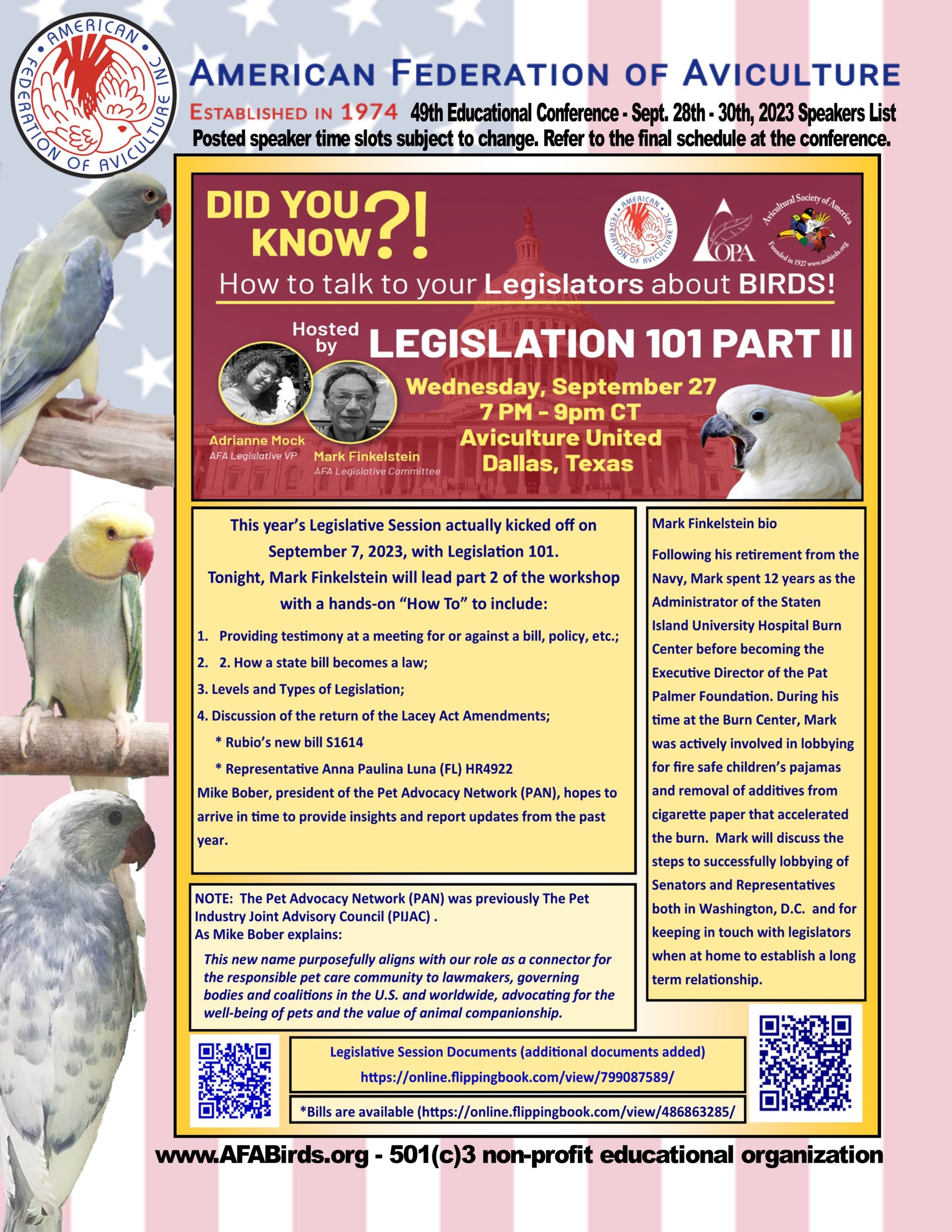
The AFA’s "Legislation 101" training course and their monitoring of the USDA’s Animal Welfare Act regulations are designed to empower the public. The goal is to ensure that laws are based on sound science and practical welfare standards rather than emotional appeals or ideological agendas. As legislative efforts continue to evolve, the avian community’s ability to organize, comment on proposed rules, and communicate with representatives will determine the future of bird keeping in America.
For the individual owner, the message is clear: a law passed in a distant state or a neighboring town today can become the template for a local ordinance tomorrow. Vigilance, education, and proactive engagement remain the most effective tools in preserving the heritage of aviculture.

