



The landscape of the global digital camera industry has undergone a significant transformation over the past three years, characterized by a notable shift in consumer demographics that has propelled Fujifilm into the upper echelons of market leaders. While historical market data has often been opaque, recent industry reports from the Nikkei Industry Map and the Japan Company Handbook provide a clearer picture of how Fujifilm has successfully pivoted its strategy to capture a younger, more diverse audience. With a substantial portion of its user base now consisting of individuals under the age of 35 and a significant percentage of female enthusiasts, Fujifilm has managed to sustain a trajectory of growth that contrasts sharply with the broader stagnation often seen in the dedicated camera market.
The Evolution of the X Series Strategy
The core of this growth lies within the Fujifilm X Series, a line of mirrorless cameras that has garnered a reputation for blending high-fidelity image quality with a distinct, tactile design language. According to internal data disclosed by Kouji Matsumoto, Corporate Vice President at Fujifilm, the brand’s strategic focus has been refined to target a "discerning segment with a high level of information literacy." This demographic, often more concerned with the creative potential and aesthetic experience of photography than with raw technical specifications alone, has responded favorably to the company’s emphasis on film simulations and compact, retro-inspired form factors.

The numbers reflect a deliberate shift in production capabilities. In 2023, Fujifilm produced approximately 380,000 units within its X Series range. By the close of 2025, that figure had climbed to 750,000 units. This rapid scaling—the largest percentage increase among major Japanese camera manufacturers—underscores a calculated effort to meet surging demand. It marks a departure from the traditional industry model, which historically focused on high-performance professional gear, and suggests a successful transition toward lifestyle-oriented, high-end photography tools.
Demographic Shifts and Market Penetration
A critical component of this success is the changing profile of the modern photographer. Industry analysis indicates that over 70% of X Series users are in their 30s or younger. Furthermore, internal corporate data reveals that approximately 40% of the brand’s user base is composed of women, a demographic that many legacy camera manufacturers have historically struggled to engage with the same level of intensity.
This demographic shift is not accidental. It is the result of a multifaceted marketing approach that prioritizes hands-on experience and community engagement. By hosting intimate events, such as the series of workshops and "Fujikina" showcases, the company has lowered the barrier to entry for potential users. A recent four-day event in Tokyo serves as a microcosm of this strategy: of the 1,400 attendees, 70% were women, and nearly 90% had never previously owned a Fujifilm camera. This suggests that the brand is not merely retaining existing customers but is actively successfully converting smartphone-centric users into dedicated camera enthusiasts.

Chronology of Growth: 2023–2026
The trajectory of Fujifilm’s recent performance can be viewed through three distinct phases of expansion:
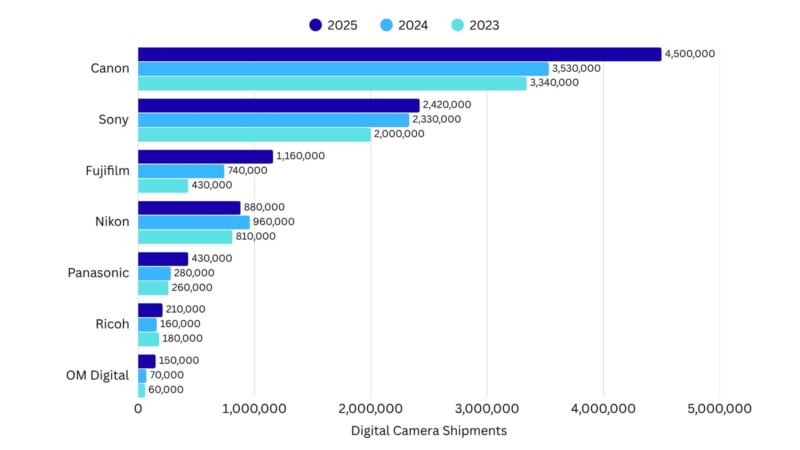
- The 2023 Foundation: At the start of this period, Fujifilm’s total digital camera shipments were recorded at 430,000 units. During this phase, the company began to aggressively pivot toward the "prosumer" and enthusiast market, focusing on the X100 and X-T series cameras that offered a more intuitive, analog-inspired user interface.
- The 2024 Acceleration: By the following year, total shipments rose to 740,000 units. This period was marked by the launch of updated firmware and refined sensor technology that appealed to creators who frequently shared their work on social media platforms, further solidifying the brand’s image as the "creator’s camera."
- The 2025 Consolidation: By the end of 2025, total shipments reached 1,160,000 units. This surge confirmed that the company had moved beyond a niche appeal and was firmly positioned as a top-three player in the global market, competing closely with established industry giants.
Industry Implications and Competitive Analysis
The implications for the broader photography industry are profound. While established manufacturers have spent years struggling to retain a customer base that has largely migrated to smartphone photography, Fujifilm’s success offers a blueprint for survival. The company has successfully repositioned the camera from a utilitarian tool for professionals to a lifestyle accessory that offers a "quality that resonates" with the modern, information-savvy consumer.
However, the industry landscape remains highly competitive. While the data from the Japan Company Handbook highlights Fujifilm’s growth, it also illustrates the sustained lead of competitors like Canon, which maintains a massive market share through a diverse portfolio ranging from entry-level to high-end professional equipment. The competitive advantage for Fujifilm lies not in attempting to out-produce these larger manufacturers in every category, but in its ability to dominate specific segments where brand identity and user experience take precedence.

The Role of Experiential Marketing
The efficacy of Fujifilm’s marketing strategy is heavily tied to its reliance on direct-to-consumer events. In an era dominated by digital advertising, the ability to put a physical camera into the hands of a user is a distinct advantage. The Tokyo event, with its high conversion rate of first-time users, demonstrates that the demand for tactile, dedicated photography hardware is still present, provided the product meets the specific needs of a younger, socially active generation.
By prioritizing this segment, Fujifilm has effectively created a virtuous cycle. Younger, female users are often more active on platforms where visual aesthetics are paramount. As they share high-quality images taken with Fujifilm cameras, they act as organic brand ambassadors, further driving the "information-literate" demographic toward the ecosystem.
Future Challenges and Sustained Success
As the company looks toward the remainder of the decade, the challenge will be to maintain this momentum without diluting the brand’s identity. High demand has already led to supply chain constraints for popular models, a situation that often accompanies rapid growth. Furthermore, the company must continue to innovate its software ecosystem to ensure that the "analogue feel" of its hardware is supported by modern, seamless connectivity features that younger users demand.
Ultimately, the data suggests that Fujifilm’s rise is a direct result of understanding the evolution of the photographer. The company has identified that the next generation of users is not interested in the same technical-first marketing that dominated the late 20th century. Instead, they are looking for a balance of aesthetics, portability, and social utility. By delivering on these fronts, Fujifilm has not only secured its position in the top tier of camera manufacturers but has also provided a clear indication of where the future of the digital camera market lies: in the hands of a diverse, creative, and increasingly younger audience.
As of late 2026, the industry remains in a state of flux, with ongoing discussions about the accuracy of shipment data and the long-term viability of the mirrorless market. Nevertheless, the quantitative data provided by industry reports confirms that Fujifilm has successfully navigated a difficult market climate, turning potential decline into a period of unprecedented growth. Whether this trend continues will depend on the brand’s ability to stay ahead of shifting trends and continue providing the high-quality, user-focused experience that has brought them to this point.

