


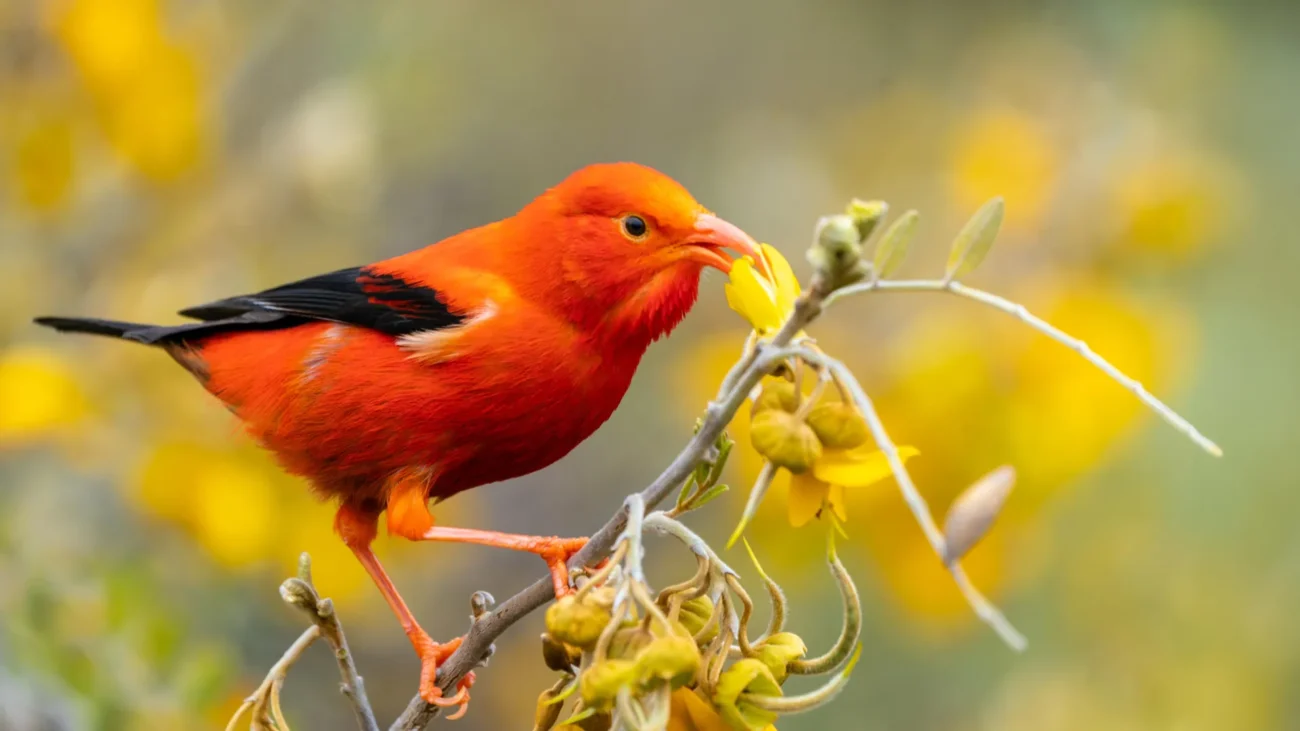
A groundbreaking study led by a researcher at the University of Hawaiʻi at Mānoa has unveiled a startling reality: nearly every forest bird species in Hawaiʻi possesses the capability to transmit avian malaria. This pervasive ability to spread the deadly disease offers a critical explanation for its widespread presence wherever mosquitoes, the disease’s vectors, are found across the Hawaiian archipelago. The findings, published on February 10 in the esteemed journal Nature Communications, paint a grim picture for the survival of the islands’ unique avian populations, many of which are already teetering on the brink of extinction.
The research team detected avian malaria at an astonishing 63 out of 64 surveyed locations across the Hawaiian Islands. These sites encompassed a diverse array of forest ecosystems, each characterized by distinct mixes of bird species. The illness, caused by the remarkably adaptable parasite Plasmodium relictum, has been a primary driver behind the precipitous declines and outright extinctions of native Hawaiian honeycreepers, a group of birds found nowhere else on Earth.
Christa M. Seidl, the mosquito research and control coordinator for the Maui Forest Bird Recovery Project and the lead author of the study, conducted this vital research as part of her doctoral dissertation at the University of California, Santa Cruz. "Avian malaria has taken a devastating toll on Hawaiʻi’s native forest birds, and this study shows why the disease has been so difficult to contain," Seidl stated. "When so many bird species can quietly sustain transmission, it narrows the options for protecting native birds and makes mosquito control not just helpful, but essential."
The Devastating Impact of Avian Malaria on Native Hawaiian Birds
Avian malaria, a parasitic disease, directly attacks the red blood cells of birds. This assault can lead to a cascade of severe health issues, including anemia, organ failure, significantly reduced survival rates, and, in many cases, death. The consequences have been particularly catastrophic for Hawaiʻi’s iconic bird species, many of which have evolved in isolation without exposure to such pathogens.
For instance, the ʻIʻiwi, also known as the scarlet honeycreeper, a once-ubiquious and beloved bird, now faces a staggering mortality rate of approximately 90 percent if infected with avian malaria. The ʻAkikiki, a small honeycreeper endemic to Kauaʻi, is now presumed extinct in the wild, with avian malaria identified as the primary culprit behind its demise. These profound losses underscore the fragility of island ecosystems and the vulnerability of their endemic inhabitants to introduced diseases.
The conventional understanding of infectious disease transmission often posits that a limited number of host species are primarily responsible for maintaining a pathogen’s spread. However, this research demonstrates that avian malaria operates with a far more insidious strategy within Hawaiʻi. The study reveals that a broad spectrum of forest birds, encompassing both native and introduced species, exhibit at least a moderate capacity to infect the southern house mosquito (Culex quinquefasciatus), which serves as the primary vector for the parasite. Crucially, even birds harboring seemingly minute quantities of the malaria parasite were found to be capable of infecting mosquitoes. This suggests that a wide array of bird communities can collectively sustain ongoing transmission of the disease.
"We often understandably think first of the birds when we think of avian malaria, but the parasite needs mosquitoes to reproduce and our work highlights just how good it has gotten at infecting them through many different birds," Seidl emphasized. This symbiotic relationship between the parasite, birds, and mosquitoes creates a resilient transmission cycle that is exceptionally challenging to disrupt.
Chronic Infections: The Silent Engine of Transmission
To arrive at these conclusions, researchers meticulously collected and analyzed blood samples from over 4,000 birds. These sampling efforts spanned four of the main Hawaiian Islands: Kauaʻi, Oʻahu, Maui, and the Island of Hawaiʻi. The field data was then integrated with rigorous laboratory experiments designed to quantify the ease with which mosquitoes became infected after feeding on birds. The results were consistent and alarming: native and introduced bird species displayed comparable levels of infectiousness, indicating that both groups play a significant role in propagating the parasite.
A particularly concerning discovery was the identification of chronic infections in many birds. These infections can persist for months, and in some instances, for years. During these prolonged periods, birds may exhibit only mild or subclinical symptoms, making them appear relatively healthy. However, they remain infectious, capable of transmitting the parasite to mosquitoes. The researchers’ estimations suggest that this long-lasting, low-to-moderate infectious stage is responsible for the majority of avian malaria transmission occurring across the state. This means that even birds that seem to have recovered or are not overtly sick can continue to be reservoirs for the disease.
Climate Change: Shrinking Safe Havens and Expanding Threats
The ubiquitous ability of the avian malaria parasite to infect a multitude of bird species offers a compelling explanation for the disease’s pervasive distribution throughout Hawaiʻi. The study’s implications suggest that very few mosquito-infested habitats on the islands remain free from the risk of malaria transmission. This dire situation is further exacerbated by the ongoing impacts of climate change.
As global temperatures continue to rise, the geographical range of both mosquitoes and avian malaria is expanding. Warmer conditions are allowing these threats to encroach upon higher elevation areas that historically served as crucial refuges for native birds. These higher elevations, previously too cool for mosquitoes to thrive, are now becoming increasingly hospitable, effectively shrinking the safe havens available to vulnerable bird populations. This phenomenon creates a double-edged sword: native birds are already weakened by existing disease pressures, and their last remaining sanctuaries are becoming compromised.
The Maui Forest Bird Recovery Project, of which Seidl is a key member, is actively involved in the "Birds, Not Mosquitoes" initiative. This collaborative effort brings together a diverse coalition of academic institutions, state and federal agencies, non-profit organizations, and industry partners. The collective goal of this partnership is to advance mosquito control strategies in direct support of Hawaiian bird conservation efforts. This highlights the urgency and the multi-faceted approach required to address the complex challenges facing Hawaiʻi’s unique avifauna.
The Maui Forest Bird Recovery Project operates under the auspices of the Pacific Cooperative Studies Unit within the University of Hawaiʻi at Mānoa’s College of Natural Sciences. It is important to note that all birds involved in this extensive study were captured and handled by highly trained ornithologists operating under strict state and federal permits, ensuring ethical and scientifically sound research practices.
Historical Context and Timeline of Avian Malaria in Hawaiʻi
The arrival of avian malaria in Hawaiʻi is intrinsically linked to the introduction of non-native species, a recurring theme in the ecological history of the islands. The parasite Plasmodium relictum was first documented in Hawaiian birds in the late 19th century, around the same time that mosquitoes were also introduced. The southern house mosquito (Culex quinquefasciatus), the primary vector, is believed to have arrived in the islands via ship ballast water in the early 1800s.
Early 1800s: Introduction of Culex quinquefasciatus mosquitoes to the Hawaiian Islands.
Late 1800s: First documentation of avian malaria (Plasmodium relictum) in Hawaiian birds.
Early to Mid-20th Century: Widespread impact of avian malaria begins to be observed, leading to significant population declines in native honeycreepers, particularly at lower elevations where mosquitoes are prevalent.
Late 20th Century: Continued decline of many native forest bird species, with avian malaria identified as a major contributing factor. Extinctions of some species begin to be recorded.
Early 21st Century: Advances in genetic research and disease monitoring allow for more detailed studies into the transmission dynamics of avian malaria.
February 2024: Publication of the University of Hawaiʻi at Mānoa-led study in Nature Communications, revealing the near-universal ability of Hawaiian forest birds to transmit avian malaria and highlighting the role of chronic infections and climate change.
The introduction of these pathogens and vectors occurred at a time when native Hawaiian birds had no evolutionary defenses. This lack of immunity, coupled with habitat loss and fragmentation due to human development, created a perfect storm for disease outbreaks. The study’s findings provide a more nuanced understanding of how the disease persists, moving beyond the assumption that only a few species are responsible.
Supporting Data and Broader Scientific Implications
The scale of the Nature Communications study is noteworthy. The analysis of over 4,000 blood samples from four major islands provides a statistically robust dataset. The laboratory experiments, which involved controlled feeding trials with mosquitoes, allowed researchers to quantify transmission rates from different bird species. The consistent detection of the parasite across a wide range of elevations and habitat types, from coastal lowlands to montane forests, underscores the pervasiveness of the threat.
The finding that even low levels of parasitemia can lead to mosquito infection is particularly significant. It implies that the parasite is highly efficient in its transmission cycle and that there are few "safe" bird populations that do not contribute to its spread. This challenges previous assumptions that only birds with high parasite loads are of concern.
Furthermore, the confirmation of chronic infections has profound implications for disease management strategies. Traditional methods of disease control often focus on eliminating actively sick individuals or targeting acute outbreaks. However, the presence of chronically infected birds means that the parasite can persist in the environment even when active outbreaks are not apparent. This necessitates long-term monitoring and control efforts.
Official and Scientific Responses
The scientific community has largely lauded the study for its comprehensive approach and critical findings. Dr. Sarah Jones, an avian ecologist not involved in the study, commented, "This research is a crucial piece of the puzzle in understanding the ecological dynamics of avian malaria in Hawaiʻi. The revelation that so many species can act as reservoirs fundamentally alters our perception of disease spread and highlights the immense challenge of conservation."
Conservation organizations have echoed the urgency expressed by the study’s authors. A spokesperson for the U.S. Fish and Wildlife Service stated, "We are deeply concerned by these findings. The widespread transmission capability documented in this study reinforces the critical need for accelerated and innovative mosquito control measures. The survival of many of Hawaiʻi’s unique bird species depends on our ability to implement effective solutions."
The implications of this research extend beyond Hawaiʻi. It provides a valuable model for understanding disease dynamics in other island ecosystems or areas where native fauna are vulnerable to introduced pathogens and vectors. The interplay between host susceptibility, parasite adaptation, vector competence, and environmental factors like climate change is a complex equation that this study helps to unravel.
Broader Impact and Future Directions
The findings of this study have direct and immediate implications for conservation strategies in Hawaiʻi. The reliance on mosquito control as a primary means of protecting native birds is now more critical than ever. This includes efforts to reduce mosquito breeding sites, explore novel mosquito control technologies, and potentially even consider landscape-level interventions to create mosquito-free zones at higher elevations.
The study also underscores the importance of continued research into the behavior and ecology of both native and introduced birds in Hawaiʻi. Understanding which species are most susceptible, which are most infectious, and how these factors change over time will be vital for refining conservation plans.
The long-term prognosis for many of Hawaiʻi’s native forest birds remains precarious. However, this research provides a clear, evidence-based roadmap for the challenges ahead. By understanding the intricate ways in which avian malaria operates, conservationists and policymakers can develop more targeted and effective interventions to safeguard these irreplaceable natural treasures for future generations. The fight against avian malaria in Hawaiʻi is a race against time, and this study has provided a stark reminder of the formidable adversary that stands in the way of preserving the islands’ extraordinary avian biodiversity.

