


The American Federation of Aviculture (AFA) Legislative Committee has issued an urgent advisory to pet owners, aviculturists, and conservation organizations regarding a sharp increase in local, state, and federal policy initiatives that threaten the future of bird ownership. As legislative bodies across the United States face a growing volume of animal-related proposals, the avicultural community is being urged to adopt a proactive approach to monitoring bills, ordinances, and regulatory agency actions that could fundamentally restrict the keeping, breeding, and exhibition of birds.
Understanding the Mechanics of Modern Legislation
To comprehend the scale of the challenge facing bird owners, it is first necessary to examine how laws are conceived and processed within American jurisprudence. Historically defined as the formal proposing of a statute or statutes, modern legislation typically originates in the form of a "Bill." A bill represents the intended text of a law drafted by its proponents. While these documents often feature an introductory summary detailing the purported objectives of the new statute, the enforcement mechanisms, and the broader community impact, these summaries can frequently obscure the true long-range consequences of the text.
Elected representatives introduce these bills, but the underlying text frequently originates from specialized lobbying organizations. Animal rights and animal welfare groups with dedicated legislative arms frequently draft model legislation and present it to supportive lawmakers for formal introduction into municipal, state, or federal systems. Consequently, the core agendas embedded within these drafts rarely reflect the everyday realities, needs, or mainstream perspectives of the general public, pet owners, or specialized animal caretakers.
The AFA focuses its monitoring efforts on legislative measures that carry adverse implications for companion birds, specialized breeder collections, educational exhibition birds, and commercial aviculture. A primary hurdle for many bird enthusiasts is understanding the indirect mechanisms by which seemingly unrelated or generalized legislation can ultimately restrict aviculture.
The Hidden Threat of Municipal Ordinances
Local governments frequently propose and enact municipal codes—commonly referred to as ordinances—that seek to regulate domestic animals within city or county limits. For example, a municipality might introduce an ordinance limiting the number of dogs or cats a single household may own. On its face, such a regulation is often framed as a fair, common-sense measure designed to prevent animal hoarding or mitigate neighborhood nuisances.
However, these ordinances often utilize broad definitions or include sweeping lists of covered fauna, ranging from dogs and cats to fish, birds, and non-human primates. Consider a hypothetical scenario involving a hobbyist canary breeder maintaining six pairs of breeding canaries within a residential home. If a municipal ordinance is initially passed to cap the population of traditional companion animals like dogs and cats, but is subsequently amended or broadly interpreted to encompass avian species or small mammals, the breeder instantly falls into non-compliance.
Such a violation can lead to substantial civil penalties, mandatory animal surrenders, or prolonged administrative hearings. Unlike criminal statutes, which carry the risk of incarceration and criminal records, municipal ordinances generally operate within the civil domain. Similar to local zoning infractions or property maintenance codes prohibiting inoperable vehicles on residential lawns, municipal ordinance violations carry escalating financial fines. If an individual fails to correct the cited condition or pay assessed penalties, the matter escalates to a judicial proceeding where a judge may impose harsher financial sanctions or hold the respondent in contempt of court.
Statutory Law Versus Administrative Regulations
A critical distinction in the legislative and regulatory process lies in how rules are enacted and modified. Statutory laws and municipal ordinances cannot be amended or newly established without a formal vote by elected legislative bodies, such as city councils, county boards of commissioners, state general assemblies, or the United States Congress. These legislative bodies are bound by public notice requirements, committee hearings, and opportunities for public testimony.
Conversely, administrative regulations—the specific operational rules promulgated under the authority of an existing law—can often be altered without a direct vote by elected officials. While regulatory agencies must adhere to structured administrative procedures, such as publishing proposed changes in federal or state registers and soliciting public comment periods, these shifts occur within executive agencies rather than legislative chambers. A prime historical and ongoing example is the United States Fish and Wildlife Service (USFWS) adjusting listings under the Endangered Species Act or modifying the implementation rules of the Migratory Bird Treaty Act. These bureaucratic adjustments can drastically alter the legal status of keeping certain avian species without requiring a direct vote from Congress.
The Broader Strategy of Animal Advocacy Lobbying
The AFA Legislative Committee, working in tandem with a coalition of national animal-keeping organizations, actively monitors legislative filings to intercept restrictive policies before they gain political momentum. Avicultural advocates often sound the alarm over proposed laws that appear superficially disconnected from aviculture—such as a local ordinance banning traveling circuses or prohibiting the public display of exotic wildlife.
Experienced legislative monitors recognize that specific phrases, broad definitions, or poorly defined statutory terms within these niche bills create vulnerabilities. Once enacted, these statutes are frequently weaponized or expanded through subsequent amendments to sweep in hobbyist bird breeders, private aviculturists, and specialized educational exhibitors. Observers note a significant surge in the introduction of anti-animal-use legislation at both the municipal and state levels nationwide.
While the explanatory text and promotional campaigns surrounding these bills invariably emphasize the elimination of inhumane treatment, the mitigation of nuisance populations, or the promotion of public safety, the actual statutory language and subsequent administrative regulations often culminate in sweeping prohibitions against keeping pet birds altogether. Vague terms such as "exotic wildlife," "non-domesticated species," or "captive propagation" are frequently deployed in ways that fail to distinguish between large-scale commercial operations and small, highly regulated private hobby collections.
Implications for the Future of Aviculture
The cumulative effect of unchecked, piecemeal legislation poses a systemic risk to the avicultural community. When restrictive laws or burdensome permitting requirements are successfully enacted in one jurisdiction, they establish a legal precedent that is rapidly replicated by advocacy groups in neighboring states and municipalities. Over time, this legislative domino effect can systematically erode the legal right of private citizens to keep, breed, and study birds.
Avicultural experts emphasize that proposed legislation rarely impacts bird owners immediately upon introduction. However, legislative trends that go unchallenged at the local level eventually form the foundation for state and federal policy shifts. If left unmonitored, the cumulative burden of compliance costs, restrictive permitting, and outright prohibitions could effectively phase out private bird ownership and commercial aviculture entirely.
Resources and Community Action
To combat these trends, aviculturists, pet owners, and industry stakeholders are encouraged to maintain active vigilance regarding legislative and regulatory proposals within their respective local, state, and federal jurisdictions. Organizations like the AFA provide dedicated tracking resources to help community members stay informed. Detailed updates, analyses of active bills, and educational tools are accessible via the Current Legislative Issues portal on the official AFA website.
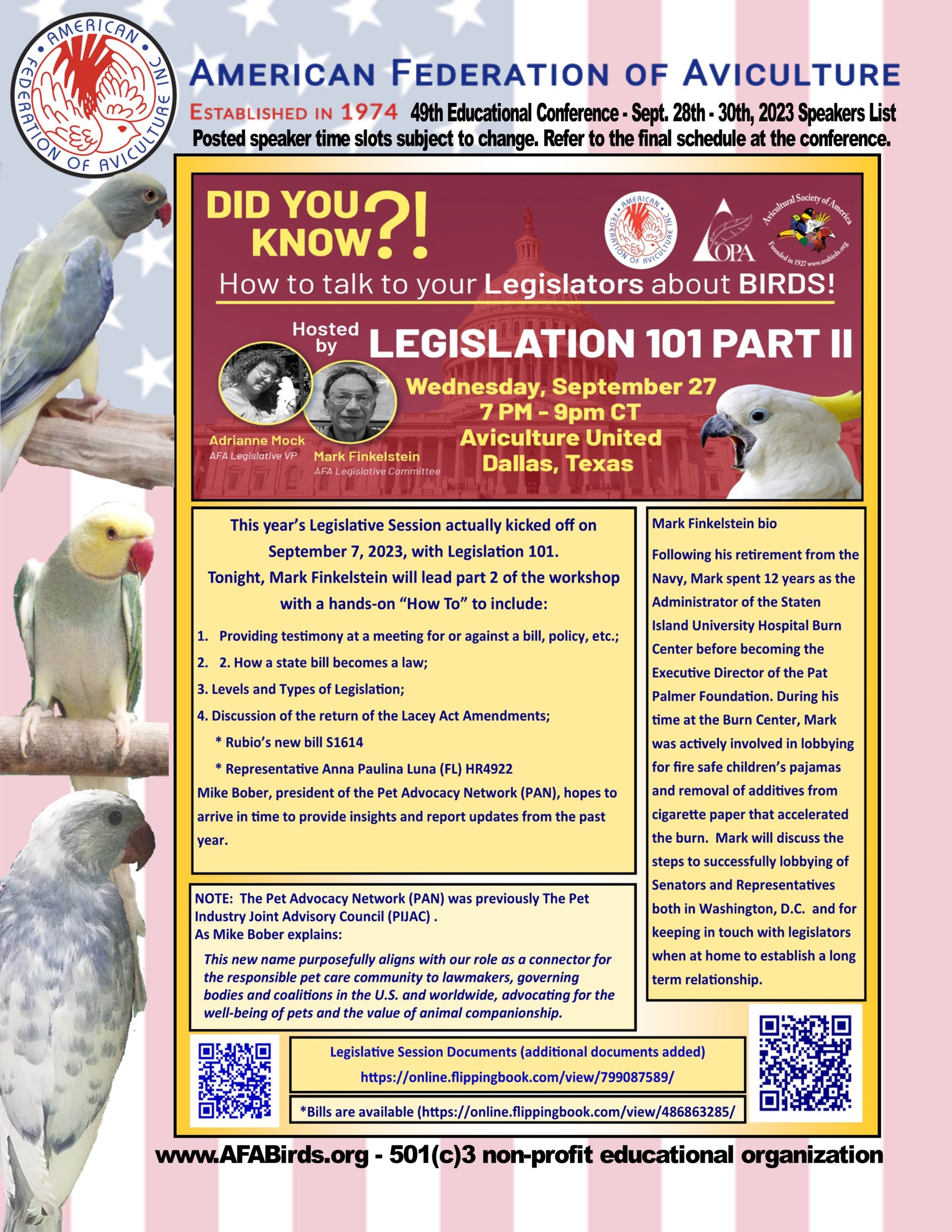
Additionally, organizations offer specialized educational programs, such as the Legislation 101 Training Course, designed to equip bird owners with the foundational knowledge required to effectively engage with lawmakers, submit public comments, and participate in the democratic process. Understanding the intersection of statutory law, administrative rulemaking, and municipal ordinance enforcement remains the avicultural community’s most effective defense in preserving the tradition of bird keeping for future generations.

