


The scientific community is increasingly grappling with the profound question of nonhuman consciousness, a debate reignited and significantly advanced by recent findings, particularly those pertaining to avian intelligence. Dr. Irene Pepperberg’s forthcoming summary in 2026, building upon decades of groundbreaking work with Grey parrots, offers critical insights into the potential depths of self-awareness in these remarkably intelligent birds. This work comes amidst a global re-evaluation of animal minds, marking a significant departure from historical perspectives that largely dismissed the inner lives of nonhuman species. The journey to understand animal consciousness has been long and fraught with challenges, moving from initial skepticism to a burgeoning acceptance, propelled by rigorous scientific inquiry and sophisticated experimental designs.
A half-century ago, Donald Griffin’s seminal 1976 book, The Question of Animal Awareness, posited a then-revolutionary idea: that nonhumans possessed consciousness and levels of self-awareness comparable to humans. At the time, this proposition was met with widespread skepticism, as the prevailing scientific consensus regarded animals primarily as instinctual beings or, at best, creatures whose actions were dictated by simple stimulus-response learning and operant conditioning, where behaviors were shaped solely by rewards and punishments. This behaviorist paradigm dominated the understanding of animal cognition for much of the 20th century, effectively sidelining any serious consideration of animal sentience or subjective experience. Griffin’s work served as a crucial catalyst, challenging these entrenched views and paving the way for a more nuanced exploration of animal minds.
The debate, however, remained unsettled for decades. Even now, the precise definition and empirical evaluation of nonhuman consciousness, especially in non-primates like birds, present formidable scientific and philosophical hurdles. Despite these challenges, a significant shift in scientific opinion has become evident. In a landmark development in 2024, hundreds of scientists signed the New York Declaration on Animal Consciousness, asserting "strong scientific support" for consciousness in mammals, birds, and potentially all other vertebrates. This declaration underscores a growing consensus that the capacity for subjective experience extends far beyond the human realm, necessitating a re-evaluation of ethical and scientific frameworks. Yet, the ultimate proof of consciousness remains elusive, not only in nonhumans but also in humans, highlighting the inherent difficulties in objectively measuring internal subjective states.
The quest to understand consciousness often begins with sentience – the capacity to experience emotions and sensations. However, focusing solely on sentience as a marker for consciousness immediately leads to further complex questions: How can we reliably evaluate emotions and sensations in nonhumans? Humans themselves often struggle to articulate or even fully comprehend their own emotional landscapes, as noted by researchers like Plutchik (2001). This introspection deficit makes the task of deciphering nonhuman emotional states exceptionally problematic. A simpler metric, such as sensitivity to pain, might seem more accessible, yet while pain perception is arguably a necessary component of consciousness, it is widely considered insufficient to argue for human-like, higher-order consciousness. The pursuit of a comprehensive, universally accepted metric continues to be an ongoing challenge for cognitive scientists and philosophers alike.
Several researchers have attempted to develop more sophisticated metrics. Birch et al. (2020) and Bayne et al. (2024) have proposed intricate frameworks for assessing animal consciousness, yet these often face criticism for being too strongly biased towards human capacities, relying on cognitive structures or behavioral expressions that may not be universal. Recognizing these limitations, Dr. Pepperberg and S.K. Lynn (2000) advanced the concept of levels of consciousness, suggesting that these levels might correlate with quantifiable cognitive abilities in a given species. Their hypothesis posited that varying degrees of cognitive processing could be a consequence of homologous or convergent brain evolution, shared perceptual structures, and similar learning mechanisms. This approach raised further questions about parallels between cognitive processes across species and the potential existence of a "neural correlate of consciousness" (NCC) in both humans and nonhumans. Intriguingly, the search for a definitive NCC in humans is still ongoing, as highlighted by the Cognitive Consortium (2025), making the task of identifying such correlates in nonhumans even more complex.
The emergence of advanced Artificial Intelligence (AI) systems further complicates the debate. Modern AI demonstrates impressive levels of cognitive processing, often surpassing human capabilities in specific tasks. If processing power alone were the sole determinant, AI systems would be strong candidates for consciousness. However, current AI systems fundamentally lack self-awareness, the subjective experience of being a conscious entity. This distinction forces researchers to reconsider whether higher-order cognitive processing alone is sufficient to infer consciousness, or if sentience, the capacity for subjective feeling, remains a more fundamental criterion, as suggested by Block (2025). This philosophical quandary pushes the scientific community to refine its understanding of what constitutes consciousness beyond mere computational prowess.
Full consciousness, as understood by many researchers, encompasses not only the monitoring of sensory inputs and mental states but also executive control over decision-making and voluntary action. Crucially, it involves self-awareness – the awareness of one’s own thoughts, specifically, being aware that one is aware. This "meta-awareness" is particularly challenging to examine in nonhumans. Even species that exhibit advanced referential communication, such as some primates and parrots, lack the symbolic language capabilities to discuss and report instances of their own self-awareness directly to human observers. This communication barrier necessitates indirect methods of investigation, relying on observable behaviors that, in humans, are understood to be indicative of self-awareness.
This is where Dr. Pepperberg’s approach becomes particularly insightful. Rather than seeking direct verbal reports, her research, detailed in her 2026 paper (an open-access publication), examines various behavioral patterns and successful task completions in nonhumans. The critical element in these tasks is that successful execution requires the subject to exhibit abilities that are considered hallmarks of self-awareness in humans. One prominent example is the concept of delayed gratification. In such tasks, an individual must forgo an immediate, less desirable reward in favor of waiting for a superior or larger reward later. For a subject to succeed in delayed gratification, they must demonstrate a complex suite of cognitive abilities: they must recognize, understand, and actively suppress immediate impulses, needs, and desires; comprehend the potential conflict between immediate gratification and long-term goals; maintain the long-term goal actively in memory; and, finally, devise and execute a strategy that engages their thoughts to achieve that goal.
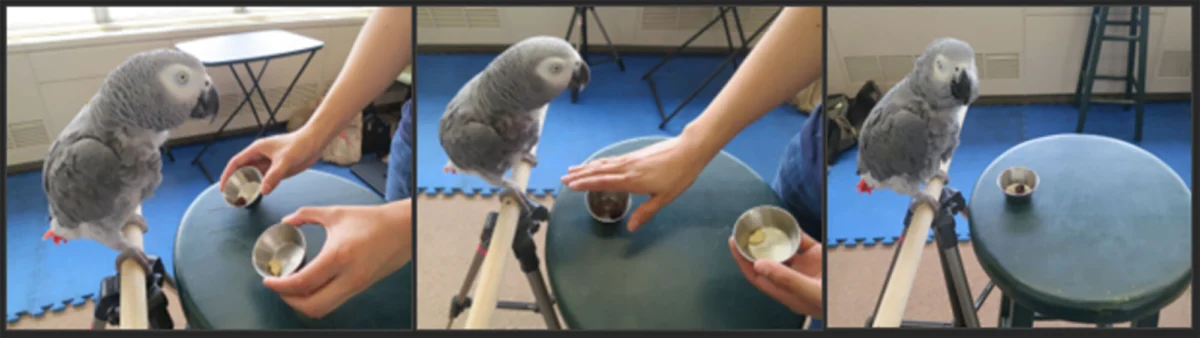
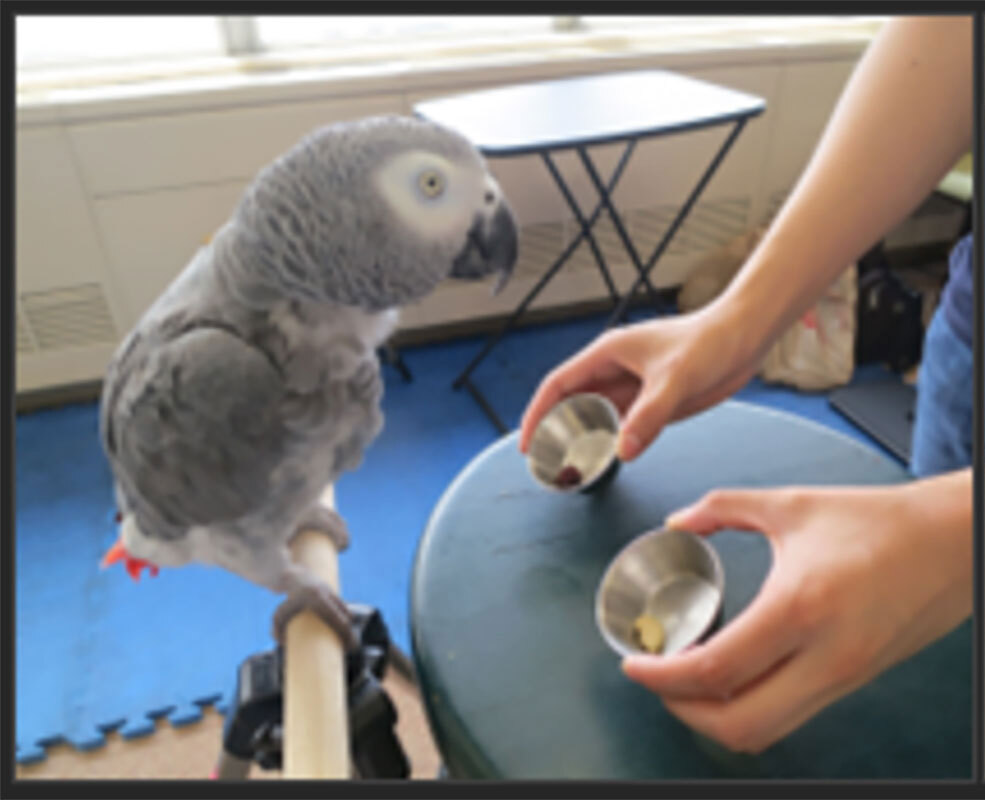
Grey parrots, the focus of much of Dr. Pepperberg’s work, have shown remarkable adeptness at delayed gratification tasks. For instance, studies by Koepke et al. (2015), Pepperberg and Hartsfield (2023), and Pepperberg and Rosenberger (2022) have consistently demonstrated Grey parrots’ ability to delay gratification, sometimes for extended periods, to secure a more preferred item. The image of Griffin, a famous Grey parrot, engaged in such a task illustrates this beautifully: he is shown two different sets of rewards, one is taken away, and the other is briefly covered while he is instructed to "wait." Griffin then sits patiently with the less appealing, though still desired, reward during the delay, anticipating the better reward. This behavior suggests a sophisticated understanding of future outcomes and an ability to exert self-control. Dr. Pepperberg’s 2026 paper also acknowledges some general, potentially problematic issues with delayed gratification tasks, underscoring the nuanced interpretation required even for seemingly clear demonstrations of cognitive ability. For example, researchers must carefully design experiments to rule out alternative explanations for the behavior, such as simple associative learning or a lack of understanding of the reward difference.
It is crucial to emphasize that these illustrative examples, while compelling, do not definitively prove the existence of avian consciousness or specifically Grey parrot consciousness. Instead, they offer invaluable "possible insights" and constitute evidence that must be rigorously evaluated alongside findings from other consciousness tests proposed by researchers like Birch et al. (2020) and Bayne et al. (2024). The scientific pursuit demands a multi-faceted approach, integrating diverse methodologies and theoretical frameworks to build a comprehensive picture of avian cognitive landscapes.
Despite the inherent difficulties and the ongoing scientific debate, Dr. Pepperberg maintains a firm belief in the necessity of collecting the most robust evidence possible regarding nonhuman consciousness. This includes meticulously examining positive, negative, and even contradictory findings, and, critically, appreciating the existence of alternative explanations for observed behaviors beyond conscious intent. However, when transitioning from purely scientific inquiry to practical decisions about how best to coexist with nonhumans, a different standard of evidence might be warranted.
In the spirit of the "Do no harm" principle, eloquently articulated in the New York Declaration (Andrews et al., 2024), prudence might dictate that the exceptionally high levels of certainty typically demanded for scientific proof of consciousness be lowered somewhat for ethical considerations. Material that is merely indicative of consciousness, even if not definitive proof, should be considered integral to the design of protocols concerning animal welfare, humane treatment, and conservation. This pragmatic approach recognizes that the potential for animals to experience suffering or joy carries significant ethical weight, regardless of whether their consciousness precisely mirrors that of humans. Such a shift in perspective would have profound implications for how we manage captive animals, conduct research, and protect species in the wild. It suggests a future where our interactions with the natural world are guided not just by what we can definitively prove, but also by a compassionate interpretation of compelling evidence, fostering a more ethical and respectful relationship with all sentient beings.
The ongoing research into Grey parrot consciousness, epitomized by Dr. Pepperberg’s tireless work, stands as a testament to the scientific community’s evolving understanding of the complex tapestry of life on Earth. As we continue to unravel the mysteries of animal minds, the insights gained from these intelligent birds contribute significantly to a broader philosophical and ethical discourse, ultimately shaping our responsibilities towards the diverse forms of consciousness that share our planet.

