


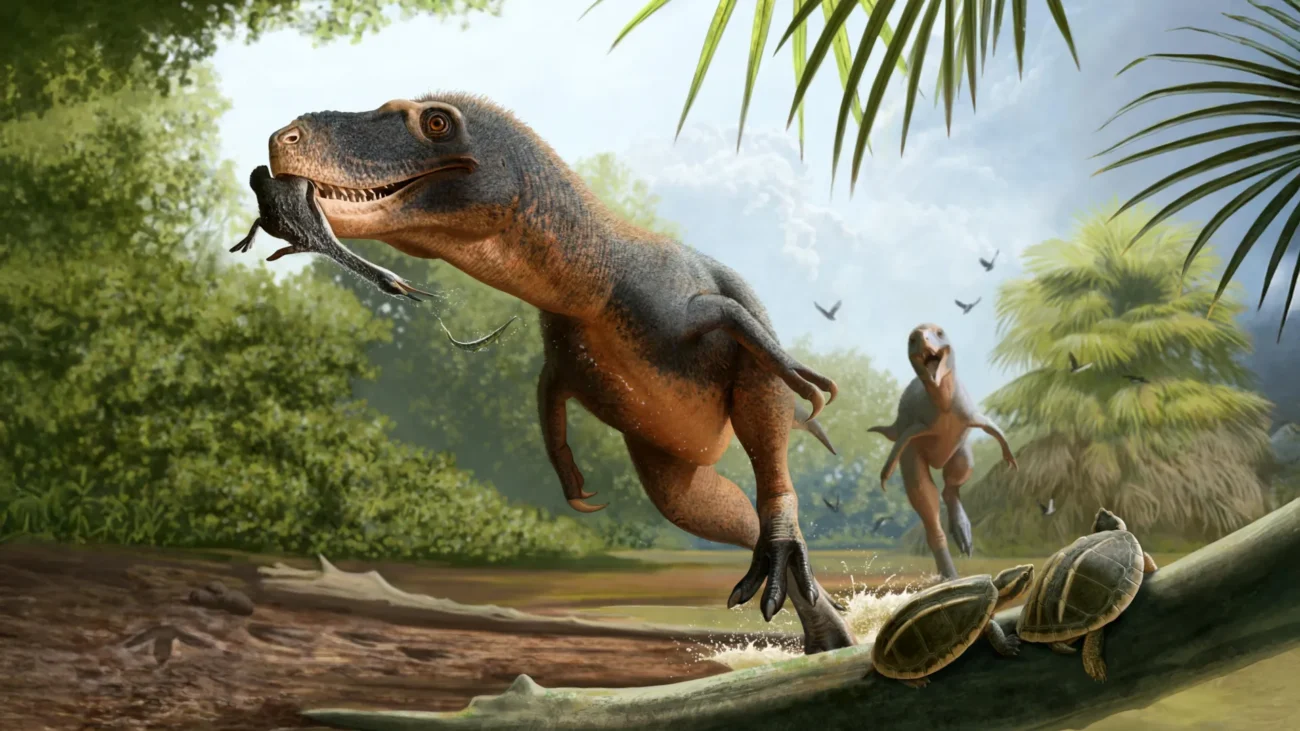
A microscopic glimpse into a 66-million-year-old predator’s final meals has yielded what paleontologists are calling the finest fossilized feather specimen ever recovered from the age of dinosaurs. Unearthed from a golf-ball-sized coprolite—fossilized feces—originating in northeastern Montana, the exceptionally preserved feather was swallowed by a large predatory dinosaur, potentially a Tyrannus rex or a close relative like Nanotyrannus, shortly before an asteroid impact wiped out the non-avian dinosaurs. Published in the journal Current Biology, the discovery has opened an unprecedented avenue for paleontological research, providing critical physical evidence that may help solve a long-standing evolutionary mystery: why modern birds survived the Cretaceous-Paleogene mass extinction while other lineages vanished.
The research team behind the discovery comprises an interdisciplinary group of scientists from institutions including the Field Museum in Chicago, the University of Washington’s Burke Museum, the Carter County Museum, and the University of Southern California. By utilizing high-resolution micro-CT scanning technology to peer inside the dark, reddish-brown rock nodule without destroying it, the researchers identified a complex assemblage of biological remnants, including gar fish scales, leg bones of an ancient diving bird, and multiple three-dimensional feathers. This microscopic preservation rivals, and in some cases surpasses, the quality of specimens trapped in Burmese amber, signaling a major methodological shift for paleo-ornithologists who traditionally rely on rare amber deposits for delicate soft-tissue data.
Chronology of the Discovery and Analysis
The remarkable find began in 2016 during routine fieldwork in the Hell Creek Formation of Montana. David DeMar, Jr., a research scientist and collections manager at the Burke Museum, was traversing a rocky outcrop to collect fossilized fish remains when an unassuming geological nodule caught his eye.
"I was crawling up a rocky outcrop collecting fish fossils when I came across a dark, reddish-brown nodule about half the size of a golf ball," DeMar recounted. Upon inspecting the surface with a hand lens, he spotted a tiny fossil feather—an astonishing anomaly, given that no feathers had ever been documented within the Hell Creek Formation despite more than a century and a half of intensive fossil prospecting.
Recognizing the potential significance of the specimen, the research team transferred the nodule to the laboratory for non-invasive analysis. Initial visual inspections suggested the nodule was a coprolite, but the true internal architecture remained hidden until the object was subjected to micro-CT scanning at the University of Southern California’s medical campus.
"Every hour processing the data revealed another feather, another scale, another bone—in stunning 3D," explained Nate Carroll, co-author of the study and a paleontologist at the Carter County Museum. The digital reconstructions exposed a microscopic matrix of features that shed direct light on the diet and ecology of late-Cretaceous predators.
Anatomical Insights into Prehistoric Prey
Detailed morphological analysis of the skeletal elements and feathers found within the coprolite revealed they belonged to a hesperornithiform, an extinct lineage of specialized aquatic birds. Ecologically, hesperornithiforms bore behavioral resemblances to modern loons. Most members of this group were flightless, utilizing powerful, specialized feet to propel themselves underwater in pursuit of fish.
The feathers extracted from the coprolite exhibited specific hydrodynamic adaptations suited for an aquatic lifestyle. However, unlike the streamlined, uniform plumage characteristic of modern birds, these specimens displayed a hybrid morphology. They featured modern-looking, waterproof exterior vanes alongside smaller, fuzzy, primitive body feathers—vestiges more commonly associated with non-avian theropod dinosaurs and enantiornithines, the most diverse group of Cretaceous birds.
This anatomical duality places the hesperornithiform feathers squarely between primitive dinosaurian down and modern avian contour feathers. Because hesperornithiforms represented an evolutionary branch distinct from both enantiornithines and the surviving Neornithes lineage, their preserved plumage provides a critical comparative baseline for understanding how avian feather structures evolved and functioned under extreme environmental stress.
Implications for the Cretaceous-Paleogene Mass Extinction
Approximately 66 million years ago, a massive asteroid impact struck the Yucatán Peninsula, triggering global climate devastation. The collision injected millions of tons of sulfur, dust, and debris into the atmosphere, blocking out solar radiation and initiating an extended period of darkness and severe global cooling known as an "impact winter." While nearly all non-avian dinosaurs and the vast majority of archaic bird species perished, a single lineage of modern birds—known scientifically as Neornithes—managed to endure, eventually diversifying into the approximately 10,000 living bird species observed today.
For decades, paleontologists debated the selective pressures that allowed Neornithes to survive while every other avian lineage went extinct. One prominent hypothesis suggested that aquatic habitats provided a buffer against the immediate thermal and ecological shocks of the impact. However, the presence of hesperornithiforms—which were explicitly aquatic and specialized for diving—challenges this simple geographic explanation. Despite living in and around aquatic environments, hesperornithiforms suffered total extinction.
The new fossil evidence points toward a physiological explanation centered on feather morphology and molting strategies. Lead author Jingmai O’Connor, associate curator of fossil reptiles at the Field Museum, suggests that the efficiency of thermal insulation played a decisive role in survival.
"The hesperornithiforms retain primitive feather types that may not have been as efficient for insulation as modern plumaceous feathers, and that could explain why they went extinct along with the enantiornithines," O’Connor stated.
During the impact winter, when ambient temperatures plummeted and food webs collapsed, animals with inferior thermal regulation would have faced insurmountable metabolic demands. Neornithes may have possessed advanced, highly efficient plumage and superior molting mechanisms that conserved vital body heat, whereas primitive feathers left competing lineages fatally vulnerable to the protracted cold.
Methodological Shifts and Future Research Directions
Beyond its contributions to evolutionary biology, the discovery highlights the largely untapped potential of coprolites as repositories for delicate biological tissues. Historically, paleontologists focused their search for fossilized feathers, skin impressions, and internal organs on exceptionally fine-grained sedimentary deposits, such as Konservat-Lagerstätten, or amber matrices. Fossilized feces were frequently overlooked as mere waste products lacking fine structural detail.
The successful extraction and 3D imaging of pristine feathers from a coprolite demonstrates that digestive processes do not invariably destroy microscopic soft tissues. Digestive acids and anoxic environments within the gut of a large theropod occasionally encapsulate and protect delicate structures from bacterial decay before evacuation and fossilization occur.
Co-author Greg Wilson Mantilla, professor at the University of Washington and curator of vertebrate paleontology at the Burke Museum, emphasized the dual value of the find. "We rarely find fossils of birds and even more rarely their feathers, giving us such important insight into the evolution of this key aspect of their biology," Mantilla noted. "On top of that, these bird feathers found within a large fossilized dinosaur dung give us an incredible window into predator-prey interactions 66 million years ago."
Researchers hope this finding will prompt paleontologists worldwide to re-examine existing museum collections of coprolites using modern non-destructive imaging techniques. Thousands of fossilized dung specimens housed in institutional archives could potentially harbor overlooked microfossils, offering a wealth of untapped data regarding ancient diets, ecosystems, and micro-morphology.
As analytical technologies such as micro-CT scanning and advanced spectroscopy continue to advance, paleontology is increasingly capable of extracting macro-evolutionary insights from the most unlikely micro-contexts. The Montana coprolite stands as a testament to the serendipity of field science and underscores how the discarded remnants of an ancient meal can illuminate the darkest chapters of Earth’s history.

