


The landscape of animal ownership in the United States is currently undergoing a period of significant legal transformation, as a surge in local, state, and federal legislative efforts seeks to redefine the relationship between humans and the avian species in their care. For the American Federation of Aviculture (AFA) and the broader community of bird enthusiasts, the task of monitoring these legislative developments has shifted from a secondary interest to a primary necessity for the survival of the hobby and the industry. The intricacies of how laws are proposed, drafted, and implemented suggest that without constant oversight, the rights of bird owners, breeders, and exhibitors could be curtailed by broad-reaching statutes that often overlook the specific needs of avian species.
The Mechanics of Modern Legislation: Bills, Ordinances, and Regulations
To understand the urgency of legislative monitoring, one must first distinguish between the various forms of legal mandates that govern animal ownership. At the core of the legislative process is the "Bill," a formal proposal for a new law or a change to an existing one. While a Bill is intended to be the definitive law upon passage, it often begins with a summary that outlines its purpose, enforcement mechanisms, and social impact. However, legal analysts and the AFA caution that these summaries can be misleading, focusing on popular concepts like "public safety" or "humane treatment" while masking the practical restrictions contained within the fine print.
While Bills are introduced by elected representatives, they frequently originate from external lobbying organizations. In the realm of animal law, these organizations are generally categorized into two camps: animal welfare groups, which focus on the humane treatment and care of animals, and animal rights groups, which may seek to eliminate animal ownership or use entirely. When these organizations draft legislation for a representative to introduce, the resulting Bill often reflects an ideological agenda that may not align with the practical realities of bird husbandry or the views of the general public.
On a more localized level, legislation takes the form of "ordinances." These are laws enacted by city councils or county boards. While they may appear less daunting than federal statutes, ordinances often have the most immediate impact on individual owners. A common example is the "limit law," which restricts the number of pets a household may keep. Initially drafted to address concerns regarding dogs and cats, these ordinances are frequently amended to include "all animals" or specific mentions of birds, hamsters, and fish. For a professional breeder or a dedicated hobbyist maintaining a diverse collection of pairs, such a change can move them from a state of compliance to a state of legal violation overnight, resulting in civil penalties, fines, or court intervention.
Chronology of Avian Legal Oversight and Regulatory Shifts
The history of avian legislation in the United States is marked by several pivotal moments that have shaped the current regulatory environment. Understanding this timeline is essential for recognizing how modern bills build upon past precedents.
- 1970s: The Foundation of Protection: Following the outbreak of Exotic Newcastle Disease in the early 1970s, which led to the culling of millions of birds, the AFA was founded in 1974 to represent the interests of bird owners. This era saw the rise of the Endangered Species Act (ESA) and the Convention on International Trade in Endangered Species of Wild Fauna and Flora (CITES), which established the first major federal and international frameworks for bird trade and possession.
- 1992: The Wild Bird Conservation Act (WBCA): This landmark federal legislation significantly restricted the importation of exotic birds into the United States. While intended to protect wild populations from over-exploitation, it also placed a greater emphasis on domestic captive breeding programs to satisfy the demand for pet birds.
- 2004-2010: The Rise of State-Level Bans: During this period, several states began introducing "Exotic Animal Acts," which often included various species of large parrots or "dangerous" birds. These laws frequently utilized broad language that could be interpreted to include common pet species.
- 2022-2023: The USDA Bird Rules: One of the most significant shifts in recent history occurred when the U.S. Department of Agriculture (USDA) finalized new standards under the Animal Welfare Act (AWA) specifically for birds. After years of litigation and public comment, the USDA began requiring federal licenses for certain breeders and exhibitors who were previously exempt.
This chronology illustrates a clear trend: regulatory oversight is expanding, moving from international trade and disease control to the granular details of how individual birds are housed and managed in private homes and facilities.
Supporting Data: The Scope and Economic Impact of Aviculture
The importance of monitoring legislation is underscored by the sheer scale of bird ownership in the United States. According to the American Pet Products Association (APPA) 2023-2024 National Pet Owners Survey, approximately 6.1 million households in the U.S. own a bird. This population includes everything from single-pet households to large-scale conservation breeding programs.
The economic impact of this sector is substantial. The avian industry supports a vast network of manufacturers (food, cages, toys), avian veterinarians, and professional breeders. Restrictive legislation does not only affect the owners; it threatens the economic stability of businesses that rely on the legal trade and maintenance of birds. Furthermore, private aviculture plays a critical role in conservation. Many species that are extinct or highly endangered in the wild, such as the Spix’s Macaw or the Bali Myna, have relied on the expertise and genetic stock maintained by private and institutional aviculturists to survive.
Official Responses and Stakeholder Perspectives
The AFA Legislative Committee, alongside organizations such as the Pet Advocacy Network (formerly PIJAC), remains on high alert regarding the language used in modern animal bills. The primary concern cited by these groups is the "incremental" nature of legislation. A bill that begins as a ban on circus animals or "wild" animal performances may contain definitions of "exotic animals" that are vague enough to be applied to parrots or other captive-bred birds in a future amendment.
"The amount of anti-animal use bills being introduced on the local and state level right now is astounding," the AFA notes in its legislative briefing. The organization emphasizes that while the verbiage of a bill may claim to address "inhumane treatment" or "overpopulation," the actual regulations derived from that law may result in a total prohibition of certain species.
Conversely, proponents of stricter regulations argue that oversight is necessary to prevent the "hoarding" of animals and to ensure that all captive birds are kept in conditions that meet basic physiological and psychological needs. They argue that the inclusion of birds in the Animal Welfare Act was a long-overdue step in providing federal protection to a group of animals that had been excluded for decades.
Fact-Based Analysis of Implications
The implications of failing to monitor and respond to legislation are profound. For the individual bird owner, it could mean the loss of their pets due to zoning changes or arbitrary limit laws. For the professional breeder, it could mean the end of a livelihood as compliance costs for new federal or state licenses become prohibitively expensive.
Perhaps the most significant long-term implication is the potential for "legislative contagion." When a restrictive law is passed in one state or municipality, it often serves as a blueprint for others. Lobbying groups use successful bills as "model legislation," presenting them to representatives in other jurisdictions as "proven" solutions. This creates a domino effect that can quickly sweep across the country, making it increasingly difficult for the avicultural community to mount a defense in every individual location.
Furthermore, the shift from "criminal" to "civil" enforcement in many local ordinances means that owners have fewer protections in some cases. As noted by the AFA, ordinances regarding "inoperable vehicles" or "nuisance animals" are often enforced through fines and court orders rather than arrests. While this may seem less severe, it allows for a lower burden of proof and can lead to a cycle of mounting financial penalties that eventually force an owner to surrender their animals.
Conclusion and Future Outlook
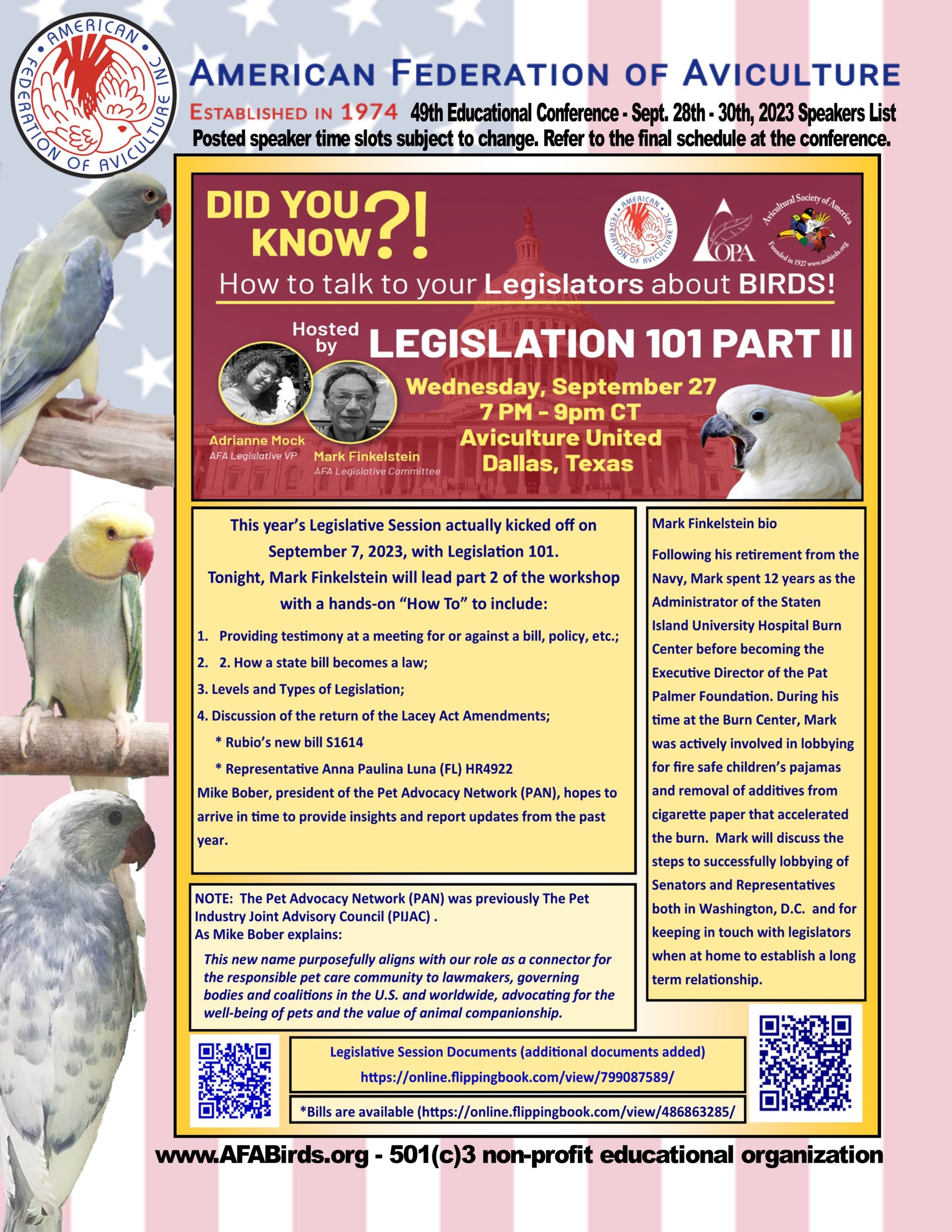
As the legal environment continues to evolve, the AFA encourages bird owners to stay informed through resources such as the "Legislation 101" training course and regular updates on the "Current Legislative Issues" page. The goal of these efforts is not merely to oppose all regulation, but to ensure that any laws passed are fair, science-based, and respectful of the long history of responsible aviculture in the United States.
The future of bird keeping depends on the ability of the community to engage with the legislative process proactively. By understanding the difference between a Bill and a Regulation, recognizing the influence of lobbying groups, and participating in public comment periods, bird enthusiasts can help shape a legal framework that protects both the welfare of the animals and the rights of those who care for them. Without this vigilance, the AFA warns, the ability to keep, breed, and enjoy birds may eventually be eliminated through a thousand small legislative cuts.

