


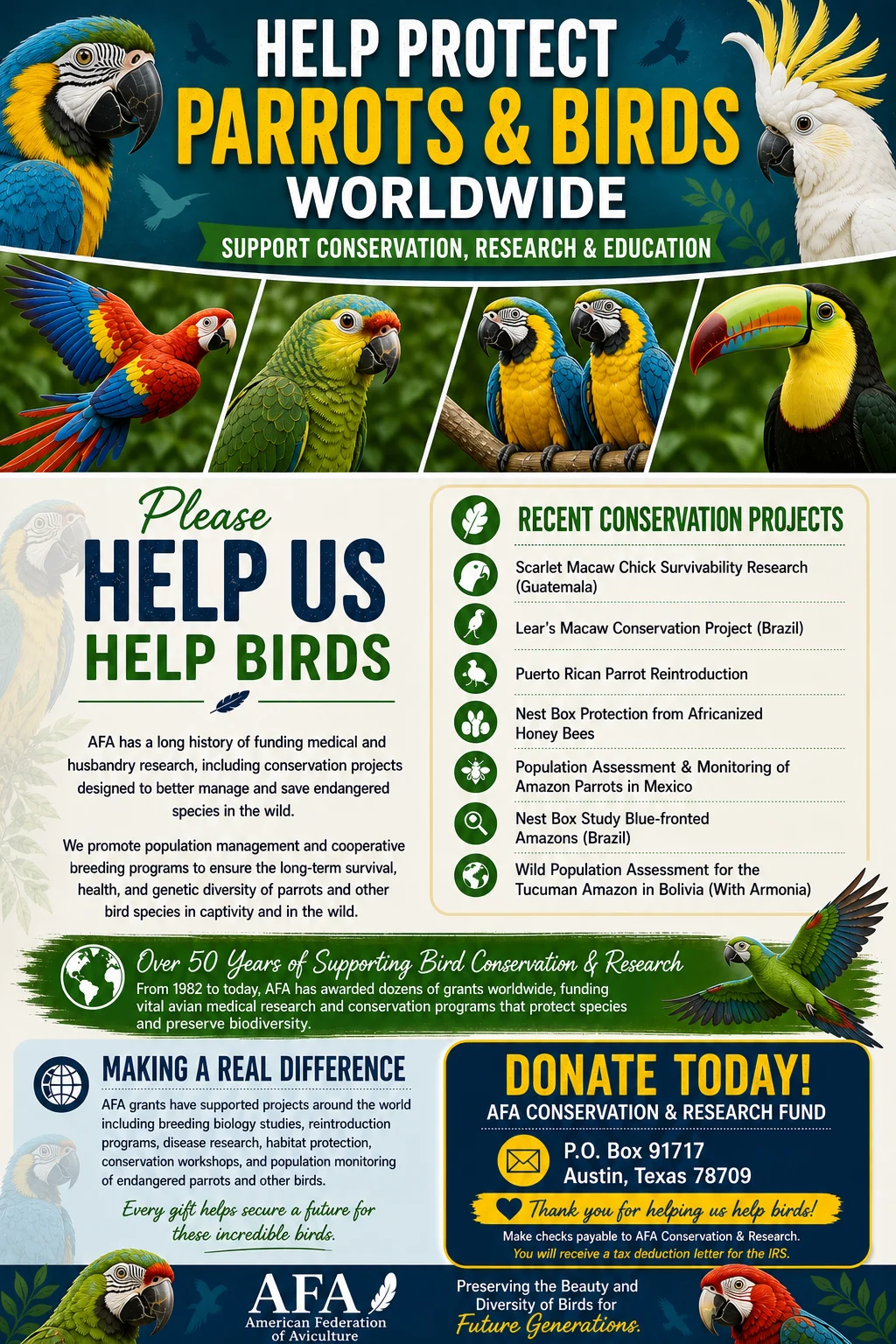
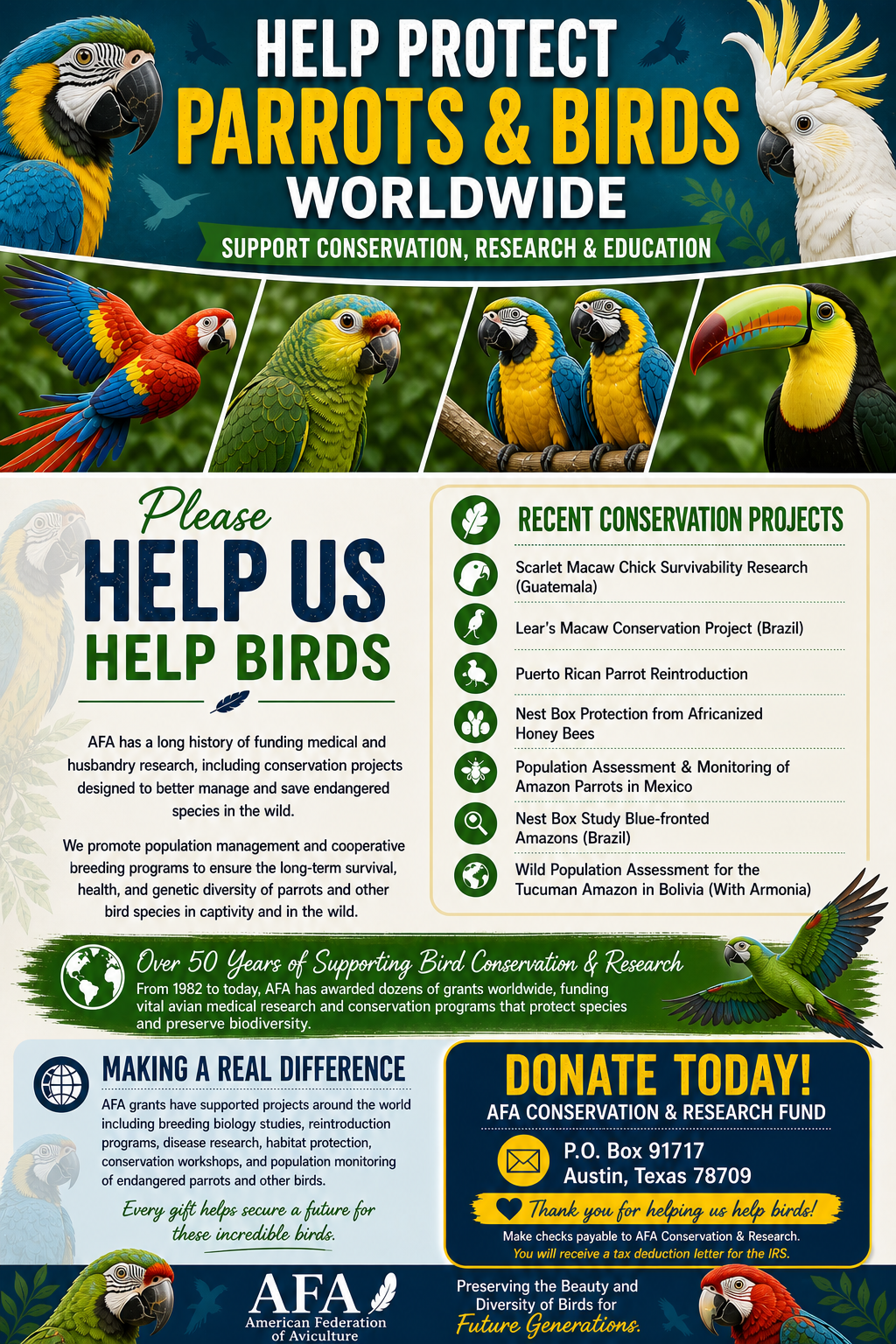
The American Federation of Aviculture (AFA) has officially launched its conservation program for the 2024-2025 cycle, marking a significant expansion of its efforts to protect wild parrot populations and their native habitats. Central to this year’s initiative is a renewed partnership with Harrison’s Bird Foods, a collaboration that underscores the critical intersection between the avicultural community and international wildlife preservation. The partnership was recently solidified by a $25,000 donation presented by representatives of Harrison’s Bird Foods to AFA Chief Financial Officer Janice Lang. This funding is earmarked to bolster small-scale grant programs and provide essential resources for field biology projects that often struggle to secure financing from larger governmental or international agencies.
Since its inception, the AFA has maintained that the survival of avian species depends on a multi-faceted approach involving captive breeding, legislative advocacy, and direct field conservation. The 2024-2025 program focuses on providing "modest but impactful" grants, typically around $500, though larger amounts are considered for projects with exceptional objectives. These funds are designed to bridge the gap for researchers and conservationists who require specific equipment or temporary operational support to maintain long-term ecological studies.
Current Field Projects and Strategic Objectives
The AFA Conservation Committee has identified several high-priority projects for the current funding cycle, ranging from the rainforests of Mexico to the clay licks of Peru. One of the flagship efforts is the Chajul Biology Station in the Lacandon rainforest of southern Mexico, operated by Natura Mexicana. This project focuses on the preservation of the wild Scarlet Macaw (Ara macao). Historically, poaching for the illegal pet trade and habitat loss resulted in a fledgling rate near zero percent. However, through the intervention of biologists who monitor nests, identify hatchlings, and hand-rear at-risk chicks for release, the program has successfully fledged over 150 macaws back into the wild. For the 2024 season, the AFA has set a fundraising goal of $5,000 to provide the station with critical medical and husbandry equipment, including incubators, brooders, gram scales, and portable medical kits.
In Guatemala, the AFA is supporting the Selva Maya Living Landscape Program, managed by the Wildlife Conservation Society (WCS). This initiative focuses on Scarlet Macaw chick survivability in the Maya Biosphere Reserve. Since 2002, the WCS has utilized a mix of threat-based interventions—such as protecting nest trees from predators—and experimental population enhancements to increase recruitment rates. The Scarlet Macaw remains one of the top five landscape species for the WCS, serving as an umbrella species whose protection ensures the survival of numerous other flora and fauna in the region.
The AFA is also funding innovative research into ecological conflicts, such as the "push-pull" protocol developed by Principle Investigator Caroline A. Efstathion. This project addresses the colonization of parrot nest boxes by Africanized honey bees, a significant threat to avian reproductive success. By using permethrin, a bird-safe insecticide, to repel scout bees from nest boxes while simultaneously using pheromone-baited traps to draw them to alternative sites, researchers have created a sustainable method to protect nesting parrots without harming local bee populations.
Advanced Biological Research and Regional Stability
Scientific data collection remains a cornerstone of the AFA’s mission. In the Tambopata region of Peru, the organization supports an investigation into the physiological health of wild parrots. Lead investigators J. Jill Heatley, Lizzie Ortiz-cam, and Donald Brightsmith are utilizing i-STAT analyzers to determine electrolytes, venous blood gases, and lactate levels in both nestlings and free-flighted adults. This data provides an invaluable baseline for avian veterinarians and conservationists to assess the overall health of parrot populations. Furthermore, the study explores the theoretical reasons for "clay lick" usage—geophagy—hypothesizing that birds visit these sites for necessary electrolytes, a finding that could revolutionize the formulation of diets for companion birds.
In Brazil, the AFA continues its support for the Lear’s Macaw Corn Subsidy Program. This project addresses a classic human-wildlife conflict where wild Lear’s Macaws raid local corn crops, leading to retaliatory killings by farmers. By providing subsidized corn to the farmers, the program ensures that the macaws can feed without threatening the livelihoods of the local community, fostering a culture of coexistence rather than conflict.
A Legacy of Avicultural Advocacy: The History of the AFA
The AFA’s commitment to conservation is rooted in its history as a defensive organization for bird owners. Founded in March 1974, the American Federation of Aviculture was born out of a crisis. During an outbreak of Exotic Newcastle Disease in California in the early 1970s, the United States Department of Agriculture (USDA) euthanized thousands of healthy exotic birds in private collections to prevent the spread of the disease. This led to proposed state legislation that would have effectively banned the private ownership of exotic birds.

In response, bird clubs and individual owners formed the AFA as an "umbrella organization" to represent the interests of aviculturists. Today, the AFA is a 501(c)3 non-profit educational organization that works with legislators and represents the avicultural community at the Convention on International Trade in Endangered Species (CITES). The organization’s mission has evolved from purely legislative defense to the promotion of breeding practices, husbandry, and global conservation research.
Navigating the Legal Landscape: CITES, ESA, and WBCA
A significant portion of the AFA’s work involves educating its members on the complex legal framework governing the movement and ownership of birds. The primary international treaty is CITES, which regulates trade based on "Appendices." Appendix I includes species threatened with extinction, for which commercial trade is generally prohibited. Appendix II includes species that may become threatened unless trade is strictly regulated.
In the United States, these international regulations are supplemented by the Endangered Species Act (ESA) of 1973 and the Wild Bird Conservation Act (WBCA) of 1992. The WBCA was a turning point for American aviculture, as it effectively banned the mass importation of wild-caught birds for the pet trade. While the law was intended to protect wild populations, it also created challenges for maintaining genetic diversity in captive populations.

To address this, the AFA oversees Cooperative Breeding Programs (CBPs). These programs allow for the limited importation of specific species, such as the Blue-eyed Cockatoo or the Red Siskin, provided the birds are used for breeding purposes to establish sustainable, genetically diverse populations within the U.S. These programs require rigorous reporting to the U.S. Fish and Wildlife Service (USFWS) and ensure that imported birds are not simply sold into the pet trade but are part of a managed conservation strategy.
Analysis of Impact and Future Outlook
The AFA’s 2024-2025 conservation strategy reflects a sophisticated understanding of modern wildlife preservation. By funding small, targeted grants, the AFA empowers local researchers to solve specific problems—like bee infestations or crop raiding—that might be overlooked by larger organizations. This "ground-up" approach ensures that funds are used efficiently and that results are tangible.
Furthermore, the emphasis on Cooperative Breeding Programs highlights the "insurance policy" role of aviculture. As wild habitats continue to shrink due to climate change and human encroachment, captive populations managed with high genetic diversity may one day be the only source for reintroduction efforts. The AFA’s work in bridging the gap between the hobbyist community and scientific researchers ensures that the knowledge gained from keeping birds in captivity is applied to saving them in the wild.
The AFA invites interested persons and organizations to become Conservation Partners. Recognition for these partners is provided in the AFA Watchbird Journal and on the organization’s website. Proposals for the next round of conservation grants are due by September 15 of each year, as the organization continues its half-century legacy of ensuring that exotic birds remain a part of the world’s natural heritage for generations to come. Through education, research, and strategic funding, the American Federation of Aviculture remains the leading voice for the avian world in the 21st century.

