


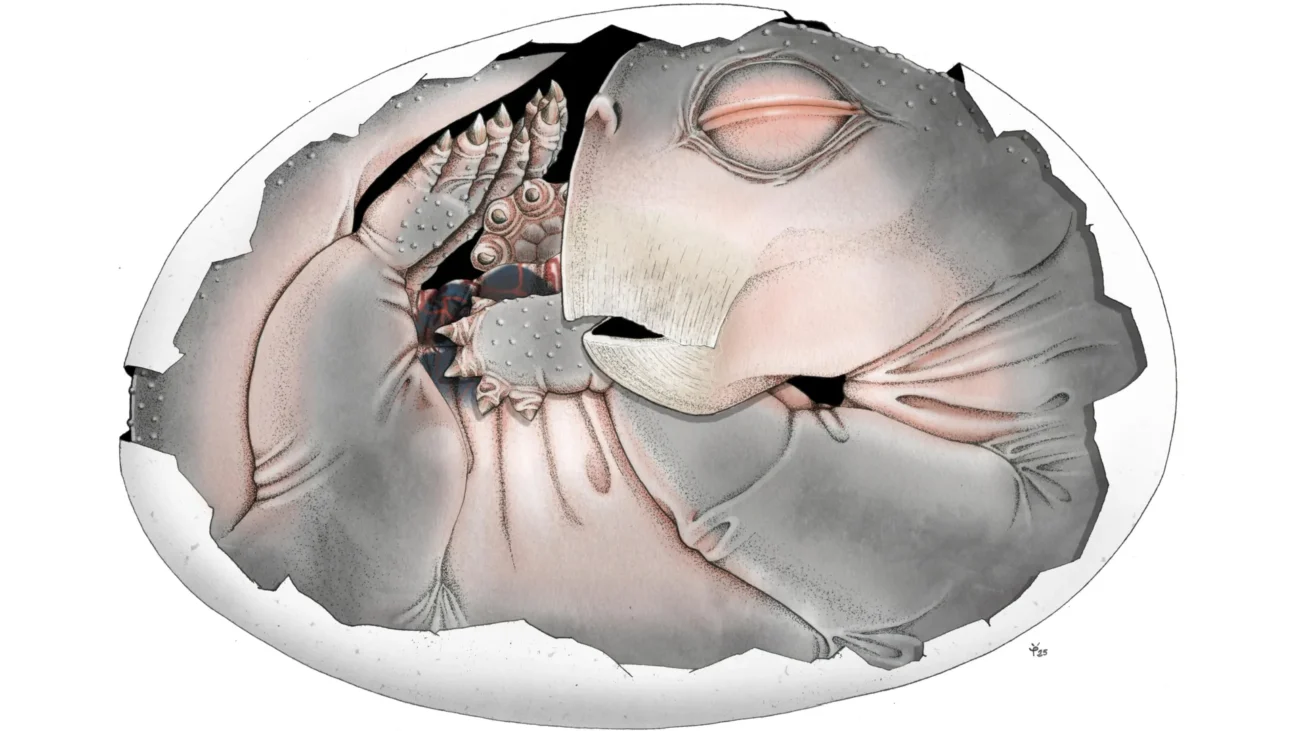
A groundbreaking fossil discovery is fundamentally reshaping our understanding of early mammal evolution and providing unprecedented insight into one of the most dramatic survival sagas in Earth’s history. Scientists have identified the first confirmed fossilized egg of a mammal ancestor, containing an approximately 250-million-year-old embryo of Lystrosaurus. This remarkable find not only answers a decades-long scientific enigma about the reproductive habits of our distant forebears but also illuminates the extraordinary resilience of this creature, which rose to dominance in the wake of the catastrophic End-Permian Mass Extinction.
A Glimpse into the Post-Extinction World
Around 252 million years ago, the Earth experienced its most devastating biological crisis, the End-Permian Mass Extinction, often referred to as the "Great Dying." This cataclysmic event, driven by massive volcanic activity in the Siberian Traps, unleashed a cascade of environmental disasters. Global temperatures soared, the oceans acidified and depleted of oxygen, and widespread atmospheric changes created an infertile, drought-ridden landscape. It is estimated that up to 96% of marine species and 70% of terrestrial vertebrate species vanished. Amidst this near-total annihilation, a small, pig-sized herbivore, Lystrosaurus, emerged as one of the few survivors, remarkably adapting and thriving in the radically altered world.
Lystrosaurus, a dicynodont therapsid, was a tough, plant-eating animal that possessed a distinctive beak-like mouth and tusks. Its ability to endure the extreme conditions that followed the extinction—unrelenting heat, unstable climate, and prolonged droughts—is a testament to its evolutionary hardiness. For decades, scientists have marveled at its post-extinction proliferation, but key questions about its reproductive biology remained unanswered.
The Elusive Egg: A Long-Standing Scientific Puzzle
The discovery, detailed in the prestigious journal PLOS ONE, was spearheaded by an international team of researchers, including Professor Julien Benoit and Professor Jennifer Botha from the Evolutionary Studies Institute at the University of the Witwatersrand in South Africa, and Dr. Vincent Fernandez from ESRF—The European Synchrotron in France. Their work centers on a fossil that has finally resolved the persistent question: did the ancestors of mammals lay eggs? The unequivocal answer, now supported by concrete evidence, is yes.
The rarity of such discoveries stems from the presumed nature of these ancient eggs. Unlike the hard, mineralized shells of dinosaur eggs that readily fossilize, the research team posits that Lystrosaurus eggs were likely soft-shelled. This fragility would have caused them to decay rapidly before the fossilization process could occur, making their preservation an exceptionally rare event. This inherent vulnerability explains why, despite extensive paleontological research, no definitive mammal ancestor egg had ever been found until now.
A Remarkable Find Unearthed Over Years
The specific fossil that has rewritten paleontological history was initially discovered during a field excursion led by Professor Jennifer Botha in 2008. Nearly 17 years prior to its detailed analysis, a skilled preparator and fossil finder, John Nyaphuli, identified a small nodule. Initial examination revealed only minute bone fragments. With meticulous care, Nyaphuli began to prepare the specimen, gradually uncovering a perfectly curled Lystrosaurus hatchling. Professor Botha harbored a strong suspicion at the time that the young animal had died within its egg, but the technological capabilities of the era were insufficient to confirm this hypothesis definitively.
Advanced Imaging Technology: Unlocking Ancient Secrets
The advent of advanced imaging techniques, particularly synchrotron X-ray computed tomography (CT) scanning, provided the crucial tools needed to examine the delicate fossil with unprecedented precision. The powerful X-rays at the ESRF facility allowed researchers to peer inside the specimen, revealing its internal structure in remarkable detail. This non-destructive imaging technology was instrumental in confirming what had long been suspected.
Dr. Vincent Fernandez described the moment of discovery as "especially exciting," noting that "Understanding reproduction in mammal ancestors has been a long-lasting enigma, and this fossil provides a key piece to this puzzle. It was essential that we scanned the fossil just right to capture the level of detail needed to resolve such tiny, delicate bones."
The detailed scans yielded a critical clue regarding the embryo’s developmental stage. Professor Julien Benoit highlighted his excitement upon observing "the incomplete mandibular symphysis." The mandible, or lower jaw, is composed of two halves that must fuse to form a complete bone, a process essential for an animal to feed. The fact that this fusion had not yet occurred in the embryo indicated that it was still entirely dependent and incapable of self-sustenance, strongly suggesting it perished before hatching.
Reproductive Strategies for a Harsh World
Beyond confirming the egg-laying habit of mammal ancestors, the study offers profound insights into Lystrosaurus‘s reproductive strategy, which was crucial for its survival in a post-extinction world. The research indicates that Lystrosaurus produced relatively large eggs when compared to its overall body size. In extant animal species, larger eggs typically contain a greater yolk reserve, providing ample nutrition for embryonic development. This suggests that Lystrosaurus embryos likely developed to a significant stage within the egg, negating the need for extensive post-hatching parental care, such as feeding young with milk, a hallmark of modern mammals.
The substantial yolk supply in these large eggs also conferred a critical advantage in the arid climate that characterized the post-Permian era. These larger eggs would have been more resilient to desiccation, a vital trait for survival in a landscape prone to prolonged droughts.
The evidence points towards Lystrosaurus hatchlings being precocial. This means they were born at an advanced stage of development, possessing the capacity to feed themselves, evade predators, and grow rapidly towards maturity. This strategy of "grow fast and reproduce early" proved to be an incredibly effective evolutionary blueprint for navigating the volatile and unforgiving environment of the early Triassic period.
The Broader Implications for Paleontology and Ecology
This discovery marks a significant milestone in paleontology, providing the first direct evidence that mammal ancestors laid eggs. It not only resolves a fundamental question about the origins of mammalian reproduction but also illuminates how specific reproductive strategies can directly influence species’ survival during periods of extreme environmental upheaval. Lystrosaurus‘s success in the post-extinction ecosystems can now be more clearly attributed to its ability to adapt through its reproductive choices.
The findings resonate with a growing understanding of survival patterns during Earth’s major extinction events. A consistent theme emerging from paleontological research is that adaptability, resilience, and flexible reproductive strategies are paramount for species to endure global crises. Lystrosaurus appears to have embodied all three of these critical traits.
Statements from the Researchers
Professor Julien Benoit emphasized the profound significance of the research: "This research is important because it provides the first direct evidence that mammal ancestors, such as Lystrosaurus, laid eggs, resolving a long-standing question about the origins of mammalian reproduction. Beyond this fundamental insight, it reveals how reproductive strategies can shape survival in extreme environments: by producing large, yolk-rich eggs and precocial young, Lystrosaurus was able to thrive in the harsh, unpredictable conditions following the end-Permian mass extinction. In a modern context, this work is highly impactful because it offers a deep-time perspective on resilience and adaptability in the face of rapid climate change and ecological crisis. Understanding how past organisms survived global upheaval helps scientists better predict how species today might respond to ongoing environmental stress, making this discovery not just a breakthrough in paleontology, but also highly relevant to current biodiversity and climate challenges." He also added, "The opportunity to work at the European Synchrotron Radiation Facility alongside beamline scientists was also an unforgettable part of the journey. The cutting-edge data we generated there allowed us to ‘see’ inside the fossil in extraordinary detail, ultimately revealing that the embryo was still at a pre-hatching stage. That moment, when the pieces all came together, was incredibly rewarding."
Professor Jennifer Botha shared her perspective on the collaborative nature of the discovery: "What makes this work especially exciting is that we were able to quite literally follow in John Nyaphuli’s footsteps, returning to a specimen he discovered nearly two decades ago and finally solve the puzzle he uncovered. At the time, all we had was a beautifully curled embryo, but no preserved eggshell to prove it had died within an egg. Using modern imaging techniques, we were able to answer that question definitively. It is also thrilling because this discovery breaks entirely new ground. For over 150 years of South African paleontology, no fossil had ever been conclusively identified as a therapsid egg. This is the first time we can say, with confidence, that mammal ancestors like Lystrosaurus laid eggs, making it a true milestone in the field."
A Timeline of Discovery and Understanding
- 252 Million Years Ago: The End-Permian Mass Extinction devastates global biodiversity. Lystrosaurus is among the few terrestrial vertebrates to survive.
- Early Triassic Period (following the extinction): Lystrosaurus experiences a population boom, becoming one of the dominant land animals. Its reproductive strategies begin to solidify its ecological success.
- 2008: Professor Jennifer Botha leads a field excursion where John Nyaphuli discovers a small nodule containing a fossilized, curled embryo. Initial preparation reveals a Lystrosaurus hatchling, with suspicions that it died within an egg.
- Early 2020s: Advanced synchrotron X-ray CT scanning technology becomes available at facilities like the ESRF.
- Present Day: An international team of researchers, utilizing advanced imaging, confirms the fossil is an embryo preserved within its egg, providing the first definitive evidence of egg-laying in mammal ancestors. The findings are published in PLOS ONE.
Future Directions and Broader Impact
This pivotal discovery opens new avenues for research into the evolution of reproduction in synapsids, the group of amniotes that includes mammals and their extinct relatives. Scientists will now be keen to identify further fossilized eggs and embryos from this crucial period, which could reveal more about the diversity of reproductive strategies among early mammal ancestors.
In a broader context, the study of Lystrosaurus‘s survival offers a potent, deep-time perspective on the resilience of life in the face of rapid environmental change and ecological collapse. As the planet grapples with contemporary challenges such as climate change and biodiversity loss, understanding how ancient organisms navigated similar existential threats provides invaluable lessons. The adaptability and strategic reproductive choices of Lystrosaurus serve as a compelling reminder that evolutionary success is often a complex interplay of biological innovation and environmental circumstance. By studying the past, scientists are better equipped to anticipate and potentially mitigate the impacts of current environmental stresses on ecosystems and species today. The story of Lystrosaurus is not just a tale of ancient survival; it is a narrative with profound relevance for the future of life on Earth.

