


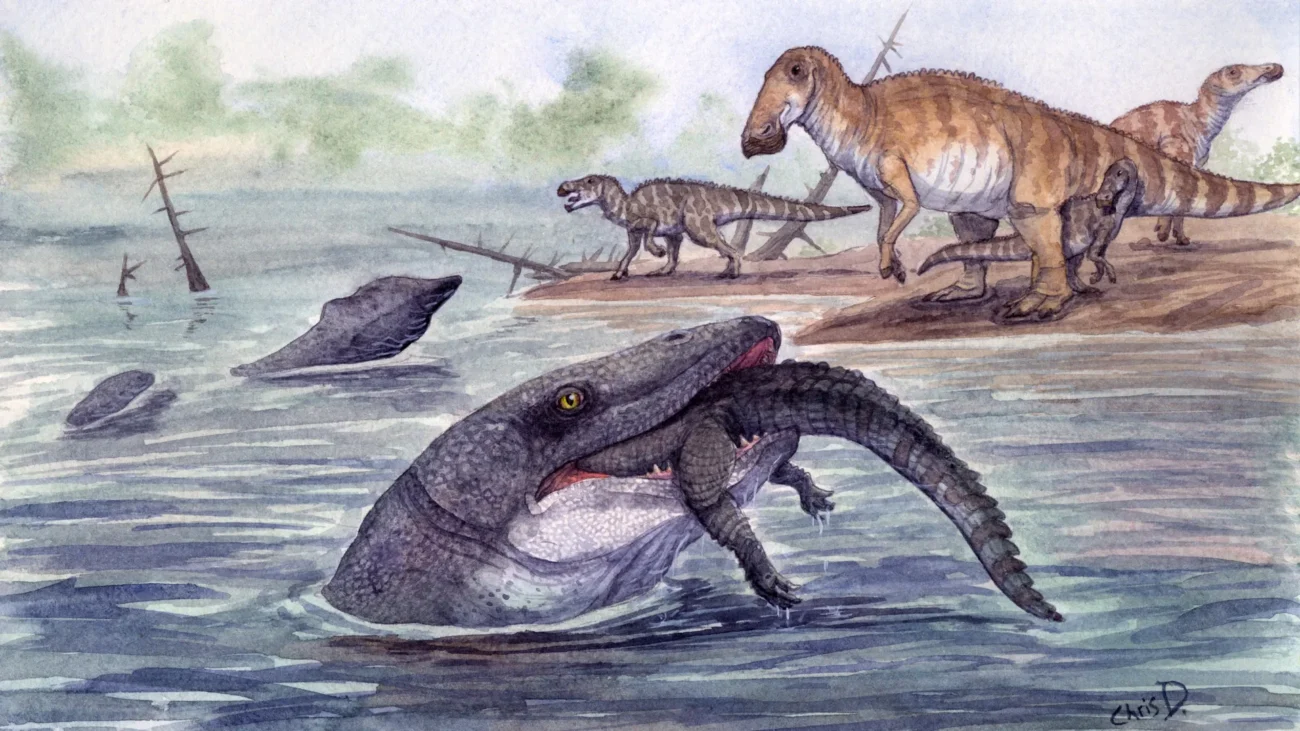
New fossil evidence unearthed in North Dakota is rewriting our understanding of mosasaurs, the formidable marine reptiles that dominated the oceans more than 66 million years ago. Contrary to long-held beliefs that these colossal predators were exclusively saltwater dwellers, a groundbreaking discovery of a mosasaur tooth suggests some species adapted to life in freshwater river systems during the twilight of their reign, just a million years before their mass extinction. This revelation, led by an international team of scientists from Uppsala University, challenges established paleontological paradigms and paints a more dynamic picture of these ancient apex predators.
A Riverine Anomaly: The Discovery in North Dakota
The pivotal discovery occurred in 2022 when researchers, meticulously excavating a river deposit in North Dakota, unearthed a mosasaur tooth. Its presence in this context was immediately puzzling. The site, already a treasure trove of Late Cretaceous fossils, had yielded the remains of terrestrial dinosaurs like Edmontosaurus, a formidable Tyrannosaurus rex tooth, and the jawbone of a crocodylian—an animal intrinsically linked to freshwater or brackish environments. The juxtaposition of a creature definitively classified as a marine reptile with these land and riverine inhabitants sparked a scientific quest to unravel the mystery.
"The unusual mix of land dinosaurs, river-dwelling crocodiles, and a giant marine reptile immediately stood out," explains Dr. Melanie During, one of the study’s corresponding authors, in a statement to the press. "If mosasaurs were ocean animals, how did one of their teeth end up preserved in a river?" This question formed the bedrock of the subsequent investigation.
Deciphering the Past Through Chemical Signatures
To address the enigma, an international consortium of researchers, pooling expertise from institutions in the United States, Sweden, and the Netherlands, embarked on a detailed chemical analysis of the mosasaur tooth’s enamel. The technique employed, isotope analysis, offered a window into the tooth’s formative environment. Because the mosasaur tooth, the T. rex tooth, and the crocodylian jawbone were all found in close proximity and dated to approximately the same period – around 66 million years ago – scientists could conduct a direct comparative chemical analysis.
The research, primarily conducted at the Vrije Universiteit (VU) in Amsterdam, focused on analyzing the ratios of specific oxygen, strontium, and carbon isotopes within the tooth enamel. The results were striking. The mosasaur tooth exhibited unusually high concentrations of the lighter oxygen isotope, oxygen-16 (16O). This isotopic signature is a well-established indicator of freshwater environments, contrasting sharply with the signatures typically found in marine settings. Furthermore, the strontium isotope ratios corroborated this finding, strongly suggesting a freshwater habitat for the mosasaur.
Unpacking Dietary Clues and Habitat Preferences
Beyond environmental indicators, the isotope analysis also provided insights into the mosasaur’s diet. Carbon isotopes in tooth enamel generally reflect an animal’s feeding habits. "Carbon isotopes in teeth generally reflect what the animal ate," Dr. During elaborated. "Many mosasaurs have low 13C values because they dive deep. The mosasaur tooth found with the T. rex tooth, on the other hand, has a higher 13C value than all known mosasaurs, dinosaurs and crocodiles, suggesting that it did not dive deep and may sometimes have fed on drowned dinosaurs." This observation implies a feeding strategy that might have involved scavenging carcasses in or near the water, a behavior more readily accommodated by a riverine or coastal environment than the open ocean.
The investigation extended beyond this single tooth. The team examined two additional mosasaur teeth discovered at nearby sites in North Dakota, which were slightly older. These teeth displayed similar freshwater isotopic signatures. "These analyses show that mosasaurs lived in riverine environments in the final million years before going extinct," Dr. During confirmed, underscoring the significance of these findings for understanding the late-stage evolution of these reptiles.
A Shifting Seaway: The Geological Context
The geographical and geological context of North Dakota during the Late Cretaceous provides a compelling explanation for this observed shift in mosasaur habitat. At that time, a vast inland sea, known as the Western Interior Seaway, bisected the North American continent, stretching from the Arctic Ocean in the north to the Gulf of Mexico in the south. Over millennia, increased freshwater runoff from surrounding landmasses gradually altered the seaway’s salinity.
Scientists theorize that this influx of freshwater transformed the seaway from a predominantly saline marine environment into a brackish and eventually, in certain regions, a predominantly freshwater system. This gradual transition mirrors the current conditions found in bodies of water like the Gulf of Bothnia, where layers of freshwater and saltwater coexist. The researchers propose that this process created a "halocline"—a distinct layer of lighter freshwater floating above denser saltwater. The isotopic data from the mosasaur teeth, which showed a preference for freshwater signatures, aligns perfectly with this scenario.
Navigating Stratified Waters: A Tale of Two Layers
To further solidify their hypothesis, the researchers compared the isotopic signatures of the mosasaur teeth with those of other marine animals found in the same geological strata. "For comparison with the mosasaur teeth, we also measured fossils from other marine animals and found a clear difference," stated Per Ahlberg, a co-author of the study and mentor to Dr. During. "All gill-breathing animals had isotope signatures linking them to brackish or salty water, while all lung-breathing animals lacked such signatures."
This crucial distinction highlights the respiratory needs of these animals. Gill-breathing creatures, such as fish and invertebrates, would have been confined to the saltier, deeper layers of the water. In contrast, lung-breathing animals, including mosasaurs, dinosaurs, and crocodiles, needed to surface to breathe. The study suggests that these lung-breathers, particularly the mosasaurs in question, likely inhabited the upper, less saline freshwater layer of this stratified environment. This adaptation allowed them to exploit resources and territories previously unavailable to purely marine reptiles.
Evolutionary Flexibility: Adapting to a Changing World
The findings underscore the remarkable adaptability of these ancient creatures. The researchers posit that the mosasaurs found in these riverine environments had undergone a significant evolutionary adjustment, demonstrating a capacity to thrive in conditions far removed from their ancestral marine habitats. This ability to transition between vastly different ecological niches is a testament to their evolutionary plasticity.
"Unlike the complex adaptation required to move from freshwater to marine habitats, the reverse adaptation is generally simpler," Dr. During noted, alluding to the biological mechanisms involved in adjusting to salinity levels. This observation is supported by modern examples of animal behavior. River dolphins, for instance, are entirely freshwater inhabitants today, despite their evolutionary lineage tracing back to marine ancestors. Similarly, the estuarine crocodile, widely known as the saltwater crocodile, exhibits remarkable flexibility, seamlessly transitioning between freshwater rivers and the open ocean in its relentless pursuit of prey.
A Bus-Sized Predator in Unexpected Waters
The implications of this discovery are amplified when considering the sheer scale of these ancient reptiles. Mosasaur fossils are generally abundant in marine deposits spanning North America, Europe, and Africa from approximately 98 to 66 million years ago. However, their presence in North Dakota’s freshwater deposits is exceptionally rare, making this discovery particularly noteworthy. The size of the discovered tooth is estimated to have come from an individual measuring up to 11 meters (approximately 36 feet) in length—comparable to the size of a modern-day bus. Earlier discoveries of mosasaur bones at a nearby site lend credence to this impressive size estimate. While the exact genus of this particular mosasaur remains unidentified, its features likely align with those of prognathodontine mosasaurs. Close relatives, such as those within the Prognathodon genus, were characterized by massive heads, powerful jaws, and robust teeth, indicating they were opportunistic predators capable of tackling substantial prey.
"The size means that the animal would rival the largest killer whales, making it an extraordinary predator to encounter in riverine environments not previously associated with such giant marine reptiles," stated Professor Ahlberg. The image of such a colossal predator navigating the confined spaces of ancient river systems is a stark departure from the typical portrayal of mosasaurs as purely oceanic titans.
Broader Implications for Paleontology and Evolutionary Science
This research has profound implications for our understanding of Cretaceous ecosystems and the evolutionary trajectories of marine reptiles. It suggests that the ecological niches occupied by mosasaurs may have been far more diverse than previously understood. The ability of some mosasaur lineages to adapt to freshwater environments could have provided them with alternative food sources and refuges, potentially playing a role in their survival during periods of environmental flux.
The discovery also raises questions about the extent of this freshwater adaptation. Were these riverine mosasaurs a distinct subspecies, a new species, or simply a population exhibiting behavioral plasticity? Further fossil discoveries and detailed isotopic analyses from various locations and time periods will be crucial in answering these questions.
A Legacy of Adaptation and Extinction
The Late Cretaceous period was a time of significant environmental change, culminating in the catastrophic asteroid impact that led to the extinction of the non-avian dinosaurs, including the mosasaurs. Understanding how these creatures were adapting to their environments in the final million years before this event provides invaluable context for their eventual demise. The shift to freshwater systems could represent a strategy for survival in a changing world, but ultimately, it was not enough to overcome the global cataclysm.
The research, a testament to international scientific collaboration, involved institutions such as Uppsala University, Eastern West Virginia Community and Technical College, Moorefield, West Virginia, Vrije Universiteit Amsterdam, and the North Dakota Geological Survey. The findings are drawn, in part, from Dr. During’s doctoral thesis, which she successfully defended at Uppsala University in November 2024, marking a significant contribution to the field of paleontology. This ongoing research promises to further illuminate the complex and often surprising lives of Earth’s ancient inhabitants.

