


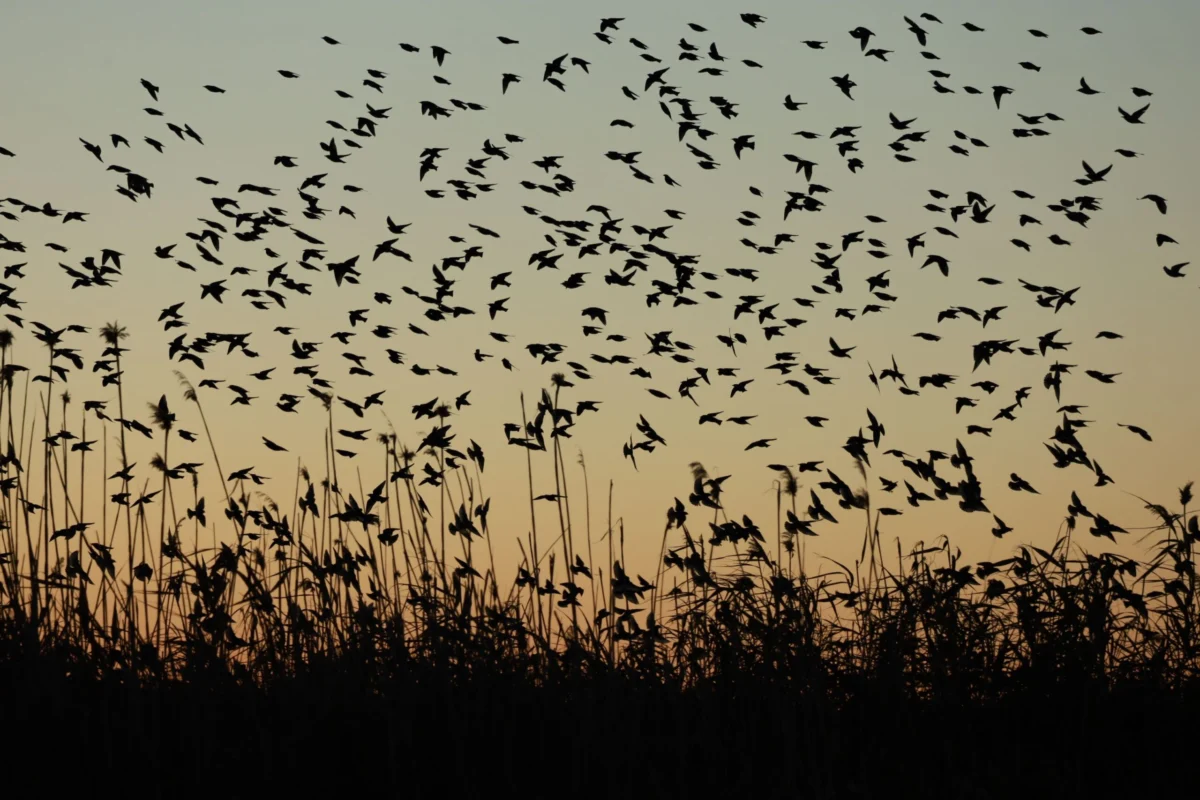
If you step outside tonight and look up at the sky, you probably won’t see much happening, yet high above you, millions of birds are likely engaged in one of the most remarkable and physically demanding journeys in the natural world. While the casual observer may see only a quiet, dark expanse, the atmosphere is currently teeming with avian life. Across North America, the fall migration is officially underway, marking the beginning of an annual, continent-spanning trek toward wintering grounds that range from the southern United States to the depths of South America.
This massive movement of biological life is largely invisible to the human eye, primarily because more than 80% of migratory bird species in North America choose to travel under the shroud of darkness. This nocturnal strategy is not a matter of preference but a complex evolutionary adaptation. By traveling at night, birds avoid the intense solar heat of the day, which helps them maintain lower body temperatures during periods of extreme physical exertion. Furthermore, the nocturnal atmosphere often provides more stable air masses and favorable wind patterns, allowing birds to conserve energy during flights that can span thousands of miles.
The Technological Breakthrough: Tracking the Invisible
For decades, the scale of this phenomenon was largely anecdotal, estimated through localized bird counts or the observation of birds silhouetted against the moon. However, modern ornithology has been revolutionized by the application of weather surveillance radar. Projects like BirdCast, a collaborative effort involving the Cornell Lab of Ornithology, Colorado State University, and the University of Massachusetts Amherst, have repurposed the national network of weather radars to monitor biological "traffic" in the skies.
These radar systems, originally designed to detect precipitation and storm fronts, are sensitive enough to identify the distinct signatures of avian flight. By analyzing these data streams, researchers can calculate the volume of birds in the air, their heading, their velocity, and their altitude. This data is critical for understanding the health of North American bird populations, as migration is the most perilous time in a bird’s life cycle.
A Chronological Window of Movement
The fall migration period is not a singular event but a prolonged, rhythmic flow that typically spans from mid-August through mid-November. While the exact timing of the "peak" varies based on latitude and regional climate, the movement follows a predictable pattern.
In late summer, the first waves consist largely of shorebirds and certain songbirds heading south. By September and October, the volume of traffic reaches its crescendo as a vast array of warblers, sparrows, thrushes, and raptors move through the continent. This timeline is heavily influenced by meteorological conditions; birds are strategic travelers, often waiting for the arrival of a cold front to provide the tailwinds necessary for efficient long-distance travel. Conversely, severe storms or persistent headwinds can force mass "fallouts," where birds are grounded in local habitats to refuel, creating temporary concentrations of wildlife that delight birdwatchers but highlight the precarious nature of the journey.

Mapping the Four Great Flyways
North America’s avian travelers follow four primary corridors, known as flyways: the Atlantic, Mississippi, Central, and Pacific. These pathways function like interstate highways for the sky, channeling millions of birds toward specific funnel points.
- The Atlantic Flyway: Following the eastern seaboard, this route is essential for birds traveling to the Caribbean and South America.
- The Mississippi Flyway: A central corridor that serves as a massive funnel for birds traveling through the heart of the United States.
- The Central Flyway: Traversing the Great Plains, this route is vital for species that thrive in grassland and prairie habitats.
- The Pacific Flyway: A coastal and mountainous route for birds navigating the western landscape.
The density of birds over these flyways is not uniform. Data from the BirdCast Migration Dashboard indicates that some regions experience significantly higher traffic than others, often depending on the geography of the terrain and the presence of stopover habitats—wetlands, forests, and fields where birds replenish their fat stores.
Historical Records and Data Insights
The scale of this migration is difficult for the human mind to grasp. In September 2025, the BirdCast network recorded an unprecedented migration event: more than 1.2 billion birds were detected moving south in a single night. This figure stands as the largest single-night total recorded since the project began its live mapping in 2018.
Such data is not merely a curiosity; it is a vital tool for conservation. By identifying "high-intensity" nights, researchers can alert municipalities to implement "Lights Out" initiatives. Artificial light at night (ALAN) is a significant threat to migratory birds, as it disorients them, leading to fatal collisions with buildings and structures. Cities that dim their non-essential lighting during these peak windows can significantly reduce the mortality rate of migrating populations.
Innovation in Species-Specific Tracking
Until recently, radar technology could tell researchers that something was flying, but it could not tell them who was flying. A major breakthrough occurred in 2026, when scientists from the Cornell Lab of Ornithology and several partner universities integrated weather radar data with the massive repository of citizen-science observations provided by eBird.
By leveraging over 2 billion human-submitted observations, the new BirdFlow Migration Traffic Rate model allows scientists to estimate species-specific migration patterns. This represents a seismic shift in the field. Instead of viewing migration as a monolithic "blob" on a radar screen, researchers can now provide weekly estimates of where specific species—such as the Blackpoll Warbler or the Swainson’s Thrush—are likely to be moving.
This level of granularity is transformative for ecological policy. If conservationists know exactly when and where a specific, at-risk species is migrating, they can implement more effective habitat protection measures or land-use restrictions.

The Broader Implications for Ecosystems
The implications of this migration are profound. Birds are essential to the health of the ecosystems they traverse, acting as pollinators, seed dispersers, and primary controllers of insect populations. The massive annual pulse of energy represented by the migration sustains the food webs of two continents.
However, the migration is under threat from multiple fronts. Habitat loss in the northern breeding grounds, the degradation of stopover sites, and the increasing frequency of extreme weather events due to climate change all pose significant risks. The ability to monitor these movements in real-time gives the scientific community a "pulse" of the continent’s biodiversity.
As we move through the current season, the data serves as a sobering reminder of the interconnectedness of our environment. The millions of birds currently navigating the dark skies above our homes are part of a delicate, ancient chain. Their survival is linked to our ability to mitigate light pollution, preserve green spaces, and understand the complex rhythms of the natural world.
A Call to Awareness
For those interested in the movement of wildlife, the tools are now more accessible than ever. The BirdCast Migration Dashboard provides real-time information for individual counties, offering data on bird speed, altitude, and direction. Engaging with this technology does more than satisfy curiosity; it fosters a deeper appreciation for the silent, invisible, and monumental effort occurring just above our heads.
As the migration continues toward its conclusion in November, the skies will remain a theater of incredible biological determination. While we sleep, the birds continue their flight, guided by stars, magnetic fields, and the shifting winds, completing a journey that has persisted for millennia—a testament to the resilience of nature in an increasingly human-dominated world. Understanding this process is the first step toward ensuring that these skies remain full for generations to come.

