


The landscape of avian ownership and conservation is increasingly dictated not by the individual choices of breeders and pet owners, but by a complex web of local, state, and federal legislation that often evolves beyond its original intent. Organizations such as the American Federation of Aviculture (AFA) have identified a growing trend where proposed bills, ostensibly designed to address animal welfare or public safety, contain broad language that can inadvertently or intentionally restrict the keeping of birds. As the legal environment shifts, the necessity for vigilant monitoring of legislative developments has become a cornerstone of modern bird keeping, ensuring that the rights of responsible owners are protected against sweeping regulations that may lack scientific nuance or practical feasibility.
The Mechanics of Modern Legislation: Bills, Ordinances, and Regulations
To understand the current challenges facing the avian community, it is essential to distinguish between the various forms of legal mandates. Historically, legislation was defined simply as the proposing of laws. In the contemporary political system, this process primarily begins with a "Bill." A Bill represents the draft of a law intended by its writer, often accompanied by an introductory summary detailing its purpose, enforcement mechanisms, and projected community impact. However, these summaries can occasionally be misleading, obscuring the long-term implications of the specific legal language used within the document.
While Bills are introduced by elected representatives, they frequently originate from lobbying organizations. Many animal rights and animal welfare groups maintain sophisticated lobbying arms that draft legislation and present it to lawmakers at the local, state, or federal levels. While these organizations often cite humane treatment as their primary goal, their agendas may diverge significantly from the views and needs of the general public or specialized communities, such as avian breeders and exhibitors.
At the local level, legislation typically takes the form of "ordinances." These are civil mandates rather than criminal ones. For example, an ordinance might restrict the number of domestic animals, such as dogs or cats, that can reside in a single household. While such a rule might appear reasonable to the average citizen, the danger for bird owners lies in the potential for these ordinances to be amended or interpreted to include all "animals," encompassing birds, hamsters, or fish. A canary breeder with six pairs of birds could suddenly find themselves in violation of a local ordinance designed for large mammals, leading to fines or court appearances. Unlike criminal charges, ordinance violations are usually managed through civil penalties; however, failure to comply can result in contempt of court or escalating financial burdens.
Furthermore, "Regulations" represent the specific rules established under an existing law. Unlike the laws themselves, which must be voted on by a city council, state assembly, or Congress, regulations can often be adjusted by administrative agencies without a direct vote from elected officials. A prominent example of this is the United States Fish and Wildlife Service (USFWS) adding a species to the Endangered Species Act (ESA), a move that can instantly change the legal status of a bird species held in captivity.
A Chronology of Avian Legislative Evolution
The history of avian regulation in the United States has moved from a period of relative autonomy for bird keepers to an era of high-level oversight. In the mid-20th century, bird keeping was largely unregulated, focused primarily on local hobbyist communities. This began to change in the 1970s and 1980s as international concerns regarding wildlife trafficking led to the development of the Convention on International Trade in Endangered Species of Wild Fauna and Flora (CITES).
A pivotal moment occurred in 1992 with the passage of the Wild Bird Conservation Act (WBCA). This federal law significantly restricted the importation of many exotic bird species into the United States, effectively shifting the focus of the American avian community toward captive breeding and sustainable domestic populations. While the WBCA was aimed at conservation, it set a precedent for federal intervention in the avian trade.
In the 2000s, the focus shifted toward welfare and public safety. Following various outbreaks of avian influenza and other zoonotic concerns, the United States Department of Agriculture (USDA) began exploring more rigorous standards for bird handlers. This culminated in the recent implementation of bird-specific regulations under the Animal Welfare Act (AWA). In 2023, after decades of legal debate and advocacy, the USDA’s Animal and Plant Health Inspection Service (APHIS) finalized standards for birds not bred for use in research. These regulations now cover a wide range of facilities, including certain breeders and exhibitors, marking a new chapter in federal oversight.
Supporting Data: The Scope of the Avian Community
The importance of legislative monitoring is underscored by the sheer scale of bird ownership in the United States. According to the American Pet Products Association (APPA), birds are one of the most popular categories of non-traditional pets. Recent surveys indicate that millions of American households own birds, contributing billions of dollars to the national economy through the purchase of feed, enclosures, veterinary services, and specialized equipment.
Data from the pet industry suggests that bird owners are among the most dedicated pet enthusiasts, often investing significant resources into the long-term care of species that can live for several decades. However, this community is also highly fragmented, consisting of small-scale hobbyist breeders, large-scale exhibitors, avian veterinarians, and conservationists. This fragmentation makes the community vulnerable to broad-spectrum legislation that does not account for the specific biological and behavioral needs of different avian species.
Furthermore, economic impact studies have shown that restrictive local ordinances can lead to the "gray market" trade of animals or the abandonment of birds when owners can no longer legally house them. By monitoring legislation, organizations like the AFA aim to prevent these negative outcomes by advocating for laws that distinguish between responsible husbandry and genuine animal neglect.
Stakeholder Responses and the Role of the AFA
The American Federation of Aviculture Legislative Committee serves as a frontline defense for the avian community. By collaborating with other animal-keeping organizations across the United States, the AFA monitors thousands of bills annually. The committee’s expertise allows them to identify "red flag" language in bills that might seemingly have no connection to birds.
A common example is a local "circus prohibition act." While the public may view such a bill as a measure to protect elephants or lions, the AFA notes that the wording in these bills often includes broad definitions of "performing animals" or "exotic displays." Without specific exemptions or clarified language, such a bill could eventually be used to prohibit educational bird shows or even the public exhibition of rare species by private breeders.
Official responses from bird organizations emphasize that the amount of anti-animal-use legislation being introduced at the state and local levels is currently at an all-time high. Advocates argue that while the verbiage of these bills often insinuates a focus on eliminating "inhumane treatment" or "overpopulation," the underlying regulations can be used to phase out bird ownership entirely. The AFA’s stance is that education and proactive engagement with lawmakers are the only ways to ensure that bird owners are not sidelined during the legislative process.
Broader Impact and Future Implications
The implications of unchecked avian legislation extend far beyond the individual bird owner. From a conservation perspective, captive breeding programs managed by private individuals play a vital role in maintaining the genetic diversity of species that may be threatened in the wild. If legislation makes it impossible for private breeders to operate, the "safety net" for these species is effectively removed.
Moreover, the precedent set by restrictive laws in one state often facilitates their introduction in others. Legislative "copy-catting" is a well-documented phenomenon where a bill passed in a progressive jurisdiction is used as a template for other regions. This can lead to a domino effect where bird-related businesses—ranging from specialized pet stores to avian-specific pharmaceutical companies—are forced to close due to a shrinking market.
In the long term, the elimination of birds from the domestic sphere could lead to a loss of public interest in avian conservation. When people are unable to interact with birds as pets or in educational settings, the emotional connection that often drives support for wild habitat preservation begins to wane.
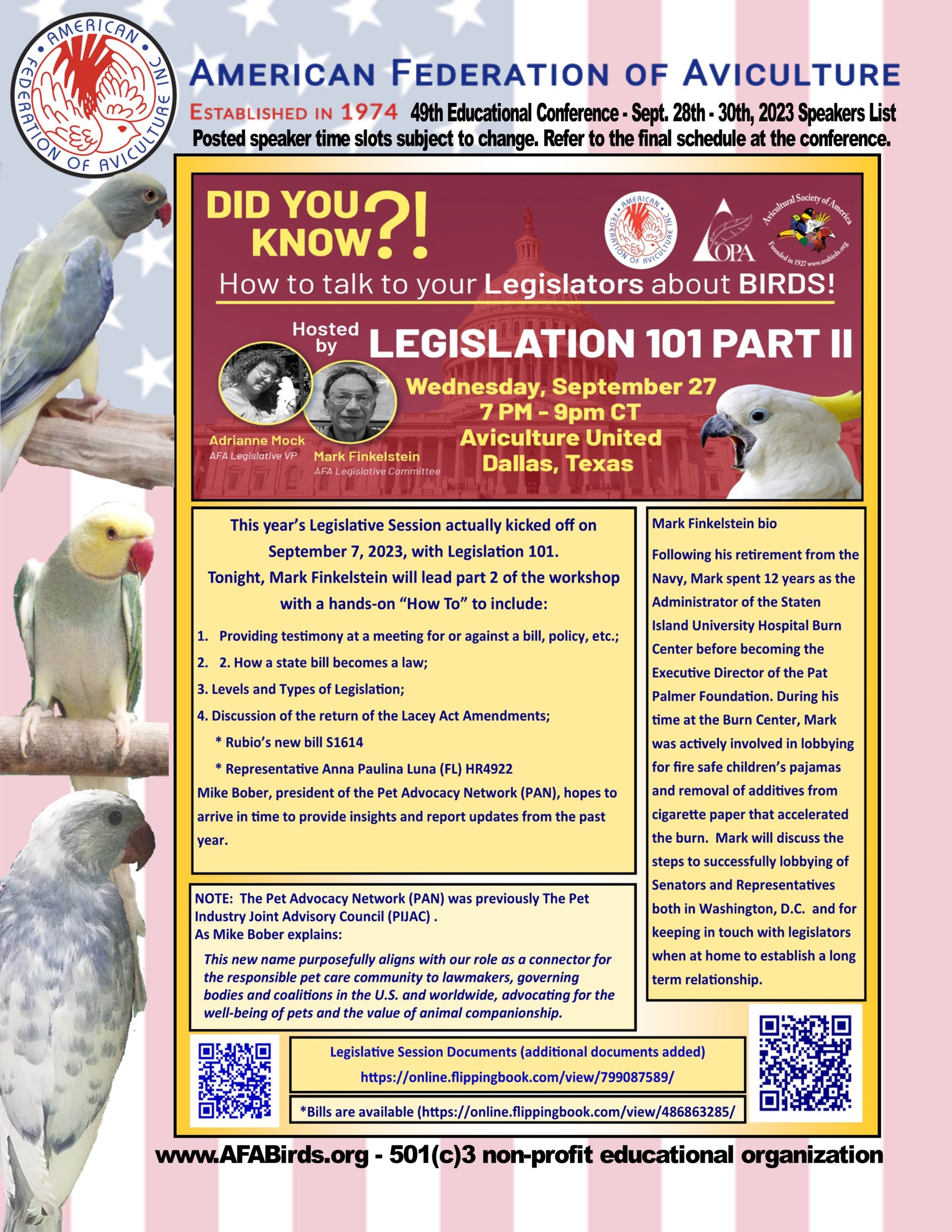
As the legal landscape continues to evolve, the avian community must remain informed and active. Checking for proposed legislation in one’s local area and state is no longer a niche activity for activists; it is a necessary part of responsible bird ownership. Through resources like the AFA’s "Current Legislative Issues" portal and educational courses like "Legislation 101," bird enthusiasts can equip themselves with the knowledge needed to protect their birds and the future of the hobby. The goal remains a balanced legal framework that promotes animal welfare without dismantling the rich tradition of avian stewardship in America.

