


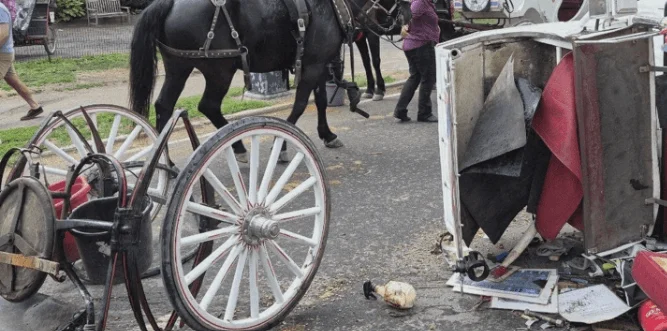
The death of 18-year-old Romanch Mahajan following a catastrophic horse-drawn carriage accident in Central Park has sent shockwaves through New York City, reigniting an intense and long-standing debate over the safety and ethics of the industry. On Wednesday, June 17, 2026, a family’s afternoon outing turned into a tragedy when a horse, startled by unknown stimuli, bolted through the busy pedestrian and vehicular pathways of the park. The resulting crash claimed the life of Mahajan, who sustained fatal injuries while reportedly attempting to shield his mother from the impact as the carriage overturned. This incident, occurring in one of the most heavily trafficked urban parks in the world, has led to a unified outcry from the victim’s family, animal rights organizations, and local legislators who argue that the carriage industry is inherently incompatible with modern metropolitan environments.
The Sequence of Events: A Fatal Turn in Central Park
According to eyewitness accounts and preliminary reports from the New York City Police Department, the incident began near the southern end of Central Park, an area frequently congested with tourists, cyclists, and motorists. The horse, which was hitched to a carriage carrying the Mahajan family, suddenly accelerated into a gallop, seemingly losing all response to the driver’s commands. Video footage captured by bystanders shows the carriage swaying violently as it navigated a curve before eventually striking a curb and flipping onto its side.
Emergency responders arrived on the scene within minutes, but the severity of the trauma sustained by Romanch Mahajan proved too great. He was transported to a local hospital where he was later pronounced dead. His mother and other family members were treated for non-life-threatening injuries and psychological trauma. In the days following the crash, the Mahajan family has broken their silence, issuing a direct plea to city officials. Their message is unequivocal: the industry that claimed their son’s life must be shut down immediately to prevent further loss of life.
The tragedy was compounded by the fact that it occurred just one week after another high-profile incident involving the carriage industry. On June 10, a horse named Deniz collapsed and died while in harness in Central Park. The back-to-back deaths of a horse and a human passenger within a seven-day window have created a sense of urgency that many advocates say is unprecedented in the decades-long struggle to regulate or ban the trade.
Historical Context and a Pattern of Incidents
The New York City horse-drawn carriage industry has been a fixture of the city’s tourism sector for over a century, but its presence has become increasingly controversial as the city’s density and noise levels have escalated. For years, organizations such as People for the Ethical Treatment of Animals (PETA) and NYCLASS (New Yorkers for Clean, Livable, and Safe Streets) have documented what they describe as a "disaster waiting to happen."
The urban environment of Manhattan presents a unique set of stressors for horses, which are prey animals by nature. High-decibel sirens, sudden movements from cyclists, the smell of exhaust, and the "heat island" effect of asphalt can cause even the most well-trained horse to spook. When a 1,500-pound animal panics while tethered to a heavy wooden vehicle, the results are frequently catastrophic.
Records indicate that the Mahajan tragedy is not an isolated event. Over the last decade, dozens of incidents have been recorded involving carriages colliding with taxis, horses collapsing from heat exhaustion, and animals bolting into traffic. In 2022, the collapse of a horse named Ryder on a busy Manhattan street gained international attention, leading to a surge in legislative efforts to replace the horses with electric, vintage-style carriages. Despite these efforts, the industry has remained operational, buoyed by tourism interests and the carriage drivers’ union.
The Legislative Response and Political Pressure
The death of Romanch Mahajan has shifted the political landscape significantly. On Monday morning, a memorial vigil was held at Cherry Hill Fountain, located near the site of the fatal accident. The vigil served as both a tribute to the young victim and a platform for political action. Among those in attendance were PETA representatives, animal welfare advocates, and members of the City Council, including Christopher Marte, a primary sponsor of legislation aimed at phasing out the industry.
A statement read on behalf of the Mahajan family during the vigil was addressed directly to Mayor Zohran Mamdani and the City Council. The family called for an "immediate and permanent" end to all horse-drawn carriage rides in New York City. The family’s stance has placed immense pressure on the Mayor’s office, which has historically navigated a middle ground between animal rights advocates and the labor unions representing carriage drivers.
Council Member Christopher Marte spoke at the vigil, emphasizing that the current regulatory framework is insufficient to ensure public safety. "We have seen time and again that you cannot regulate away the instinct of a horse to run when it is frightened," Marte stated. "This is no longer just an animal welfare issue; it is a public safety crisis. We cannot wait for another death to take the action that has been necessary for years."
The proposed legislation, often referred to as the "Ryder’s Law" in reference to the 2022 collapse, seeks to transition the current workforce into operating electric carriages. These vehicles would maintain the "old-world charm" that tourists seek while eliminating the risks associated with live animals in traffic. Proponents argue this would protect the livelihoods of the drivers while ensuring that no more lives—human or equine—are lost to preventable accidents.
Data and Safety Analysis of Urban Carriage Operations
Statistical data regarding horse-drawn carriages in urban centers suggests a high rate of incident occurrence relative to other forms of transport. A study of metropolitan carriage operations found that the majority of accidents are caused by "spooking," a biological flight response that is difficult to predict or mitigate. In New York City specifically, the narrow corridors of Central Park and the surrounding streets provide little room for maneuverability when a horse loses control.
Furthermore, veterinary experts have frequently raised concerns about the physiological toll on horses working in Manhattan. The hard pavement causes chronic joint issues, while the proximity to bus and car exhaust leads to respiratory ailments. The death of the horse Deniz a week prior to the Mahajan accident is currently under investigation, with preliminary findings suggesting heat-related stress may have played a factor, despite the industry’s claims of adhering to strict temperature regulations.
Critics of the industry point out that New York City’s infrastructure has evolved, but the carriage industry has not. The introduction of electric bikes, high-speed scooters, and increased vehicular congestion has made the park’s loop more dangerous than it was when the carriages were first introduced. The collision of these 19th-century methods with 21st-century technology has created a volatility that experts say is unsustainable.
Broader Implications for NYC Tourism and Ethics
The fallout from Romanch Mahajan’s death is expected to have a lasting impact on New York City’s tourism strategy. For many, the image of a carriage ride through Central Park is an iconic New York experience. However, the ethical implications of animal exploitation for entertainment are increasingly scrutinized by a younger, more socially conscious demographic.
The tragic loss of an 18-year-old student—a life cut short just as it was beginning—has personalized the debate in a way that previous horse injuries had not. The narrative has shifted from a niche animal rights concern to a broader conversation about urban safety and the responsibility of a city to protect its residents and visitors.
If the City Council moves forward with a ban, New York would join other major cities like Chicago, Salt Lake City, and Montreal, which have already prohibited horse-drawn carriages in favor of safer alternatives. Such a move would require a significant restructuring of the park’s tourism hubs but could potentially open the door for more modern, sustainable attractions.
Conclusion: A City at a Crossroads
As the investigation into the Wednesday crash continues, the city remains in a state of mourning. Romanch Mahajan is remembered by his peers and family as a courageous young man whose final act was one of selfless protection. His death has become a catalyst for a movement that is no longer asking for reform, but demanding a total cessation of the industry.
The coming weeks will be a period of intense legislative debate at City Hall. With the Mahajan family’s plea echoing through the chambers of government, the city must decide whether the tradition of horse-drawn carriages is worth the inherent risks they pose. As the vigil at Cherry Hill Fountain concluded, the message from the community was clear: New York City can no longer afford to ignore the warnings. The death of a teenager in the heart of the city’s most famous park may well be the tipping point that finally brings the era of horse-drawn carriages in Manhattan to a close.

